While there are museums in the world such as the Musée des Arts Decoratifs in Paris, the Schmuckmuseum in Pforzheim, and the Victoria and Albert Museum in London that have brilliant permanent jewelry galleries, few of them rival the impressive collection of contemporary jewelry on view in the Danner Rotunda at the Pinakothek der Moderne in Munich. The Danner Rotunda is part of the Die Neue Sammlung (the International Design Museum), which is housed under the state-sponsored roof of the Pinakothek along with the Architekturmuseum der Technischen Universität München (The Technical University’s Museum of Architecture), Bayerische Staatsgemäldesammlungen (Bavarian State Painting Collections), and Staatliche Graphische Sammlung (The State Collection of Works on Paper).
What Rome is to ecclesiastic art or Brussels is to Art Nouveau architecture, Munich is to contemporary jewelry. Every year since 1959, the city hosts the Internationale Handwerksmesse (International Crafts Fair) of which “Schmuck,” the special, world renowned jewelry exhibition is a part and is sponsored by the Danner Foundation. The museum boasts that Munich is also the home of the German Werkbund (or Work Federation), founded in 1907. The purpose of this state-sponsored association, comprised mostly of architects and industrialists, was to encourage partnerships between traditional craft, design, and the industry.
The Die Neue Sammlung began to exhibit international contemporary jewelry in 2004. Although, when touring the space with museum director Dr. Florian Hufnagl, senior curator Dr. Petra Holscher, and jewelry artist Karl Fritsch in March 2012, AJF learned this was not soon enough. Dr. Hufnagel told the group that when he joined the museum 22 years ago, he was surprised that it did not have a jewelry collection alongside the other decorative arts, and he made it his mission to establish one. Dr. Hufnagel traveled around the world to meet the most important artists working in the medium. The first donation came in 1995 when, on the eve of his 60th birthday, celebrated artist and professor at the Munich Art Academy Peter Skubic gave 60 pieces of jewelry from his personal collection, none of which were by him. As a result of this generosity, the Austrian artist Sepp Schmölzer also bequeathed his collection to the museum. This was followed in 1996 by a donation from Marianne Schliwinski and Jürgen Eickhoff, whose Galerie Spektrum is located just across the plaza at Theresienstrasse 46D. On the strength of these three donations, the Danner Foundation gifted DM 1,000,000 to the museum for the installation of the jewelry in its own dedicated gallery within the museum, the Danner Rotunda. Their first permanent loan to the museum came in 1999. The Danner-Stiftung (Foundation) has been collecting and supporting contemporary jewelry since the 1980s. It did not have a permanent exhibition space, so the partnership with the Die Neue Sammlung was very opportune for both parties. Professors Hermann Jünger and Otto Künzli were asked to curate the inaugural permanent installation. Both men are beacons in the field, both taught at the Munich Art Academy, and their work is in the collection.
In March 2010, the collection was reinstalled under the guidance of its new curator Karl Fritsch. A former student of both Jünger and Künzli at the Munich Art Academy, Fritsch is seen as a one of the leading jewelers of his generation. Dr. Corinna Rösner is chief curator at the Die Neue Sammlung and oversees the Danner Rotunda. She said that Fritsch was chosen for the job because he represents a younger generation of artist jewelers, and his outlook on the jewelry field is very different from that of his predecessors. During the AJF visit, Fritsch divulged that he had approximately 1000 pieces to choose from, not including those he recommended the museum acquire. His first task as curator was to look at the entire collection. He felt that the first installation already encapsulated the best work, and the possibility of new loans made it easier for him to make his statement about the contemporary jewelry.
The collection of the Danner Foundation includes artists from all over the world. It begins with the avant-garde artists of the 1960s and takes us through to contemporary times. In fact, some of the work featured in the exhibition is so new that it begs the question whether it’s evolved enough to be included in a museum exhibition of this caliber. For example, the work of 2012 Herbert Hofmann Prize winners Alexander Blank and Despho Sophocleous is already on view. Their inclusion in the exhibition exemplifies why the Danner Rotunda chose Fritsch as the curator in 2010. A relatively young artist himself, Fritsch is familiar with the new generation of makers. But, should the work of such fresh talent already be part of the collection, and what are the criteria for the inclusion in the Danner Rotunda? The foundation would not comment on its acquisition policy for this article, and we are left to make our own conclusions.
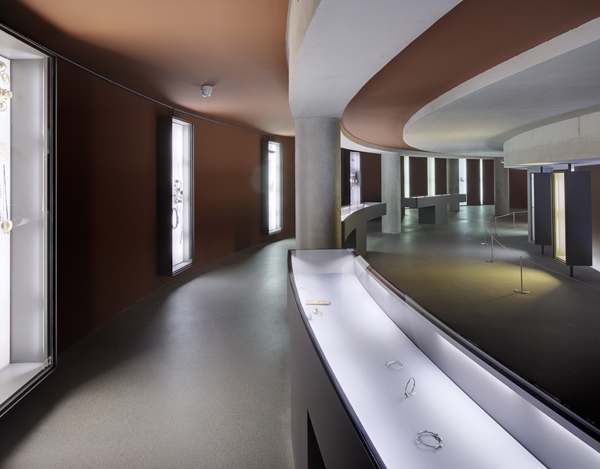
The Danner Rotunda is located in the sub-basement of the museum, reached by walking down a long flight of stairs. This area was used for museum storage before Dr. Hufnagel suggested it be put to better use. The gallery is a narrow circular space with a low ceiling and wide columns, and it is painted a dark chocolate brown. Light emanates from vertical wall-mounted vitrines that line the walls and from freestanding vitrines placed around the gallery’s circumference. The bursts of color come from the jewelry itself. Most pieces are not made of precious stones. Shimmering gold and silver settings are interspersed with bright plastics, enamels, or various found objects. One vitrine can have as many as 34 pieces on view, all different types, all in different materials, by artists as diverse as Lisa Walker, Jiro Kamata, Klaus Bürgel, Gerd Rothmann, and Francesco Pavan. Alternatively, some vitrines are dedicated to the work of just one artist. There are a total of 34 vitrines in all. The display cases have remained the same from the first installation in 2004. The only thing that has changed is the color of the walls, which were previously painted white. Originally, Karl Fritsch wanted to show all of the jewelry on shelves, with the entire collection on one side of the gallery and his “chosen” pieces on the opposite, but due to spatial constraints, this was not possible. Every visitor to the Danner Rotunda leaves with a memento: a brochure with a numbered sketch and information about every piece on display.
In my opinion, the most pivotal point of the Danner Rotunda is that contemporary jewelry is recognized as a vital art form on the same plane as the fine and decorative arts. While it may be relegated to the grotto-like sub-basement of this glorious museum, it is certainly not treated like an ugly step-child. In fact, when you get through the encyclopedic installation of the decorative arts galleries on the upper floors (80,000 objects are in the Die Neue Sammlung’s collection, the largest in the world), and you are left breathless aching to see more of Ruhlmann, Rietveld, and Mackintosh, you understand that this is an institution that takes itself very seriously. While the Danner Foundation’s extensive inventory is on a par with the Pinakotheke’s other permanent collections, the appointment of Karl Fritsch as collection curator, and his decision to exhibit the latest in contemporary jewelry reflects the foundation’s singular position within the museum. Its role is that of a partner of, rather than a witness to, a young and thriving creative field. The foundation is encouraging emerging talent (many of whom are graduates of the city’s Art Academy) by assuring them that their work can end up in this serious museum. Secondly, the foundation is educating its visitors by showing them, in one place, what is happening in contemporary jewelry right now.
Ruhlmann, Rietveld, and Mackintosh were considered “fresh talent” at some point too. A little encouragement goes a long way.