Damian Skinner, ed., Marzee. Stuttgart: Arnoldsche Art Publishers, 2026.
“Ownership is the most intimate relationship one can have to objects. Not that they come alive in you; it is you who lives in them.” —Walter Benjamin
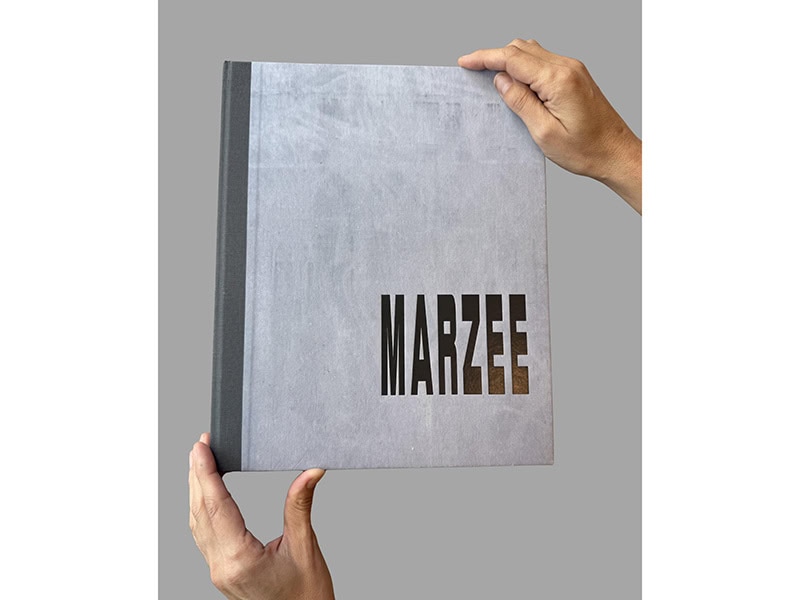
This sober, light-blue volume, with its cloth-bound spine, could be described as a comprehensive book on the history of contemporary jewelry. It could also be a guide to understanding the field, or a great gift for young enthusiasts looking to identify the key players. It might serve as a reference for every school, kept within reach on a classroom table to show students the origins of almost everything they make today. For future gallerists, it would be a vital tool for understanding how a gallery is built and, above all, how it is sustained.
But more than anything, this book is the portrait of a woman—a biography constructed through different voices and perspectives.
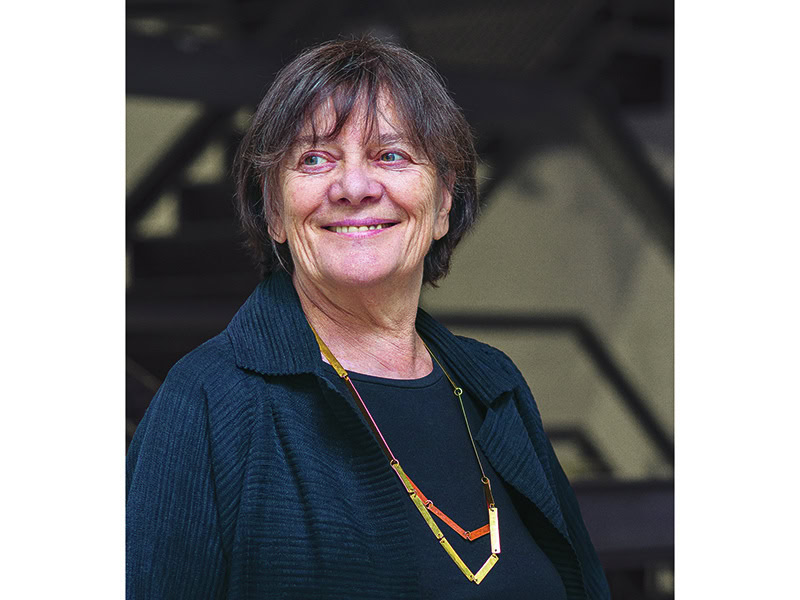
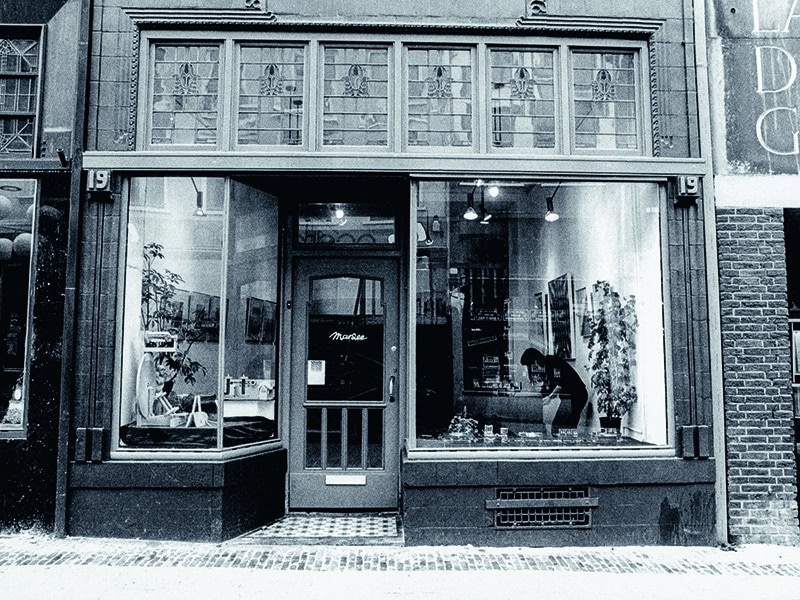
In political theory, a state of exception is a space where the common law is suspended to allow a new order to emerge. When Galerie Marzee opened, in Nijmegen, Netherlands, in 1978, contemporary jewelry was a young, anarchic discipline. The traditional norms of the market no longer applied, and new ones had not yet been written. In that gap, Marie-José van den Hout established an autonomous territory. She did not follow the existing market, but created her own, educating collectors and dictating the criteria that would separate her vision from the surrounding chaos. In the end, this book proves that the “state of exception” known as Marzee, and the collection within it, is her definitive self-portrait, and these 255 pages are the founding charter of a territory where her eye is the sole authority.
The book opens with a foreword by Petra Hölscher, who today holds a key position at Die Neue Sammlung, in Munich. Her text is an intimate account, a way of looking at her own professional trajectory through her relationship with van den Hout. This bond has worked as a compass, a relationship defined by a warm distance—a professional and personal closeness that never lacks rigor. Their connection shifted and deepened through the work, specifically when Hölscher showed interest in Annelies Planteijdt, an artist for whom van den Hout feels a true devotion. When the museum’s interest aligned with the gallery’s passion, the relationship reached a new level of mutual validation. It is a story of how long-term trust is built, portraying a gallerist who masters the balance between friendship and professionalism, making it clear that van den Hout’s priority is always the maker and the work above all else.
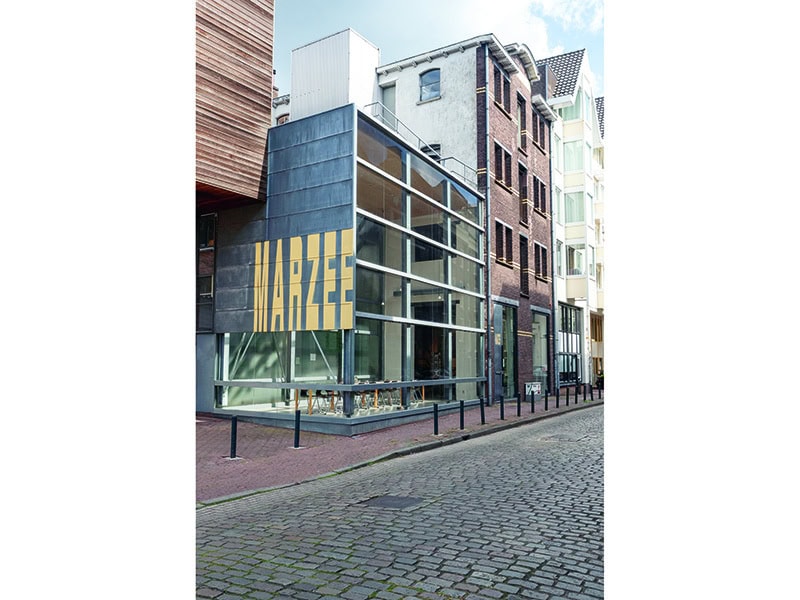
The opening pages show the architecture of the gallery—that Dutch blend of design, austerity, and spatial efficiency. There is no decoration; everything functions. After the foreword, the closed drawers from those initial images seem to open, revealing the first part of van den Hout’s personal jewelry collection. The choice of paper is precise: a matte stock where you can feel the cellulose without falling into the trap of a forced texture. This finish allows the pieces to shine through their own materiality, making their three-dimensionality almost tactile.
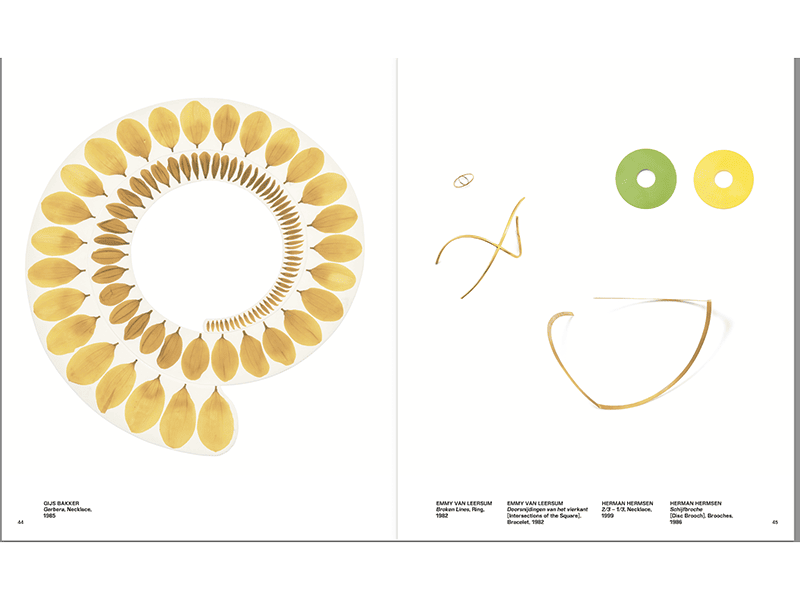
In the book, the works are organized by artist rather than by year, arranged side by side for purely aesthetic reasons. They converse and coexist just as they do in the gallery. Van den Hout knows why a piece by Dorothea Prühl sits near one by Rudolf Kocéa; we don’t necessarily need to know the reason, but in this “state” that is Marzee, there is a master eye at work. Every piece is ordered through an internal logic, one complements the other to create its own narrative. All the pieces are shown to the same scale—an exquisite decision. In jewelry, one is always grateful for this. It allows us to understand not only the invisible conceptual relationships but also the formal connection of scale.
After the visual immersion, Susan Cummins—founder of Art Jewelry Forum and a long-time gallerist herself—provides the essential context. Her text performs a visual operation that mirrors the book’s structure but adds a sense of scale, zooming in from the macro to the micro: the arrival at the train station, the walk toward the building, and finally, the three floors of the gallery. It is a compelling exercise to approach something as intimate as jewelry through a geographic lens. Ultimately, Galerie Marzee is just that: the experience of traveling to a specific destination simply to exist within its walls.
Once inside the gallery, Cummins takes us on a tour, opening the drawers alongside van den Hout. It is a source of intellectual excitement. Both women share a deep, unspoken understanding of what lies within; there is a deep pleasure in seeing in its entirety all the work by Onno Boekhoudt that van den Hout has collected near the contrasting work from the Padua School—two different forms of the same revolution. This text is fundamental to grasping how taste is constructed and to understanding van den Hout’s uncompromising demand for materiality. For Cummins, the history of this collection is inseparable from the history of its founder: her way of promoting, educating, and exercising the power to discern between beauty and the void. Ultimately, these pages reveal a woman who leaves nothing to chance, driven by an obligation to filter the outside world so the gallery remains a space of absolute clarity.
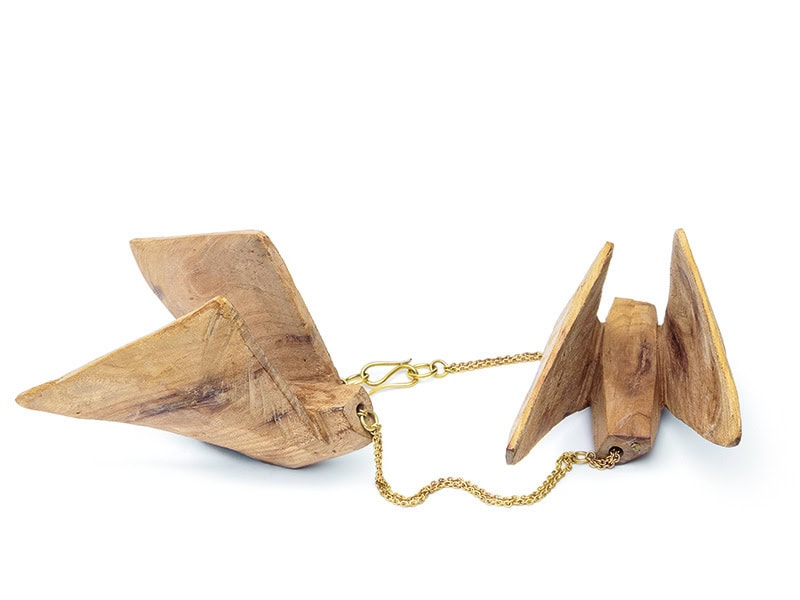
To understand this “state of exception,” one must look at its origins. Art historian and independent curator Flos Wildschut—whose 2023 essay on the gallerist remains one of the most intimate accounts about her—provides a map of van den Hout’s life, showing that her authority is a legacy. Born into a family of goldsmiths, she grew up understanding the weight of tradition and the sound of the workshop. Wildschut traces a timeline where life and career are not separate entities; the gallery is not a job, but a way of living. Everything—relationships, motherhood, the very space she inhabits—is shaped by the drive of the gallery.
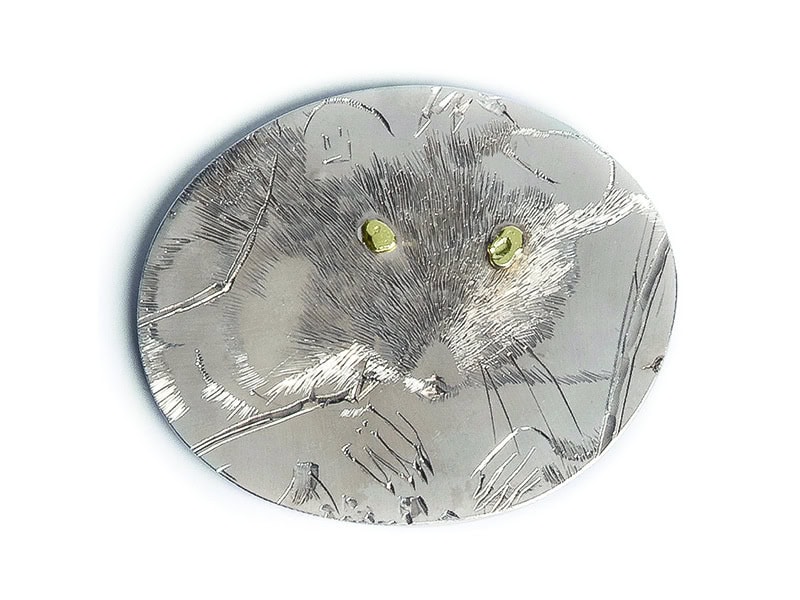
This outcome was forged in moments of crisis. When faced with the potential loss of her most commercial artists, she did not retreat; she became more ambitious. She chose the difficult path, representing those who didn’t fit the “easy” rules of the market. This same firmness is evident in her refusal to move to Amsterdam. While others saw Nijmegen as a distant periphery, van den Hout saw a center. By staying, she subverted the logic of the mainstream, forcing the world to travel to her. She proved that a clear vision can turn any location into a global destination. Yet this is not an act of isolation. In her case, being a gallerist is an act of generosity—a way of sharing her eye with a community and a deep sense of duty toward her artists.
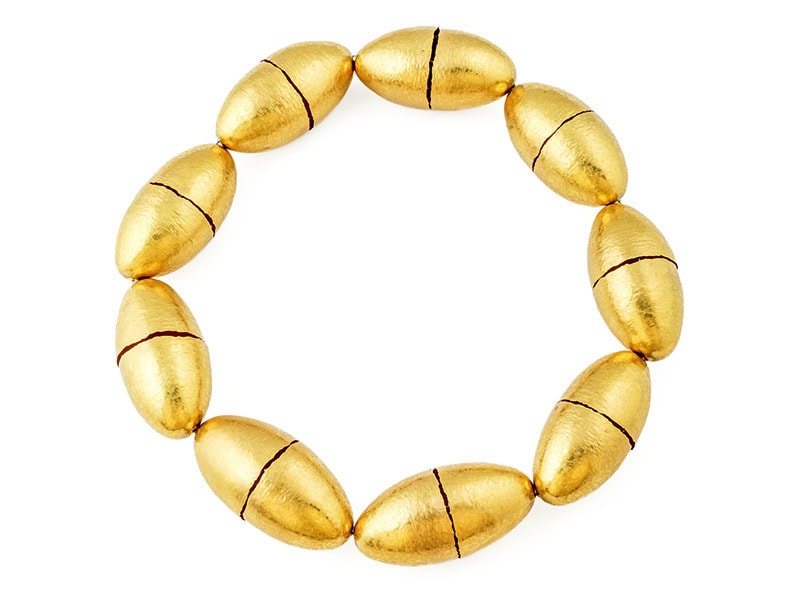
As the book continues, iconic exhibitions such as Combs or Amulets appear, revealing a sense of humor shared between van den Hout and her artists, and a rare opportunity to step away from the solemnity of conceptual jewelry. Between blocks of high-quality images, we find silver vessels—bowls, cups, and chalices—alongside photographs and texts that document Marzee’s experimental side: social events, symposiums, and site-specific projects.
The final text, by Lizzie Atkins—a London-based jeweler, writer, and long-time collaborator of Galerie Marzee since 2002—covers the period from 1995 to 2025 in its definitive location. Here, Nijmegen gazes at the gallery from across the Waal River and, within those glass walls, every piece seems to have found its ideal way of being shown. Atkins highlights the Marzee Graduate Show—an annual exhibition inviting the most promising jewelry graduates from schools around the world to present their work—and the Marzee Prize, awarded to the most outstanding among them. Together, these initiatives prove that van den Hout is not a collector who only rescues the past, but someone who takes the risk of betting on the future. For countless new graduates, the Graduate Show is the milestone they look forward to, the event that marks the true beginning of a career.
Ultimately, this book is a masterclass in belief. It is a vital tool for younger generations, as it offers something rare: certainty. If someone has believed in our discipline with such ferocity, with such uncompromising love, how can we not believe in it ourselves? This book is a self-portrait, a territory of pure clarity, and a gesture of gratitude. To read it is to understand that Marzee is not just a place in the Netherlands. It is a state of mind where the best of our work is always yet to come.
The opinions stated here do not necessarily express those of AJF.
We welcome your comments on our publishing, and will publish letters that engage with our articles in a thoughtful and polite manner. Please submit letters to the editor electronically; do so here. The page on which we publish Letters to the Editor is here.
© 2026 Art Jewelry Forum. All rights reserved. Content may not be reproduced in whole or in part without permission. For reprint permission, contact info (at) artjewelryforum (dot) org