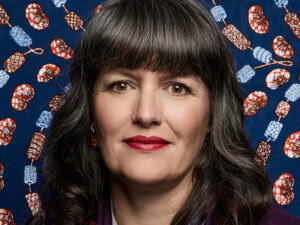
Corrina Goutos has been a finalist for the Young Artist Award three times! A graduate of the Savannah College of Art and Design, she later did a residency at the Françoise van den Bosch Foundation. Goutos has given lectures at DIVA Museum, Gerrit Rietveld Academie, and for SNAG. Originally from upstate New York, she now lives in Hamburg, Germany.
The Young Artist Award, supported by Karen and Michael Rotenberg, given every two years, acknowledges promise, innovation, and individuality in the work of an emerging jewelry artist aged 35 or younger. Through this prize, AJF supports new and exciting work that will inspire future developments in the field.
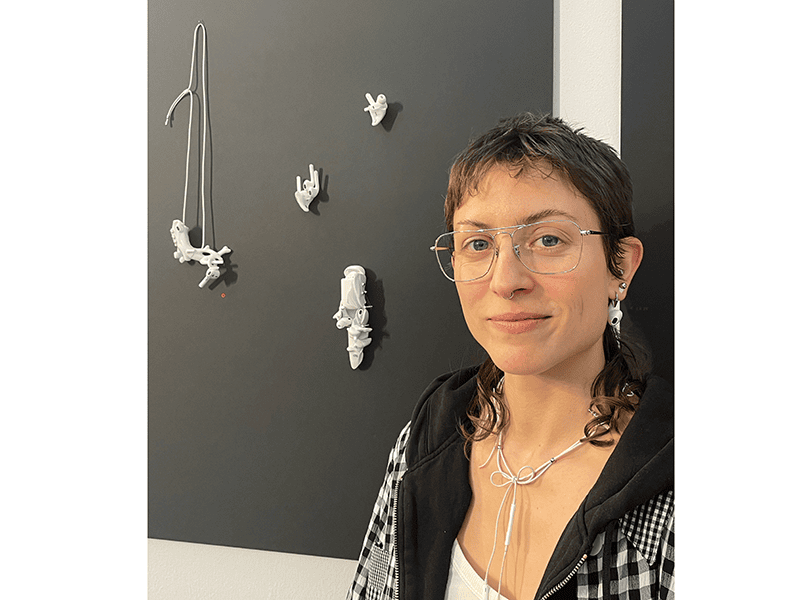
AJF: Congratulations on being a finalist for the Young Artist Award competition—what an accomplishment! How did you become interested in jewelry? And what inspires your work?
Corrina Goutos: Before I had the words to describe it, I was fascinated by how select objects achieve super-charged status. Everyday things get tasked with placeholding significant human experience, and are thereby enabled to transcend their market values. The chance to foster this bond between humans and nonhumans drew me to jewelry over other art forms.
I love to work with universally recognizable objects to conjure up associations in the viewer’s mind—only to quickly betray them, revealing the objects themselves as lively agents entangled in our capitalist schemes and sentimental tendencies. I am most excited about documenting and reproducing ambiguous objects. Ones that don’t fit tidily into the supposed dichotomy of nature and industry. Objects in transition.
What does being a finalist mean for you? Will it influence you moving forward?
Corrina Goutos: Being the first person to be an AJF Young Artist Award finalist three times is a testament to the consistency of the work I have developed since graduation. Three blind juries selected three wholly distinct series each time around. This reflects highly on my authorship and dedication to my craft and gives me confidence that the stories I am telling are reaching people—which in turn, motivates me to keep telling them. I am very honored to be here again.
Tell us about the work you applied with.
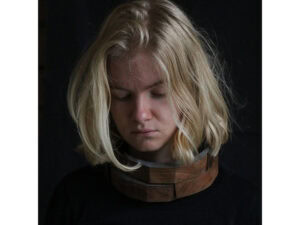
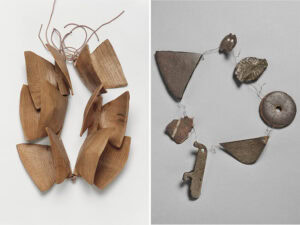
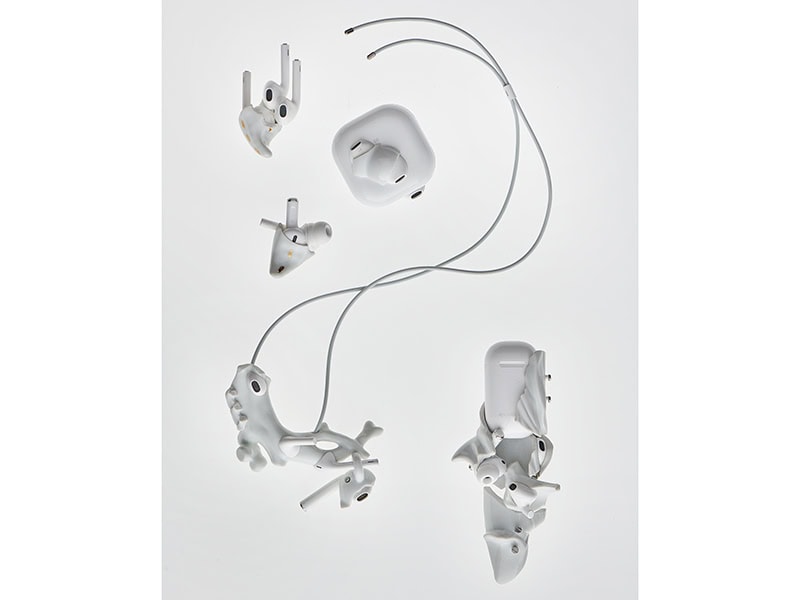
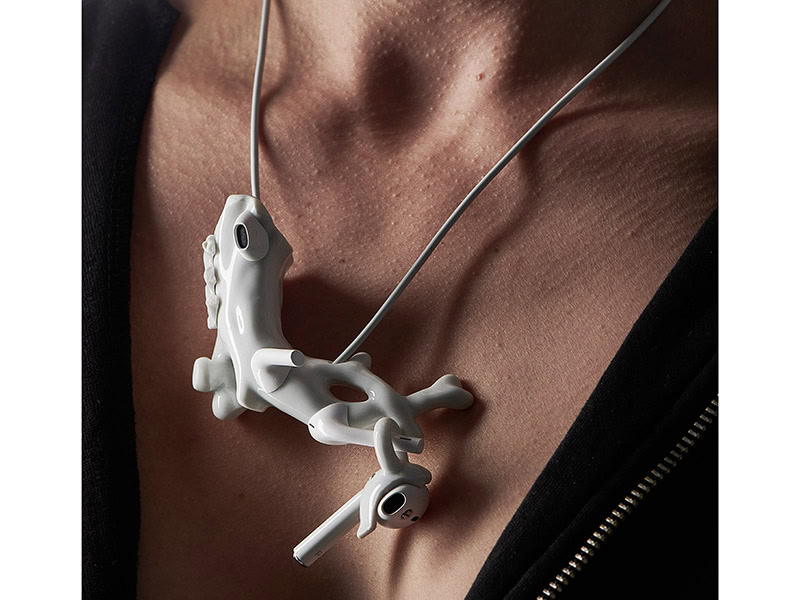
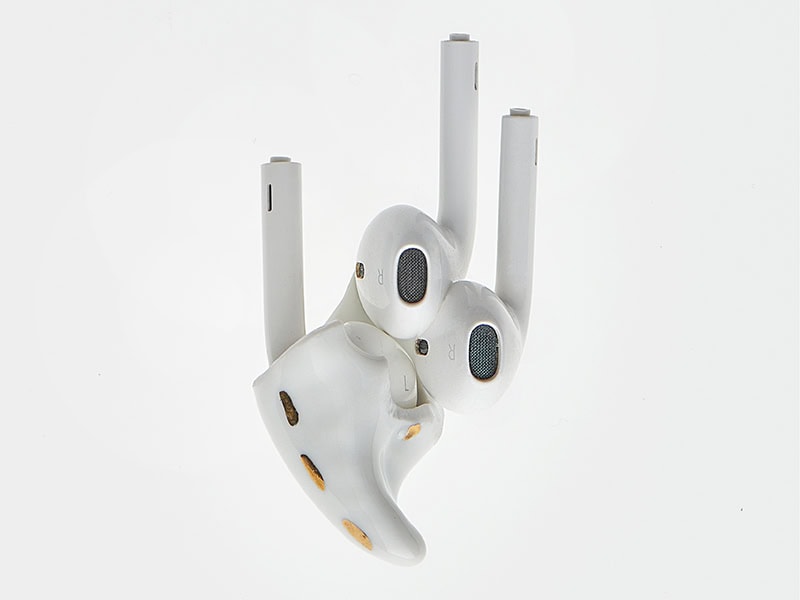
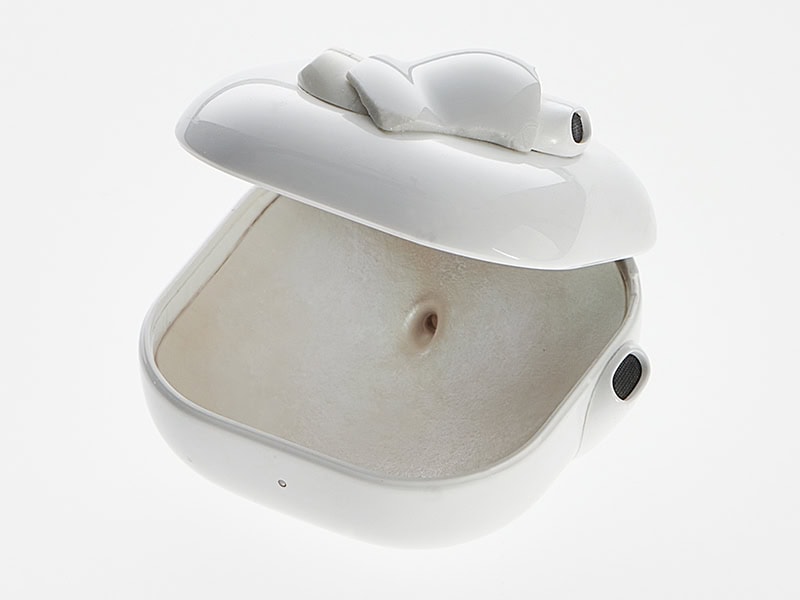
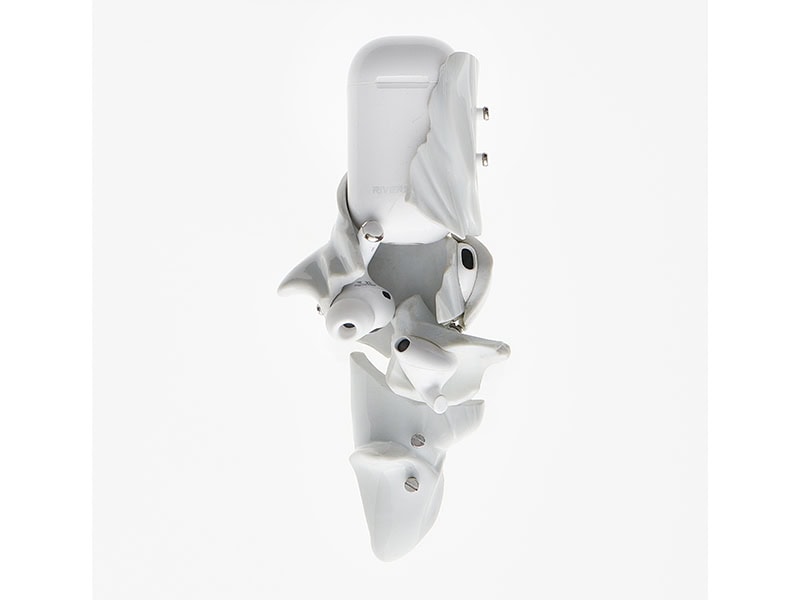
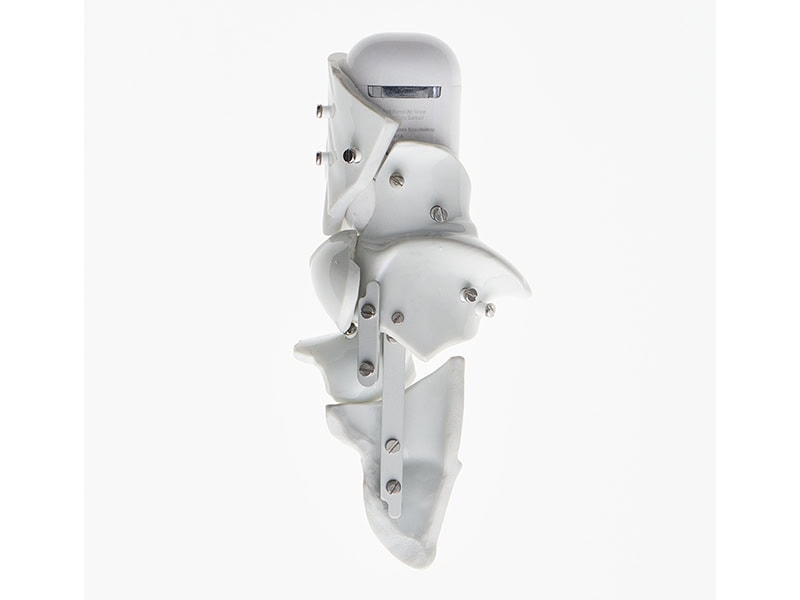
Corrina Goutos: The wearable, holdable series The BlossomVerse imagines the embedded agency of our tech implants, which seemingly overnight became extensions of our own vital senses, profiting in a symbiotic exchange. Fueled by human vitality, they attempt a technojailbreak. Just centimeters from their familiar terrain in our ears, on our necklines, and [on our] moist palms, these speculative iOS mutations emerge from their cocoons as we witness them. Super seed pods appear to be germinating, while earbuds burst into EarBlossoms.
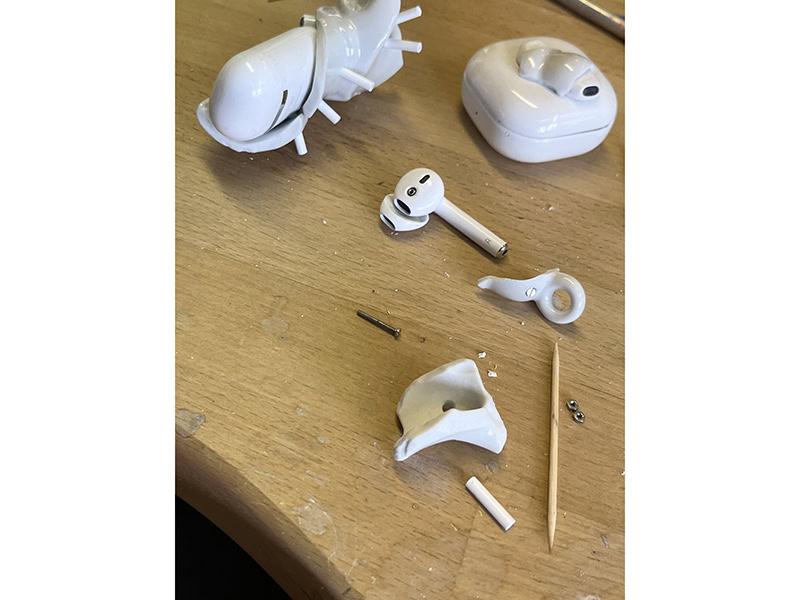
In this series, I invited entropy into my process wherever possible—quieting my own voice to amplify those of nonhuman agents. On my bench, broken porcelain figures and e-waste begin to converse: shapes mirror one another, concave curves attract their perfect counterpart—like AirPods snapping into their case.
steel, epoxy clay, paint, 4 x 2 ¾ x 1 ⅜ inches (100 x 70 x 35 mm), photo: Volker Hobl
Tell us more about one of the pieces in your application.
Corrina Goutos: Crafting the EarBlossom was when the ethos of this series became clear to me. I began thinking about Apple’s use of biomimicry and the many active states of nature embedded in its visual language and branding. I thought about the buds on the cherry blossom and how they exist for only a brief moment before erupting into cherry blossoms. I wondered what might happen if Apple’s organic metaphors were taken to their logical conclusion: if the heat and moisture of the body could coax these dormant earbuds into blossoming.
What was once a kitschy porcelain figurine of a baby beneath a tree branch became the foundation of this piece. Liberated from its former life by a fatal fall, the shards revealed a familiar allure, not unlike the glossy seduction of Apple products. I allowed entropy, coupled with a bit of imagination, to rewild the fragments.
To capture this seemingly effortless composition, I repurposed components extracted from iOS devices and drew inspiration from the armatures used to reconstruct archaeological artifacts. I employed thread-cutting, porcelain lapidary, and urban mining techniques to adapt disparate materials. The resulting post-Apple speculative objects resist categorization as craft, design, or art—provoking the holiness of the luxury good by dismantling and reconfiguring both its components and its perceived value.
clay, paint, 1 ⅜ x 1 ⅝ x 1 ⅛ inches (35 x 40 x 30 mm), photo: Volker Hobl
What excites you about the field of art jewelry?
Corrina Goutos: What excites me about art jewelry is that it defies determinism. A jewel is never truly finished when it leaves my hands. It only comes fully to life through its wearer. It shape-shifts with every body, context, and lived experience it encounters. A piece can place-hold a certain sentimentality, whilst being vacant for further lived experiences.
Materials truly keep the score. They record wear, touch, and time, becoming collaborators in a shared history. Through this process, a kind of kinship emerges between human and nonhuman worlds. Art jewelry is one of the few spaces where conversations about these relationships can happen without being dismissed as overly sentimental, esoteric, or unacademic. I feel like I found people who speak my language here. The field allows me to contemplate intimacy, material agency, and attachment in ways that feel both rigorous and deeply personal.
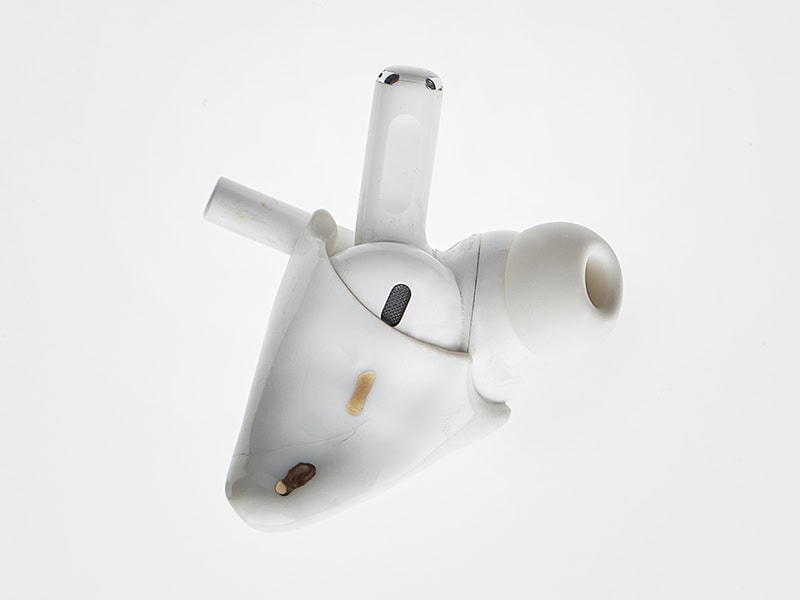
clay, paint, 2 ½ x 1 ½ x 1 inches (65 x 35 x 25 mm), photo: Volker Hobl
Where do you think the field is going? What new and exciting trends do you see in art jewelry?
Corrina Goutos: It is a slow process, but I do see the art jewelry bubble bursting open a bit, which is exciting. Initiatives like The Body Collective are widening the intersection between art contextualized on the body and the evocation of the sensory body in art. I see fringe mediums such as grillz and headwear appearing on the art jewelry radar, and more interactive works such as inventive jewelry boxes and modular jewelry taking an upswing. I always like to see tropes getting reimagined and more consideration being taken for where the things live when they are off the body.
Do you have any frustrations with the field? Please describe.
Corrina Goutos: Certainly. One frustration is the disconnect between the appearance of success and the economic reality of sustaining a practice. Young artists entering the field are often encouraged to believe that dedication and excellence alone will lead to financial stability. In reality, many of the most respected makers of our field rely on teaching, family support, secondary careers, or other sources of income to sustain their work. We would serve emerging artists better by speaking more openly about these realities, so that individuals are less likely to internalize financial struggle as a personal failure.
Related to this, I would like to see more acknowledgment of how this privilege shapes our field, and who has access to it. Greater transparency about the support needed to pursue a craft-based practice could help create a more welcoming environment for makers from a wider range of economic and educational backgrounds, as well as encourage deeper engagement with artists from the Global South.
A field that values diverse perspectives should also be attentive to the barriers that determine who is able to participate in the first place.
If you could write a master plan for your practice, where would you like to be five years from now?
Corrina Goutos: I see myself reaping the fruits of my labor from my athletic early career. Standing then at the 20-year benchmark of my career, I hope to be working smarter, not harder. I am interested in making less, and in writing and reflecting more. Not just on my own “Anthrosmithing,” but on other movements in craftsmanship and emergent artistic philosophies which address living with a dying planet. Most likely this research will culminate in something workshop-able, which hopefully will be a fresh breath of air for those makers coming up in strange times.
In many ways my practice is healing trauma one material at a time, and I hope at one point to be co-regulated enough to start handing out cheat codes.
Congratulations again! Thank you for taking the time to tell us about yourself and your practice.
Corrina Goutos: Thank you so much to AJF and the 2026 YAA jury for this honor!
The opinions stated here do not necessarily express those of AJF.
We welcome your comments on our publishing, and will publish letters that engage with our articles in a thoughtful and polite manner. Please submit letters to the editor electronically; do so here. The page on which we publish Letters to the Editor is here.
© 2026 Art Jewelry Forum. All rights reserved. Content may not be reproduced in whole or in part without permission. For reprint permission, contact info (at) artjewelryforum (dot) org