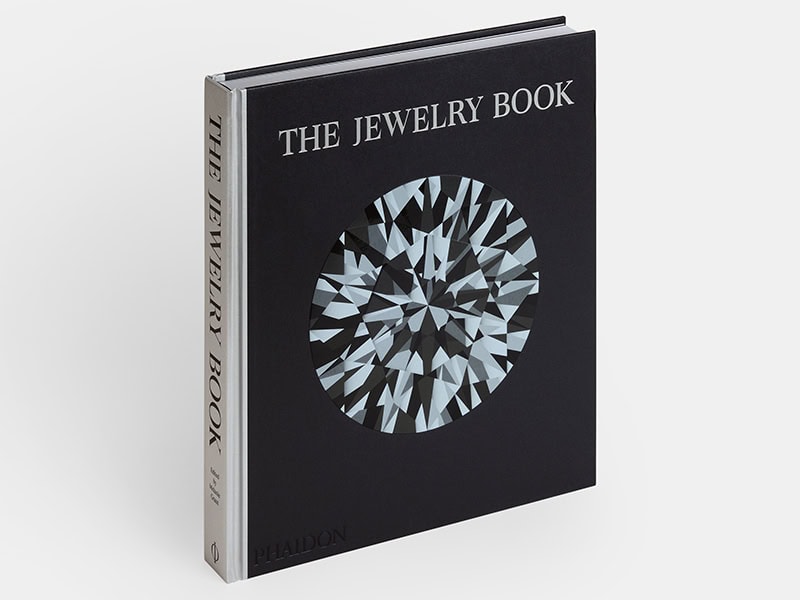
Melanie Grant, ed., The Jewelry Book. London: Phaidon, 2025.
I’m not immune to the allure of stones and precious metals, but I prefer studio jewelry and unconventional adornment. Nonetheless, I found Melanie Grant’s The Jewelry Book, which focuses heavily on high-end baubles, engrossing and enchanting. The book’s 300 jewelry-focused entries feature glorious examples of craftsmanship covering a broad swath of players and innovators in the field of jewelry. You’ll find:
- Fine jewelry houses like Tiffany’s and David Yurman
- Auction houses, including Christie’s
- Costume jewelry from Chanel, YSL, Swarovski, and Trifari
- Creative directors, such as Daniel Roseberry, at Schiaparelli
- Fine artists who designed jewelry—Giacometti, Max Ernst, Pol Bury, and others
- Galleries: Galerie MiniMasterpiece, Mahnaz Collection, Louisa Guinness Gallery, and Elisabetta Cipriani Gallery
- Dealers such as Didier Ltd and Symbolic & Chase
- Collectors including Diane Venet
- Designers, among them Capucine Huguet, Henning Koppel, and Jacqueline Rabun
- Educators, such as Dorothy Hogg
- Photographers such as Irvine Penn and Hiro
- Royalty, movie stars, musicians, socialites, and heiresses
- Style icons galore, from Grace Jones to Jacqueline Kennedy Onassis
- The gem specialist George Frederick Kunz
- The goldsmithing workshop GEM Montebello
- Important historical figures, among them Leonardo da Vinci and Benvenuto Cellini, but also songwriter Cole Porter and his wife, Linda, who helped finance Verdura’s shop and commissioned works from the most important jewelry designers of their time
Yeah, yeah, it’s a lot of bullets—it’s a lot of book!
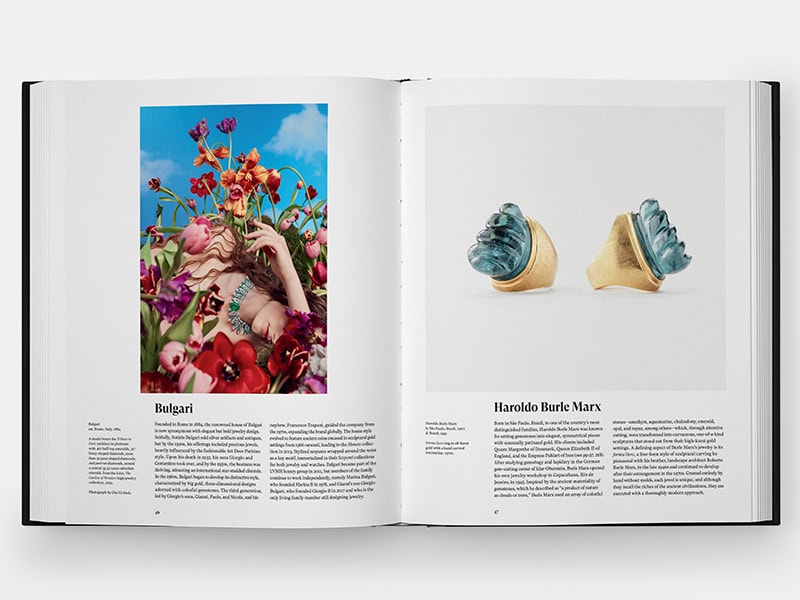
A 15-person advisory committee chose the contents. They include historians, gallerists, curators, collectors, fashion directors, auction house department heads, and executives at high jewelry companies. Smart! This results in an eclectic and delightful selection of entries. But some of the advisory committee’s members count among the book’s entries. This seems like a conflict of interest. A solution: Run the bios for the advisory panel—with an image of jewelry or a portrait—in a differently designed section at the end of the book.
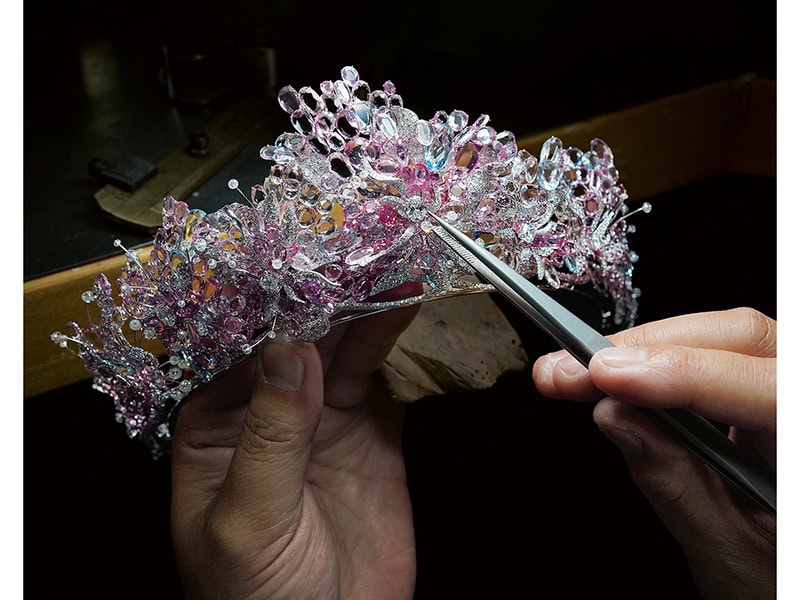
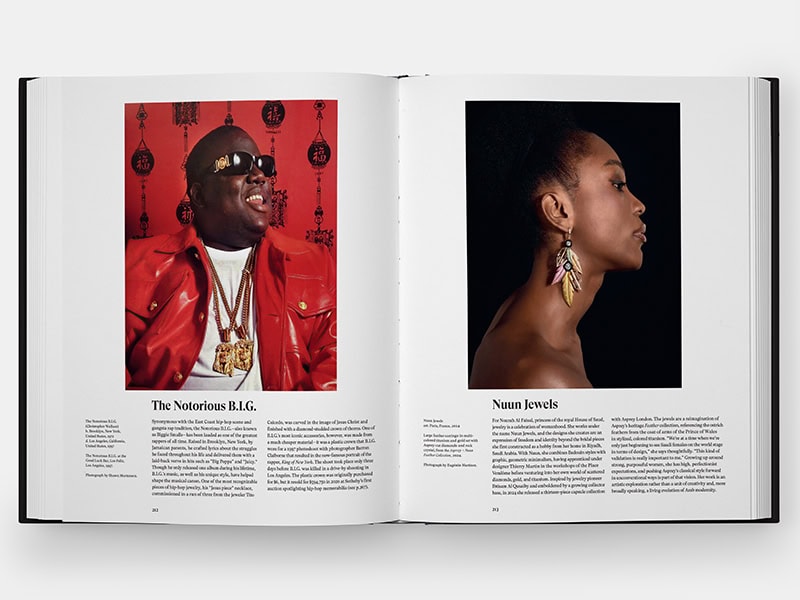
The design is tasteful. Each entry has its own page. A large image takes center stage. The images include photos of jewelry, portraits of people, and lovely renderings. Feng J’s entry shows a tiara in fabrication, rather than a finished work—how fun! Garrard’s page shows gouaches for Princess Diana’s engagement ring instead of a photo of the finished piece—interesting and unexpected.
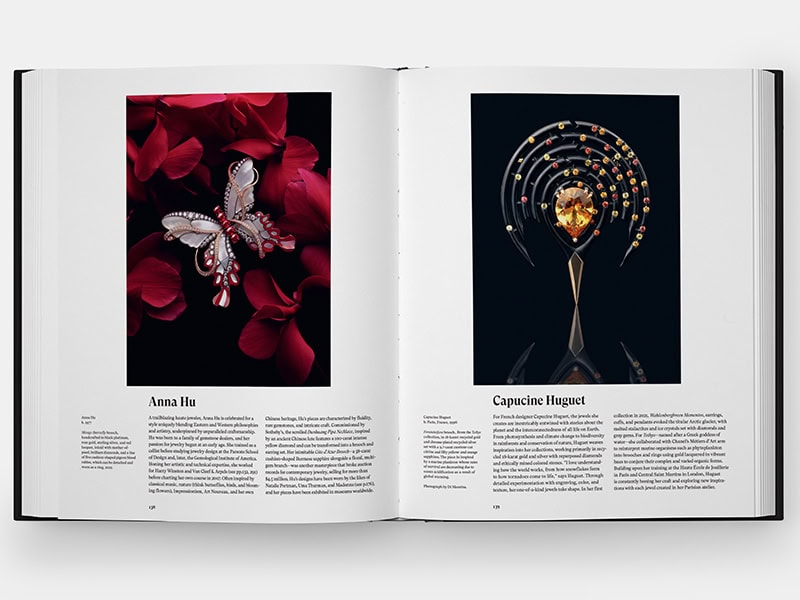
Beneath each image appears factual information: the year a firm established itself or the years an individual has lived, and where; a caption; and a short biography. I would find it useful for each entry to begin with a description along the lines of “designer,” “dealer,” “jewelry house,” “studio jeweler,” etc., as the bios didn’t always make that clear.
The entries appear in alphabetical order. This results in a few surprising or fortuitous pairings. I got a kick from seeing Mr. T across from Shinji Nakaba! How amusing that page 240 shows JAR’s Sheep’s Head clip, and the facing page mentions that rams and other powerful mythological symbols inspire Olivier Rousteing when he designs his collections. And what a happy coincidence that Jean Schlumberger, who at one point worked for Elsa Schiaparelli, appears across from her in the book.
The chic design frustrates in one area. Every bio describes several pieces of jewelry. A design with two or three small images beneath the large vertical image would have satisfied reader curiosity by showing more works.
I noticed the careful mixture of jewelry designs by people born all over the world, from Argentina to Ukraine, by way of Cuba, Iran, Nigeria, Sierra Leone, and Turkey. An index by country could have been useful.
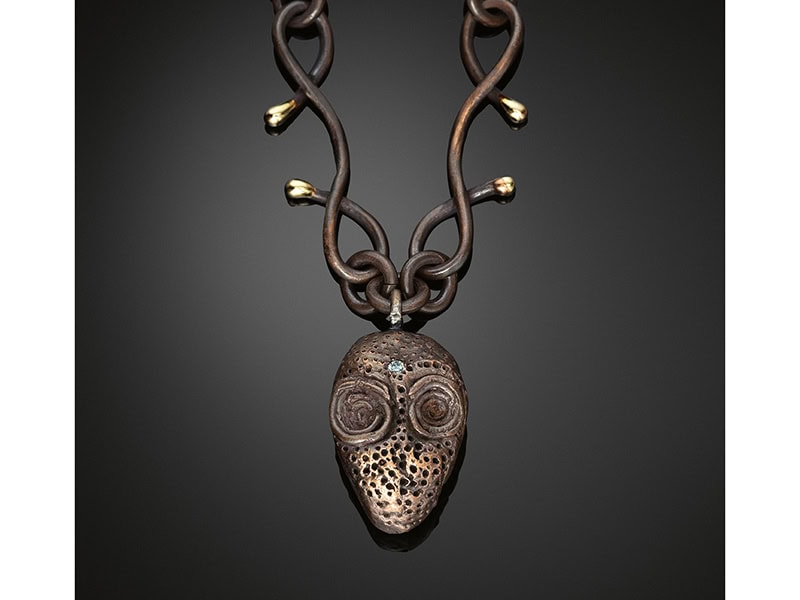
Poring through the book reveals many absorbing facts. For example, we learn that the studio jeweler Judy Geib crochets pouches and carves wooden boxes to house her works. Elsewhere, Glenn Spiro says, “I’ve always designed things people don’t want, but then someone always does” (page 269). Nicholas Varney makes precious jewels that also incorporate eggshells from his own hens. We find Alessandro Sabbatini described as the antithesis of the traditional high jeweler: “he is surprisingly young, likes to laugh, and is enthusiastically effervescent” (page 243).
Want more juicy tidbits? Michael Robinson envisions a future with AI overlords that seek to comprehend jewelry’s magic and soul. He designs pieces for them to wear when they take over. When the late poet Edith Sitwell gave a reading at the Edinburgh Festival, her large gold collar made so much noise that the audience had difficulty hearing her. At age five, the Greek jeweler Elsa Sarantidou—who works primarily at night and makes only about 30 pieces per year—sculpted the Hindu god Ganesha from clay “and decided then and there to become a jeweler” (page 247). Buccellati goldsmiths train for a year on brass before getting to work in gold! And—who knew?—the master photographer Robert Mapplethorpe had a talent for jewelry making.
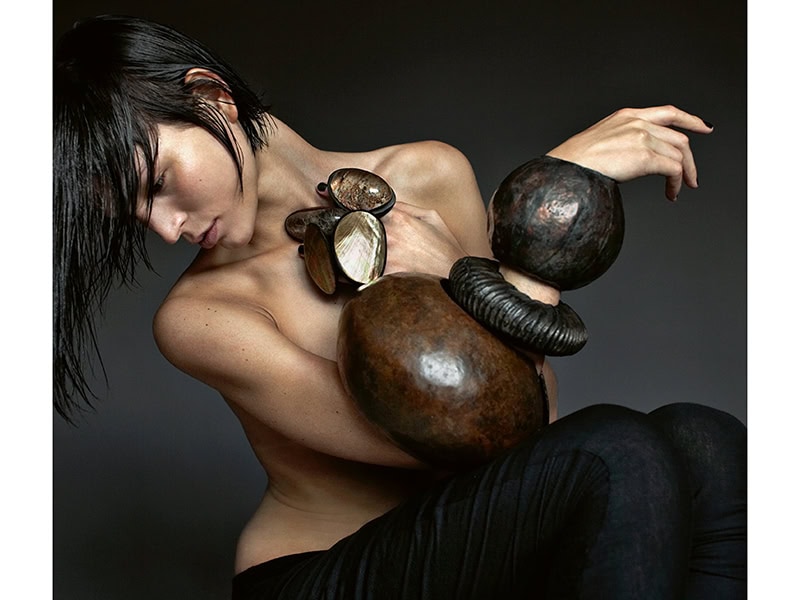
I loved discovering artists I didn’t know. Castro Smith produces jewels with gorgeous engravings filled with translucent metallic lacquer; his ring made me drool. Gabriella Kiss produces pieces “only available in a few select stores that make an art of selling jewelry”; I gasped at her comb. I kept returning to admire the gigantic, magnificent bangles by Monies. Also new to me, and utterly wonderful: India’s Studio Renn, Giorgio Vigna, Walid Akad, Billy Porter, Sylvie Corbelin, and Cora Sheibani, with semiprecious earrings adorned with frond-like elements of green anodized aluminum.
Grant, who is English, is an expert on haute bijouterie and high-end watches. She has written on these topics for luxury magazines including Vanity Fair, Vogue, and Tatler. She co-authored Winged Beauty: The Butterfly Jewellery Art of Wallace Chan. She twice curated Brilliant and Black for Sotheby’s. Her book Coveted: Art and Innovation in High Jewelry, showcases 75 of the most exclusive jewelers working today, including Bulgari, Cartier, Tiffany, Van Cleef & Arpels, and Solange Azagury-Partridge.
With Grant so typically focused on status jewelry, it’s exciting to see The Jewelry Book include a number of art jewelers our field embraces: Giampaolo Babetto, Castro NYC, Winifred Mason Chenet, Giovanni Corvaja, Ute Decker, Melanie Eddy, Melanie Georgacopoulos, Kaori Juzu, Sam Kramer, Shaun Leane, Fritz Maierhofer, Joel Marsters, John Moore, Robert Lee Morris, Shinji Nakaba, Wendy Ramshaw, Joe Sheehan, Art Smith, and Vivianna Torun Bülow-Hübe.
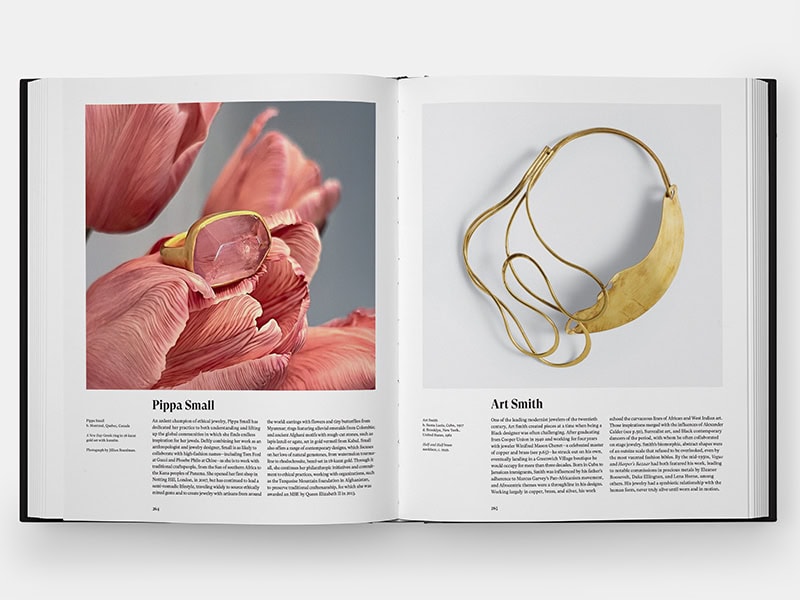
Posts on IG celebrated this fact, but didn’t give a full list. Seeing so much art jewelry in the book, I began to feel greedy. I wish it included still more. If I could wave an editorial magic wand, which entries might I replace for art jewelry made of precious metals and rocks, in keeping with the book’s focus?
For a start, I’d omit the Dreher Carvings. The gorgeous sculpture of a chameleon doesn’t count as jewelry. And I’d cut all the royals, leaving 20+ open slots. The power and ability to amass and inherit jewels doesn’t make the nobility experts or special as “collectors.”
For that matter, many of the entries celebrate people with wealth, fame, and power who use jewelry to show off their status and taste. Are celebrities all that interesting in a book that highlights artistry, innovation, and skill? Sometimes the jewelry they’re wearing barely shows in the photo of the VIP; that’s telling. Some of the stars shown in the book don’t even own the bling we see on them. They wear borrowed jewels on the red carpet to promote the luxury houses. Does the book trade on their cachet? A far better choice: Adrien Brody. The actor collects large brooches by Elsa Jin and wears them to awards ceremonies. He’s among the trailblazers who launched this fashion for contemporary men, but you won’t find him in these pages.
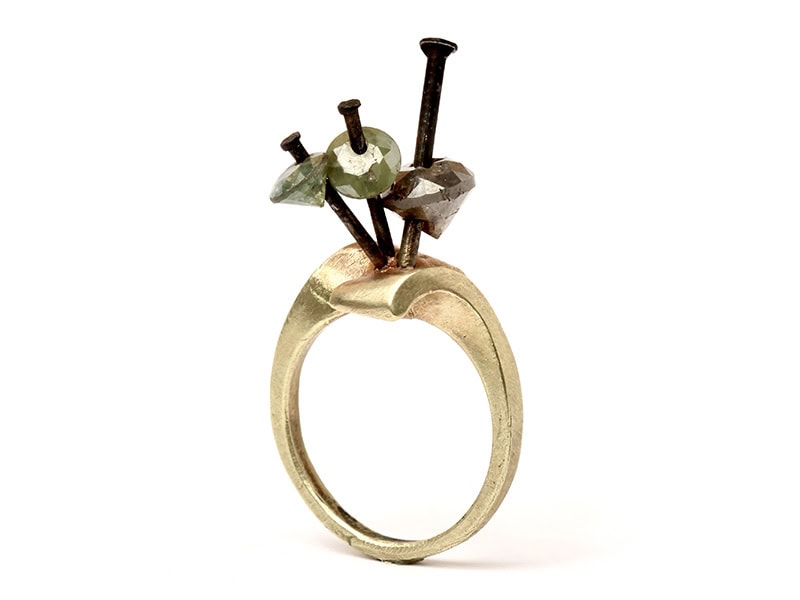
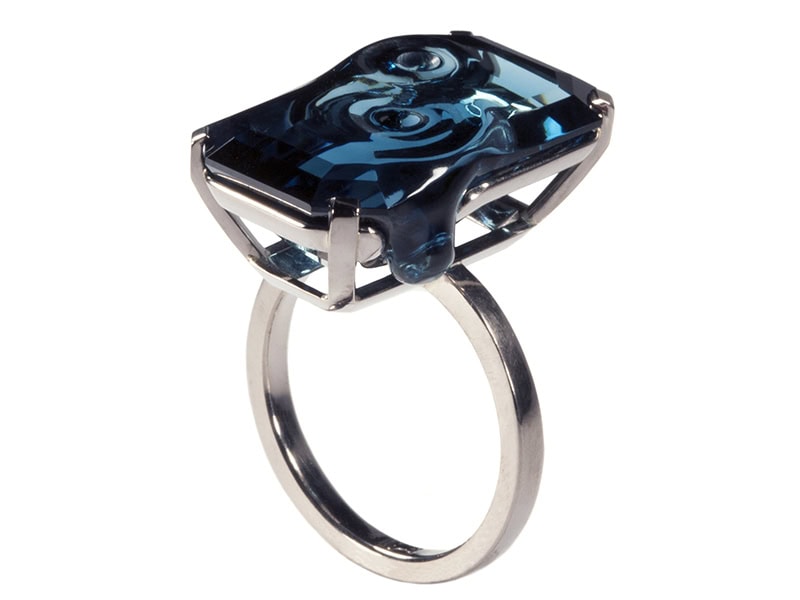
The text describes works by Hannah Martin and Tasaki as “punk.” Hardly. For real punk, look to the irreverent way Karl Fritsch mounts gems in rings. He truly belongs in this book! And Julia Maria Künnap’s unique work is also somehow missing from these pages. Who else makes gemstones seem to melt or turn to liquid?! Furthermore, how could the advisors leave out Benedict Haener’s subversive rock candy in the Kill Your Darlings series?[1] He smashes diamonds to the size of sugar crystals to encrust mouth-watering jewels! Finally, where are the athletes who array themselves in bling? Football player Stefon Diggs doesn’t wear art jewelry, but his choices in adornment should have earned him a page.[2]
Back to the book. With its coffee table dimensions and so much fabulous content, you can’t take in this volume all at once. If bling, wealth, and fame move you, you won’t want to. This book encourages savoring. You’ll page through it slowly, thoughtfully, in multiple sittings, seduced by the abundance of beauty.
[1] Benedict Haener won AJF’s 2026 Young Artist Award, supported by Karen and Michael Rotenberg. This review was written with no knowledge of his application to the prize.
[2] See examples of Diggs’s jewelry here, and a dozen football players flashing their bling here.
The opinions stated here do not necessarily express those of AJF.
We welcome your comments on our publishing, and we will publish letters that engage with our articles in a thoughtful and polite manner. Please submit letters to the editor electronically; do so here. The page on which we publish Letters to the Editor is here.
© 2026 Art Jewelry Forum. All rights reserved. Content may not be reproduced in whole or in part without permission. For reprint permission, contact info (at) artjewelryforum (dot) org