Note: During the installation of Lori Talcott: Jewels for the Underworld in New York City’s SoHo, the writer of this review held multiple conversations with the artist. Talcott’s quotes below are pulled from those discussions.
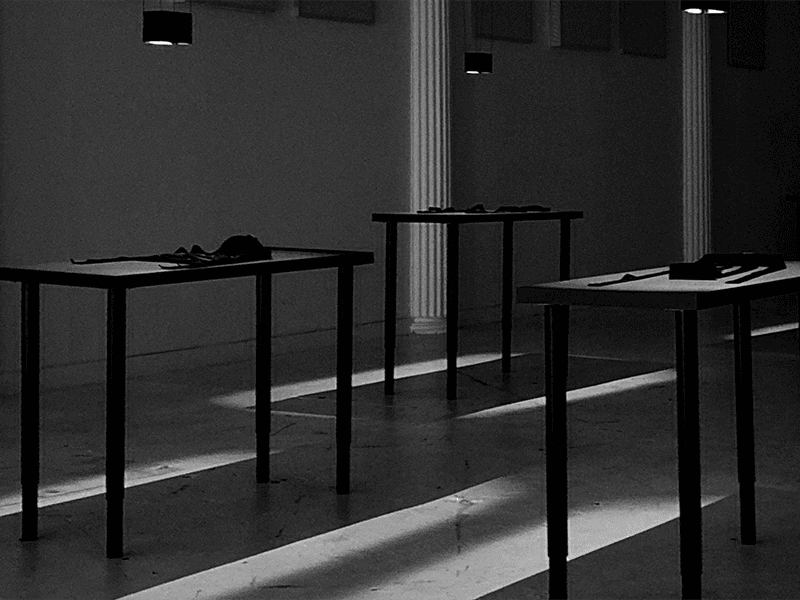
Lori Talcott: Jewels for the Underworld, 2025
November 21–23, 2025
New York City Jewelry Week, New York
Presented by Sienna Patti Gallery, Lori Talcott’s Jewels for the Underworld was one of the defining exhibitions of NYC Jewelry Week 2025. The exhibition concentrates Talcott’s long engagement with jewelry as a site of embodied knowledge. The darkened space recalls an alchemist’s laboratory. There, substances remain in transition, and making becomes inquiry. Each work is installed on its own table, illuminated by a suspended light that isolates and intensifies attention.
Within this environment, Talcott’s objects move between conceptual domains. They are at once adornment, ritual instrument, and mnemonic device. The works draw from medieval devotional culture, Norwegian dress-silver traditions, alchemical processes, and contemporary craft discourse. The pieces approach these as mutable systems rather than fixed inheritances.
Lori Talcott: I understand jewelry as inherently relational and ritualistic, capable of acting upon the wearer and the world around it. I experience jewelry as having agency: carrying memory, mediating transitions, protecting bodies, persuading people, witnessing relationships. I often return to Ananda Coomaraswamy’s meditations on ornament, particularly the Sanskrit term alaṁkāra. In this interpretation, ornament is not merely decoration; to be ornamented is to be properly equipped, enabling one to function fully in the world. This idea is central to my work, and if I pay attention to it, along with my chosen materials and forms, the object will do its work.
Talcott was born into generations of jewelers and later apprenticed under a master silversmith in Norway. As such, she possesses a technical command that could easily resolve into virtuosity alone. Instead, Jewels for the Underworld is distinguished by restraint. Scholarship is embedded in the work rather than foregrounded as research. Talcott’s refusal to over-determine form gives the exhibition its emotional and conceptual power.
Lori Talcott: While I would define my work as research-driven, I never want this to hinder an intimate, affective encounter. I see it as an invisible structure that supports the work, giving the viewer the sense that something serious has taken place without it becoming pedantic or overdetermined. I want the object to remain open enough to meet people where they are.
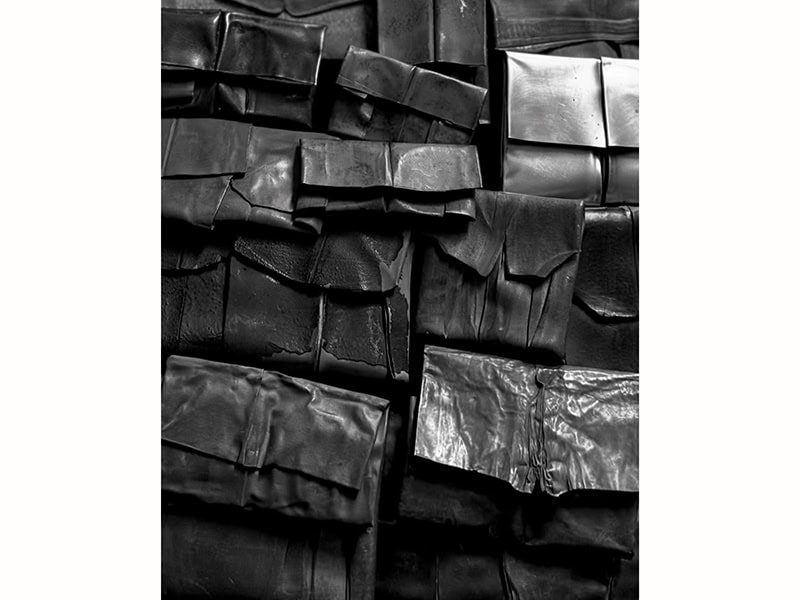
Lead is the exhibition’s central material. In alchemical cosmology, the metal is associated with Saturn, gravity, duration, and slowness. Talcott never allows these associations to collapse into metaphor. Soft and impressionable, lead yields to touch while retaining its trace. Worn against the body, its weight becomes grounding: gravity remains literal even as a symbolic charge accumulates. Rather than transforming matter into image, Talcott allows lead to retain its material presence, carrying meaning through contact, pressure, and endurance.
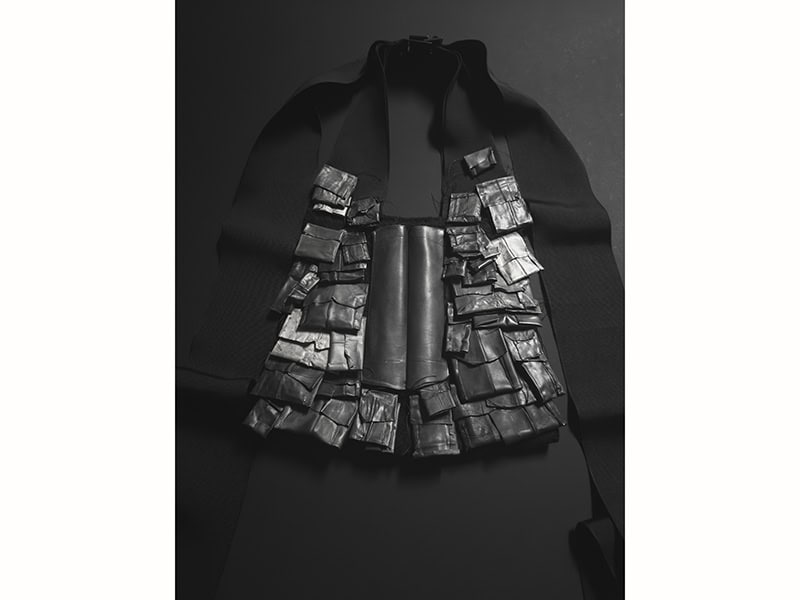
One sees this most clearly in works centered on folding, containment, and transmission. When worn, Archivum’s two wide vintage ribbons meet over the heart, secured by a lead book whose pages remain open and curved. Folded lead and silver envelopes spread across the sternum, each carrying the intimacy of a sealed fragment or preserved trace. Folding becomes a language of care, concealment, and preservation. Talcott draws upon domestic and intergenerational traditions within jewelry practice. Gestures historically associated with women’s labor persist within her work. In Archivum, the body becomes a living archive where cosmology, ritual, and touch remain inseparable.
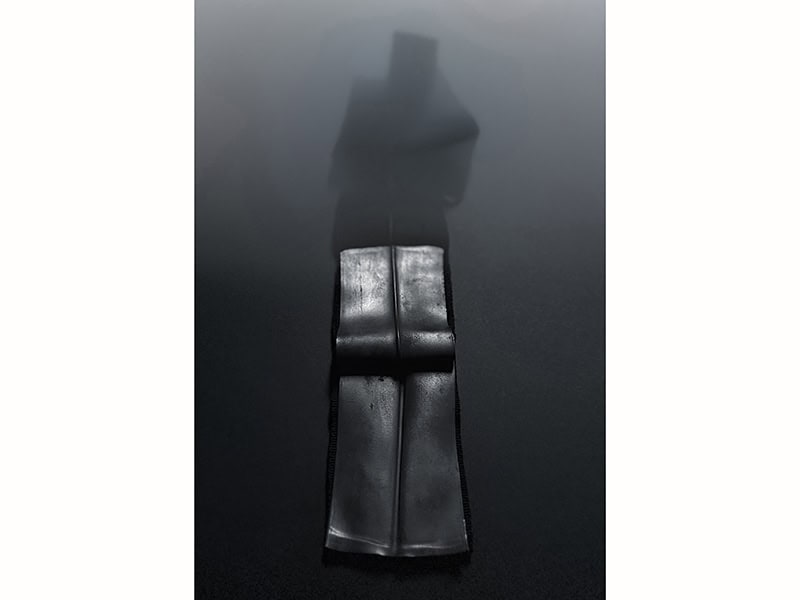
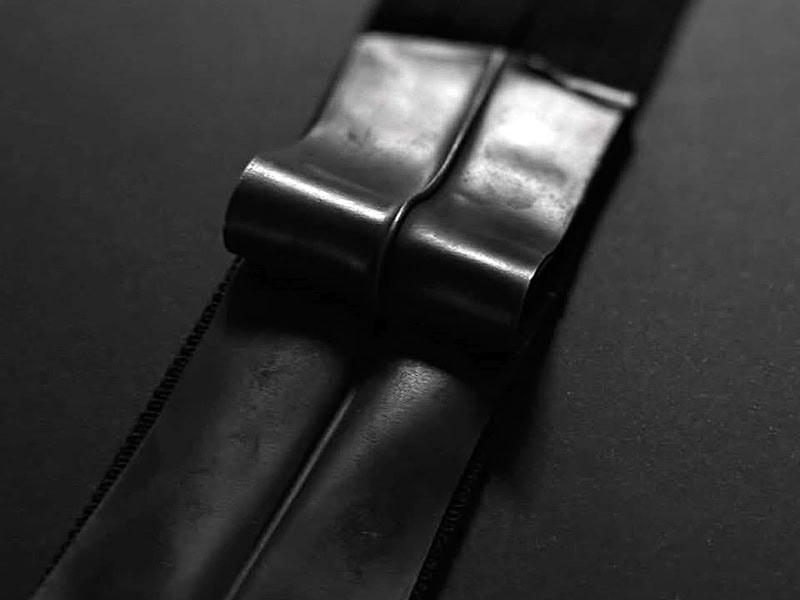
Offering distills these ideas. A length of lead, curved, folded, and unfolded, descends along the torso. It rests over the heart as both weight and disclosure. Deceptively simple, the piece occupied Talcott’s studio for years, subsequent works unfolding from it. The lead was left to oxidize, its surface darkening over time. Held in suspension between weight and yielding, the form retains a subtle precarity.
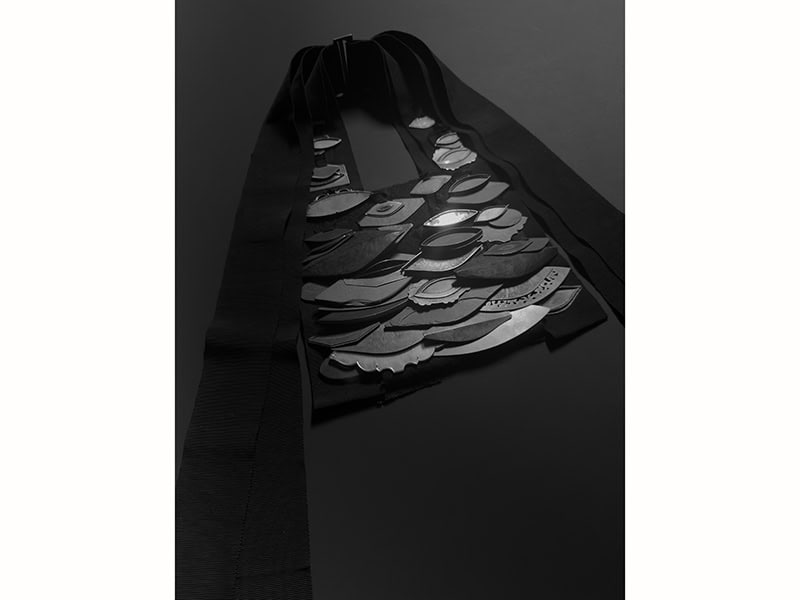
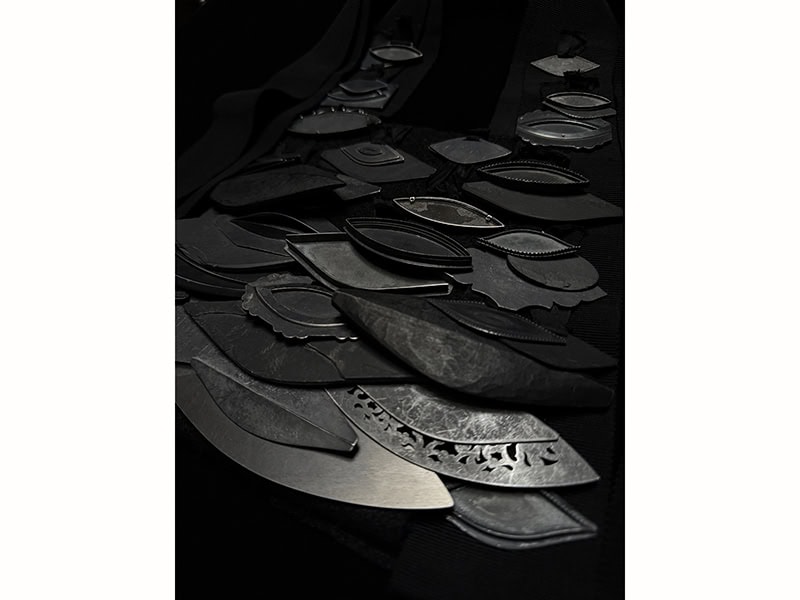
The exhibition changes intensity with Votum. A harness of hand-cut eye motifs crosses the chest in overlapping layers of oxidized silver, steel, slate, wood, and glass. The surface shifts between protective skin and exposed wound. Repetition does not flatten the work into pattern. Sealed and open forms alternate across the work. The eye operates simultaneously as organ, threshold, and site of projection. Some elements hold panes of glass while others remain empty, producing a tension between concealment and access. In Votum, looking and being looked at collapse into the same condition.
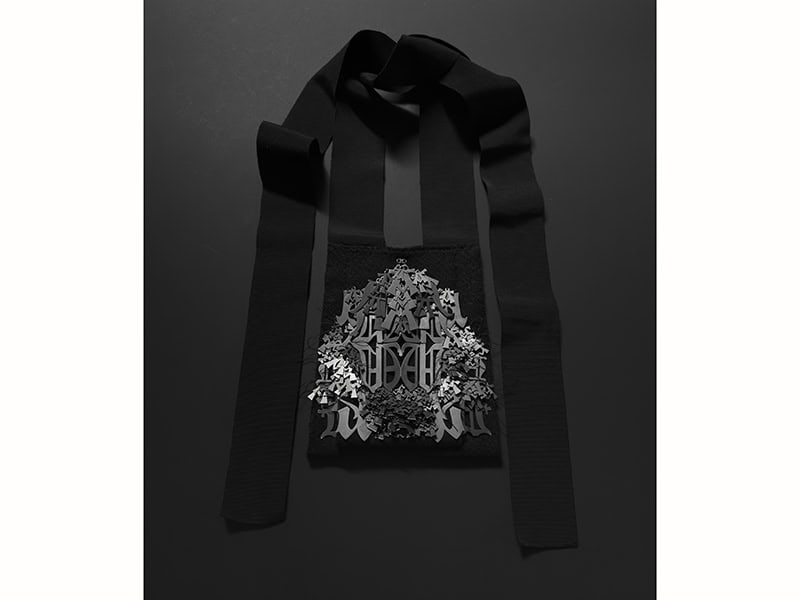
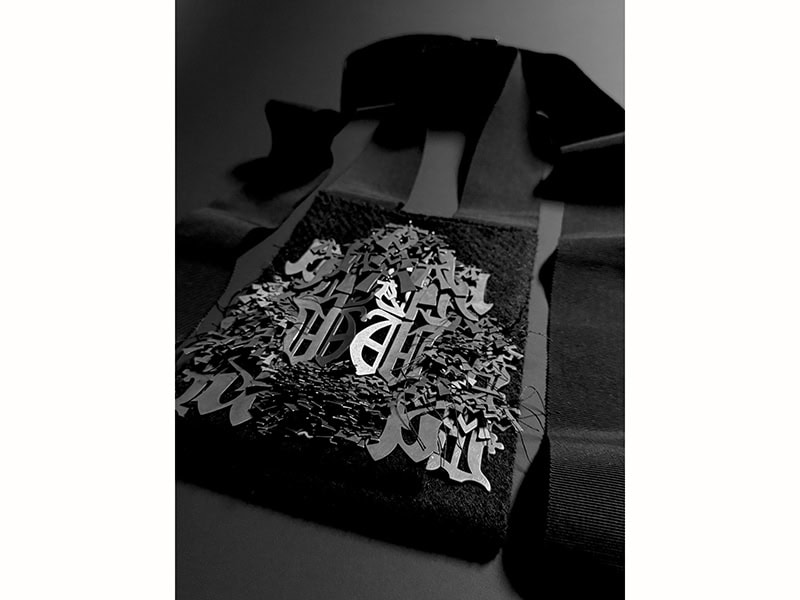
With the architectural, apron-like structures of Grimoire and Sigil, Talcott explores incantation and embodied language. Hundreds of oxidized silver Gothic “A” forms are sutured to wool surfaces, transforming script into structure. In medieval Europe, the Gothic letter A functioned as an amulet invoking Amor Vincit Omnia and Ave Maria. Produced during the pandemic through a daily meditative practice, the letterforms that compose Grimoire and Sigil carry the disciplined rhythm of their making into the finished works. To be enchanted is to be “within the song,” and these pieces accumulate force through repetition and duration rather than speech. Language acquires weight, tension, and presence. Removed from the page and placed in direct relation to the body, the letter becomes both structure and invocation.
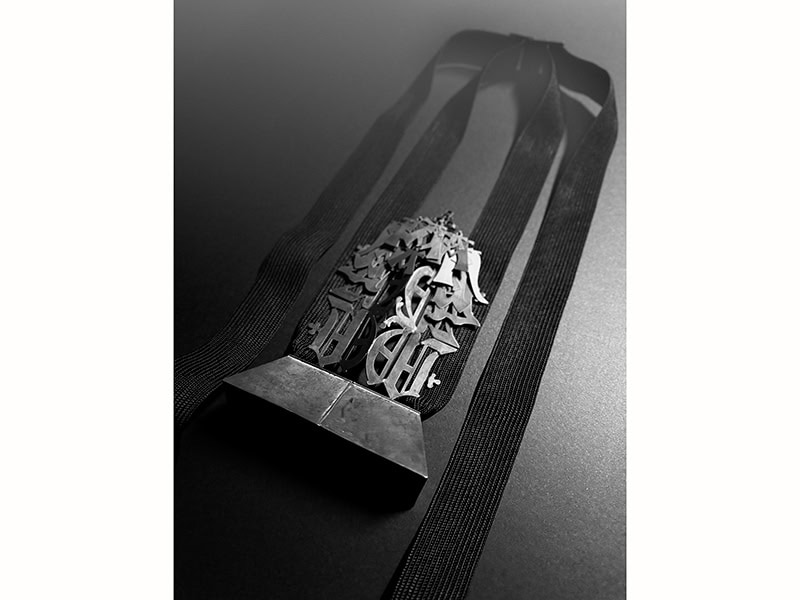
Lori Talcott: Today, the Underworld is often used as a psychological metaphor. I see it more as a condition we periodically enter. While reading about Inanna’s descent,[i] I began thinking about older systems of knowledge we no longer know how to access. I wonder whether the Underworld recognizes our technologies and modes of communication. Something else may be required—a different kind of technology, alternative tools, something old-school and analog. Jewelry is exactly that. It accompanies the body through thresholds, holding memory, identity, and protection when everything else is removed.
Across the exhibition, darkness governs the installation. It concentrates perception without theatricality. Oxidized metal, wool, slate, and lead sharpen distinctions through adjacency and repetition. Jewelry here does not provide narrative clarity so much as insist upon intimacy, allowing subconscious association to remain active. Meaning emerges through sustained encounter rather than explanation.
What gives Jewels for the Underworld its unusual force is the degree to which Talcott allows knowledge, intuition, and material responsiveness to remain inseparable. Nothing is forced into coherence. The exhibition promises no transcendence: lead remains lead. The show enacts descent through objects attuned to darkness, duration, pressure, and return. Within this field, matter remains active, memory operative, and transformation occurs without spectacle.
[i] In a Sumerian myth, the goddess Inanna journeys into the Underworld to overthrow its ruler, another goddess named Ereshkigal. She is Inanna’s sister.
The opinions stated here do not necessarily express those of AJF.
We welcome your comments on our publishing, and will publish letters that engage with our articles in a thoughtful and polite manner. Please submit letters to the editor electronically; do so here. The page on which we publish Letters to the Editor is here.
© 2026 Art Jewelry Forum. All rights reserved. Content may not be reproduced in whole or in part without permission. For reprint permission, contact info (at) artjewelryforum (dot) org