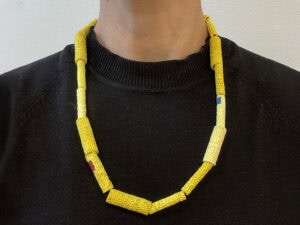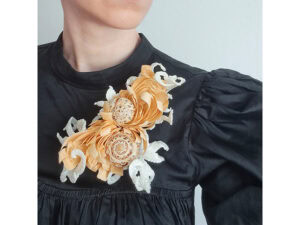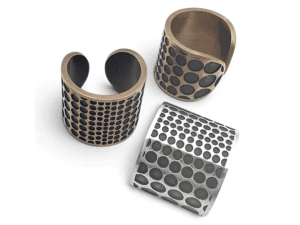
Schmuck—or Munich Jewellery Week, depending on who you ask—is a pilgrimage, a marketplace, a reunion, or a reckoning. Each year in March, Munich becomes a temporary capital of contemporary jewelry—a week when makers, gallerists, curators, collectors, and critics inhabit the same rooms, the same openings, the same conversations. The essays gathered here emerged from that week. Written from four distinct vantage points—by critics, curators, educators, and practicing artists—they don’t arrive at the same conclusions. But they share a preoccupation with a question that hung over Munich Jewellery Week 2026: what does it mean to sell, and what does it cost not to?
Commerce is not a comfortable word in contemporary jewelry. The field has long defined itself in opposition to the decorative, the commercial, the merely pretty—and yet galleries are closing, collectors are scarce, and the pressure to make work that sells is reshaping what gets made. These essays take that tension seriously, tracing it through student exhibitions and studio visits, through earring installations and handmade iron rings pulled from a coat pocket, through packed vitrines and carefully emptied ones.
“Art and Commerce” is part of a series of essay collections responding to Schmuck and Munich Jewellery Week 2026. Contemporary jewelry resists tidy summaries. The kind of sustained, skeptical attention these writers bring to it is exactly what the field deserves. —Aaron Decker
By isabel wang pontoppidan
Through the dubious lens of “art and commerce,” I hope to glean some meaning from a brief analysis of two exhibitions: the international student pop-up summit at the Pinakothek and the Central Saint Martins (CSM) exhibition TEN, at Vitsœ. Both show student work, both are anniversary events, both left me feeling deeply ambiguous.
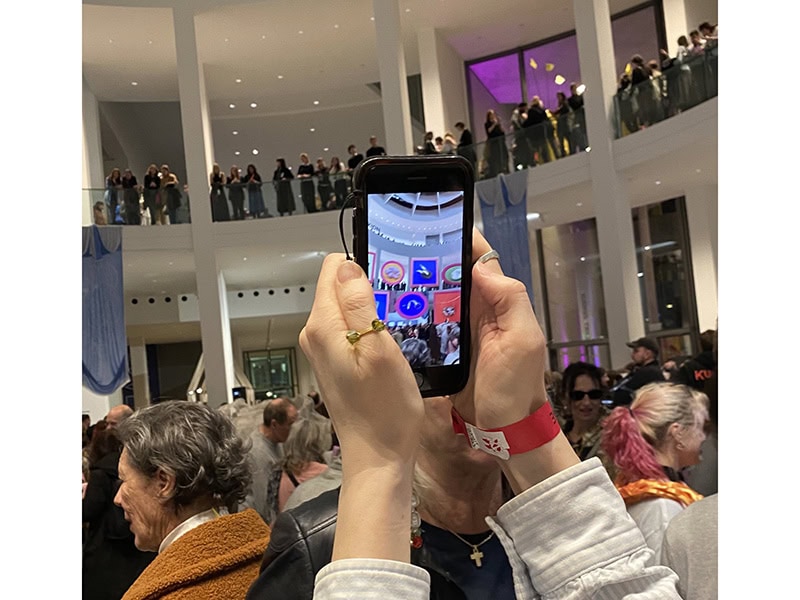
Let’s begin with the elephant in the room: the evening extravaganza at the Pinakothek der Moderne. It was was orchestrated in the advent of celebrating 100 years of Die Neue Sammlung and the 30-year anniversary of the inception of its jewelry collection. Instead of showcasing a monographic exhibition focused on the oeuvre of an established jewelry artist, as is usually the case, the museum invited students from 40+ institutions in 24 different countries to put on an exhibition for one night, complete with live music and gargantuan cakes.
In myself and my colleagues, I sensed a shared confusion at the lack of transparency from the museum. Because it was titled “1st Summit of Jewelry Classes,” I wonder whether this is a phenomenon that’s here to stay. While I was excited at the idea of platforming the work of students, the loss of the annual monographic exhibition would mean the dissolution of (at least) two things: (1) a momentous milestone in the career of an art jeweler, important not just for its spotlight on an artist’s work, but also its aspirational quality in a precarious field, and (2) at a variegated event such as Munich Jewellery Week, the exhibition opening is an important point of confluence, gathering almost the entire field.
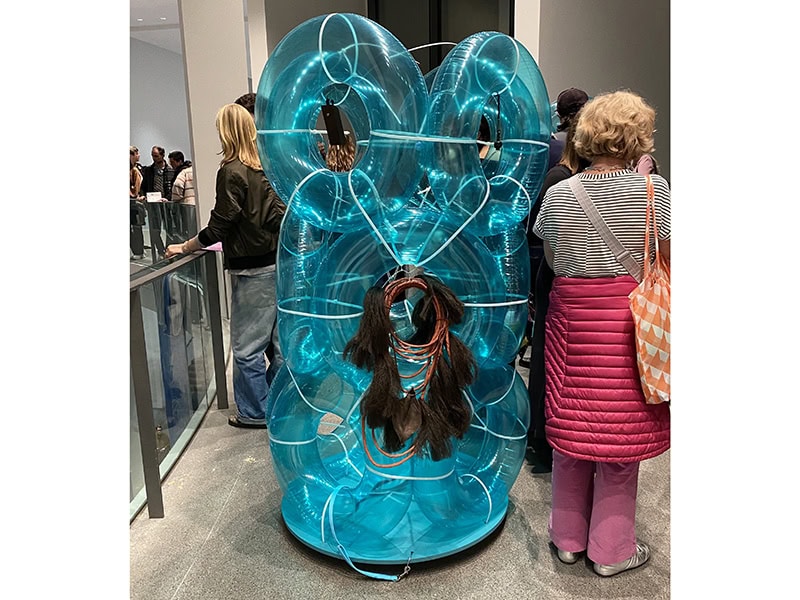
Since the reason for this event (whether it was a singular occurrence or will be the new status quo) was not publicly announced, we can only speculate on the museum’s motivations. Die Neue Sammlung is, despite being state-funded, a commercial venture. As all institutions, they consider their numbers: visitors, entrance tickets, etc. The fact that they were unwilling to invest in the usual exhibition this year, with all of its accoutrements (vitrines, exhibition texts and design, curation, printed catalogs) could indicate a lack of art jewelry’s commercial viability from the museum’s point of view. In this context, the indiscriminate recruiting of hundreds of students responsible not just for providing the artworks, taking care of their presentation, and entertaining the crowds circulating in the rotunda, but also getting to Munich and staying there for several days, feels at best like a neglectful attitude toward the students. At worst, it would seem like the museum is using them to outsource labor and infrastructural resources.
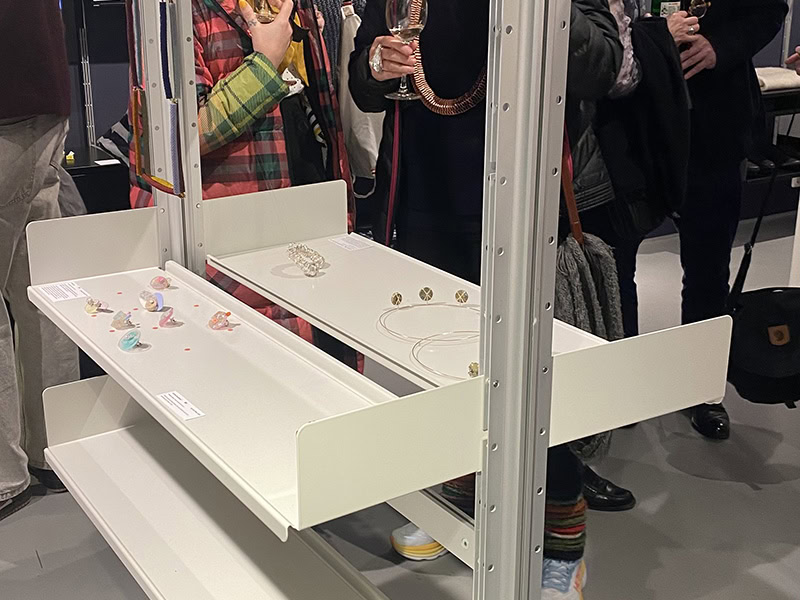
Around the corner from the Pinakothek, the exhibition TEN, by CSM students, staff, and guests was on display in Vitsœ. It marked the 10-year anniversary of CSM’s BA Jewellery Design course collaborating with the Vitsœ space in Munich. As I traversed the crowded opening, it seemed to me that every other artist exhibited was a tutor or guest lecturer, leaving only half the exhibition space for students and alumni. The choice to include so many “guests” gives me pause. I would assume that the exhibition of an institution like CSM, which is made up mainly of students and a handful of contracted staff, would be curated in a way that reflects its demographic. Again, this exhibition is marked by a lack of transparency. Are the curatorial decisions made in accordance with representation of the institution, or in accordance with wanting to exhibit as many well-known artists as possible?
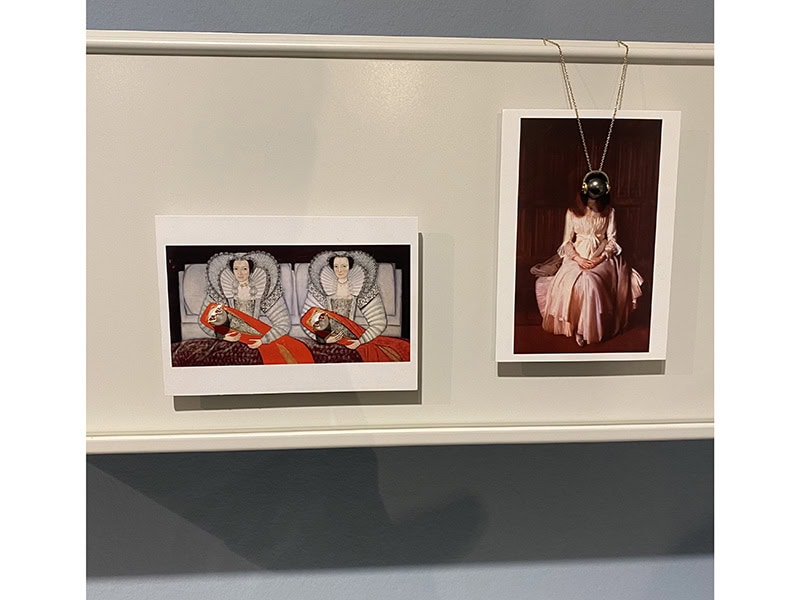
Of course, it’s not up to me to set the qualifiers for what marks a significant contribution to this institution, nor to decide how its exhibition should be curated. I am merely posing these questions to probe at a larger issue. It seems that we can use the presence (or absence) of student work as an indicator of what is deemed commercially (non)viable. At the Pinakothek, the students provide a cost-effective solution to the void of the investment in this year’s monographic exhibition. At Vitsœ, the amount of work by students and alumni is limited in favor of exhibiting established artists. This sycophantic curation should not be viewed in a vacuum; contemporary art jewelry is by no means the only field in which curation becomes a game to collect the most star-studded exhibition cast.
This tendency tells us much about the ossifying effects of prestige and ultimately value in art. But for a field in which sales are down, collectors are scarce, and galleries are closing, we cannot afford to foreclose the horizon in this way. We cannot afford for students to be sidelined by the very academies that are supposed to support them, nor to use them as patchwork interjections when resources are scarce. To regurgitate the same work over and over and to include certain people for the sake of being decorated with their names will not increase dynamism in the field. It will only slow down our metabolic rate until it ceases to function. ■
By Elena Karpilova
It’s interesting to consider the price ranges one encounters in Munich—and how differently the notion of “affordability” is perceived.
Since 2009, Katja Schlegel has presented jewelry exhibitions during Munich Jewelry Week. This year, her show was titled Affordable. But what does “affordable” mean today? In this case, it referred quite concretely to price: all works were capped at €490. At the same time, the exhibition featured established names such as Ela Bauer, Sofia Björkman, and Karin Seufert. According to Schlegel, the exhibition was a clear success, attracting many visitors and generating strong sales.
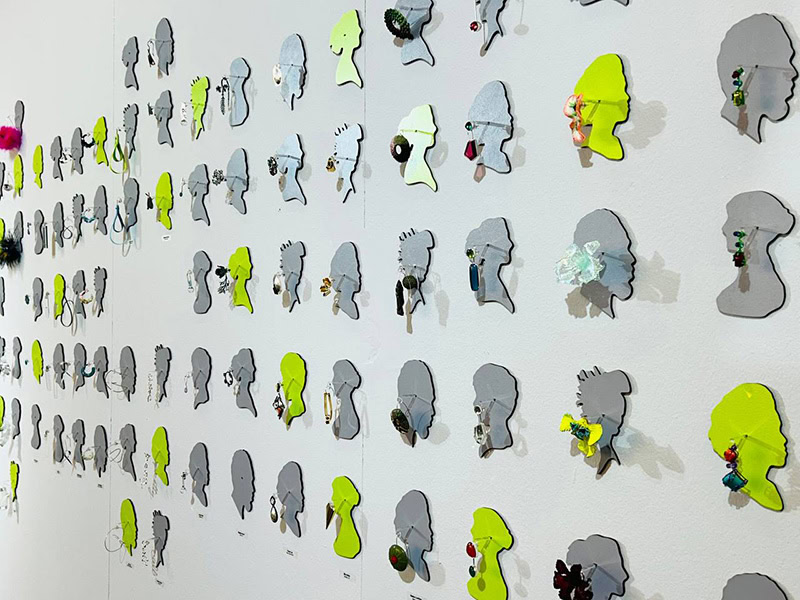
It seems that Earrings Galore’s exhibition strategy plays a key role in appealing to buyers. First, the display format remains consistent year after year, creating a recognizable identity: earrings are shown individually on silhouettes (one is modeled after Michelle Obama). Second, the concept is immediately clear—earrings only. Third, the visual effect is highly seductive: the display resembles a candy shop, with a vibrant array of colorful pieces drawing visitors in. This year, the project presented 253 pairs of earrings, priced from under $50 to over $2,500, making it accessible across a wide range of budgets. Approximately 15% of the works sold, which organizer Heidi Lowe considers a success.
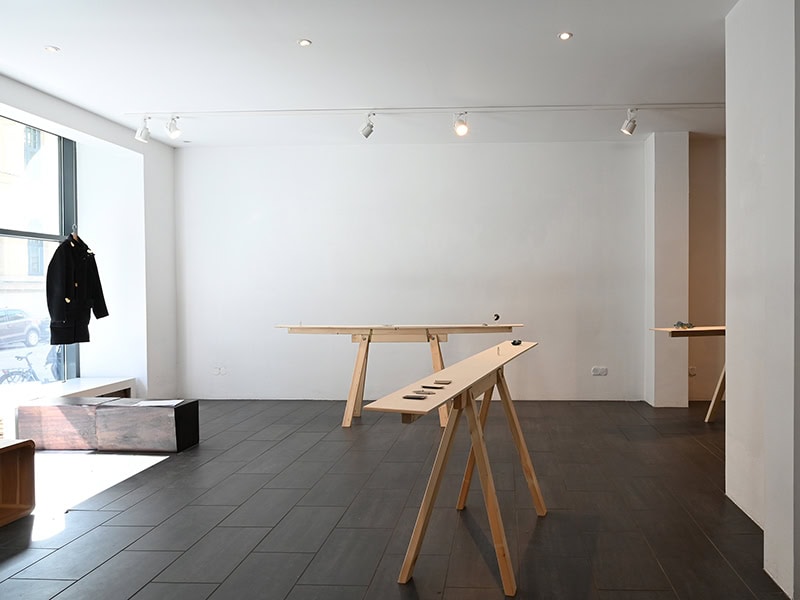
Not everyone views accessibility as an unqualified good. Takayoshi Terajima, curator of Brooch by CJST and winner of the 2024 Herbert Hofmann Prize, points to its downsides. Having exhibited in Munich for over a decade, he describes the current market as extremely challenging. In the past, collectors actively supported artists and their practices, but such encounters have become increasingly rare. Although Terajima sold several works this year, all were priced below €500 (retail). What concerns him most is the growing pressure to produce “sellable” jewelry. As material and energy costs rise, artists are forced to keep their work “affordable” in order to sell. In this way, contemporary jewelry risks shifting from artistic expression toward a field shaped primarily by customer preferences and market demands.
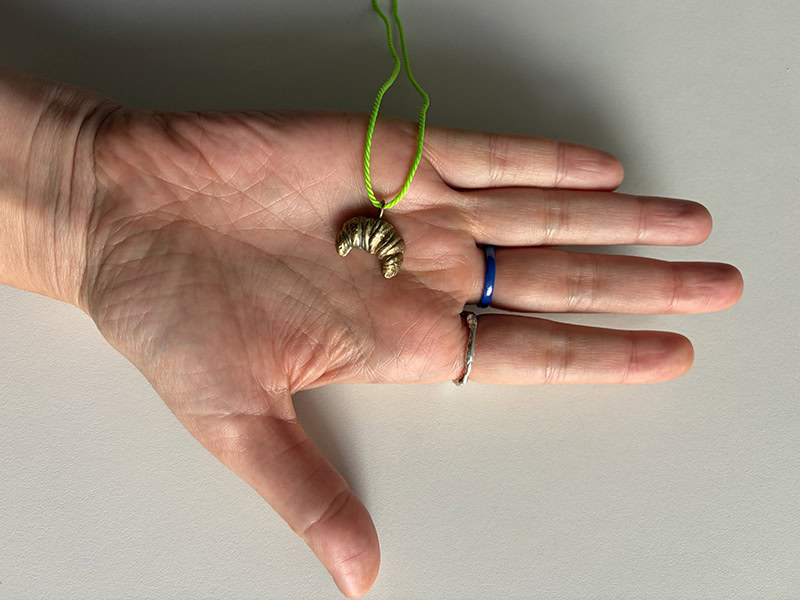
The most “affordable” object I encountered—in a straightforward and unproblematic sense—cost just €10. At the Messe, I came across the booth of the Vocational College for Design, Jewelry, and Everyday Objects (Berufskolleg für Design, Schmuck und Gerät) at the Goldsmith School in Pforzheim, the world’s oldest vocational school of its kind, one over 250 years old. It was not simply an exhibition but an active workshop: tools for sandcasting, students at work, the process unfolding in real time. A box filled with small plastic objects—animal figurines, geometric shapes, even toy parts from Kinder Surprise eggs—sat alongside a handwritten sign reading “10 euros.” Visitors could choose an object. Students would then cast it in silver, brass, or copper over the course of several hours, refining their skills as they worked. I left with a small croissant-shaped piece, while Marta Costa Reis walked away with a cast of part of a finger. ■
By Steven KP
To say that the current trends of the markets were felt in Munich this year would be a gentle statement. Jewelry like ours, that resists the dependency of commodities-market materials and fine gemstones, is always a precarious position of commerce—but is in that uncertainty that a lot of its potentials, excitements, and problems arise. It always surprised me how immediate the pressure of selling works felt during Schmuck and Munich Jewelry Week, and this is most immediately apparent at the International Handwerksmesse and the galleries and exhibitions present within the fair’s booths.
The context of the Messe’s booths places art jewelry into dialogue with hand crafts, fashion, and material industry in a sprawling convention center.
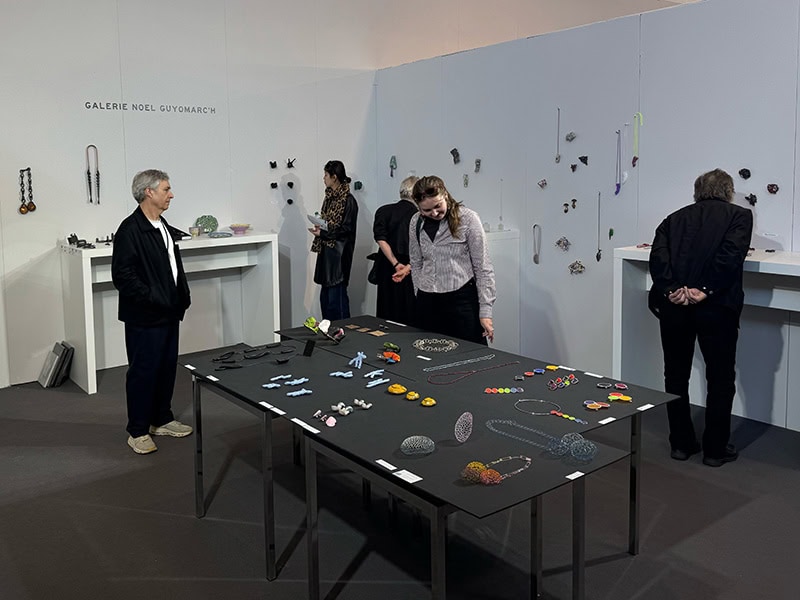
As an exhibiting and selling artist, my excitement for potential inspiration and surprise at the fair is always tempered by my concern that my financial livelihood is supported through my work finding a home, and I am always reaffirmed when my work gets to live with a person who will care for it—especially if I get to meet them in person at the fair. The emphasis on sales requires galleries to show wide ranges of work shown salon-style to best capture the wide range of potential buyers. Flanking the hallmark Schmuck exhibition, there were distinctly strong showings from several galleries including Montreal-based Galerie Noel Guyomarc’h, Stockholm-based Platina, and the Beijing-based The Closer Gallery.
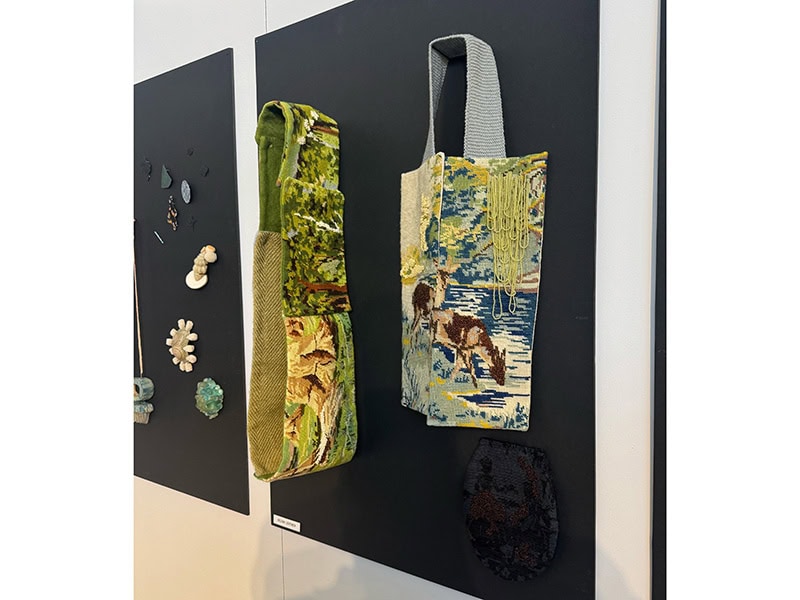
Art jewelry has always had a tenuous status within the market, and things are changing. The conventional collector base has shifted, the reliance on a few big names has limited the growth of younger emerging voices, and the models that served by default may need rethinking. But art jewelry’s resistance to conventional market structures might be its independence as markets collapse. Despite the conservative collecting that happened at Munich and indeed has been happening across all markets—art and otherwise—there were special moments of excitement and much more direct connection by way of more clandestine sales and conversations.
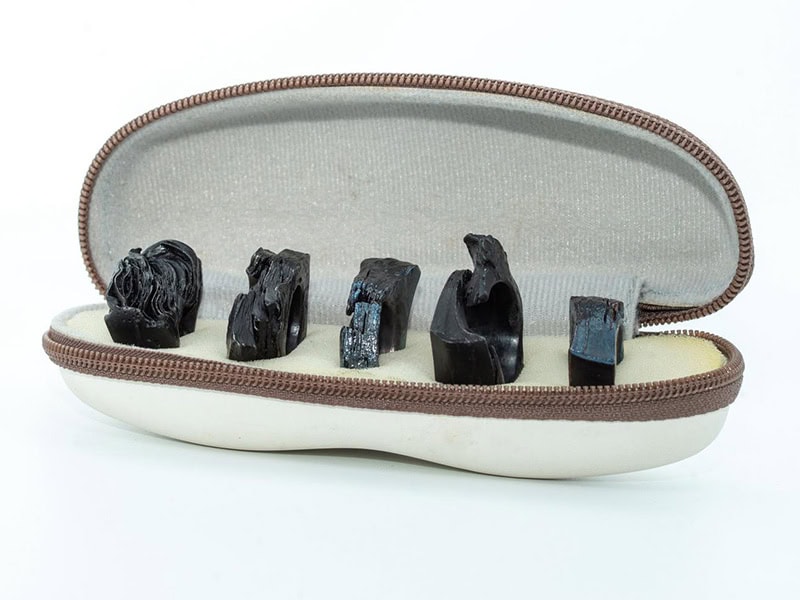
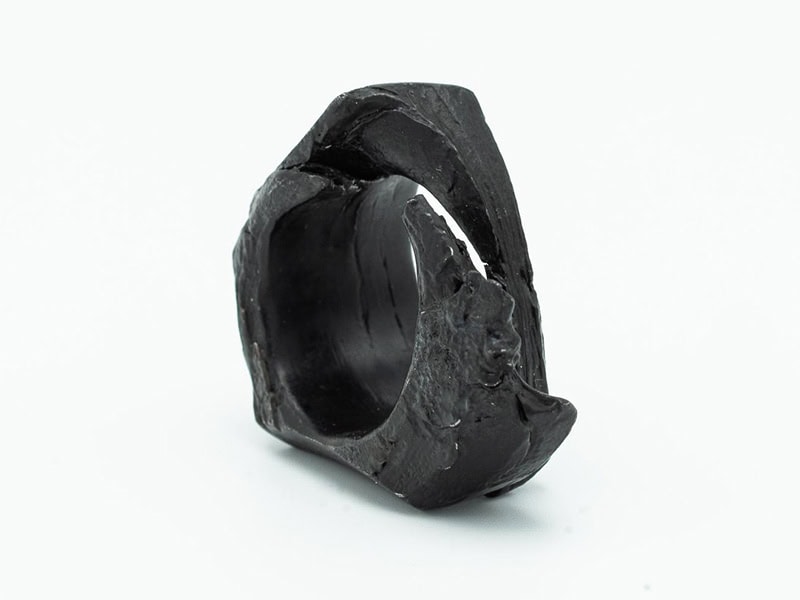
One example of these less conventional opportunities arose at the Pinakothek der Moderne’s annual gathering on Friday night when Sami artist Janne Peltokangas reached into their coat pocket and opened a sunglass case filled with hand-forged iron rings. The conversational atmosphere amongst artists and the mutual respect allowed for an exchange that felt much more nourishing than transactional, and that is what I look for at these events. Moments of connection, appreciation, and a new, better understanding that is very hard to achieve with the pretext of a financial transaction. Peltokangas’s rings are each unique with their folds and fit, and the opportunity to talk with the artist and try each ring on from its zippered container and foam allowed for a deeper level of connection than any conventional space could have offered.
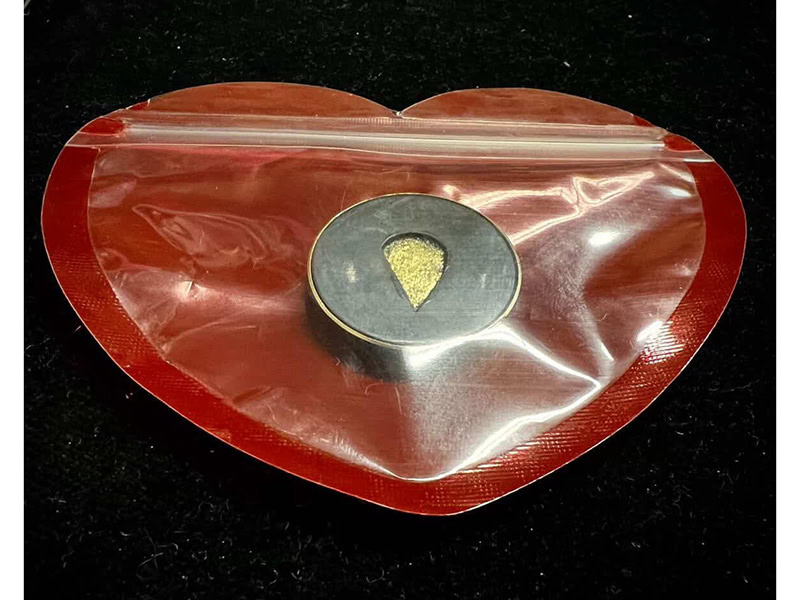
Another of these moments came in the form of an invitation from artist Erinn Michelle Cox, who is currently undertaking a PhD in Oslo. Cox invited me (and others) on the sidewalk outside of a gallery to participate in a study, purchase a small pin, and agree to ongoing conversations around wearing and living with the work. These small copper and brass pins were exceptionally affordable but still required an exchange of money for the commitment. I’m invested in where the conversation will go next.
These methods are nothing new, but they’re perennially effective. While we can hope that markets persist, that collectors continue to collect despite the shifts in how investment structures and values have occurred, we can rely on artists supporting artists, in the most micro and macro ways. These were exchanges, and while smaller in monetary gain, much more reciprocal than transactional.
Maybe it’s romantic thinking that these alternative pathways are richer and more reciprocal than any market-driven response, but practical thinking is what has led us to where we are. ■
By Anneleen Swillen
“We’ve done something different this year,” Thereza Pedrosa tells me. Having recently shown Peter Bauhuis at Pedrosa Gallery, the question arose whether to bring the exhibition to MJW. Instead, they organized an event at Bauhuis’s studio.
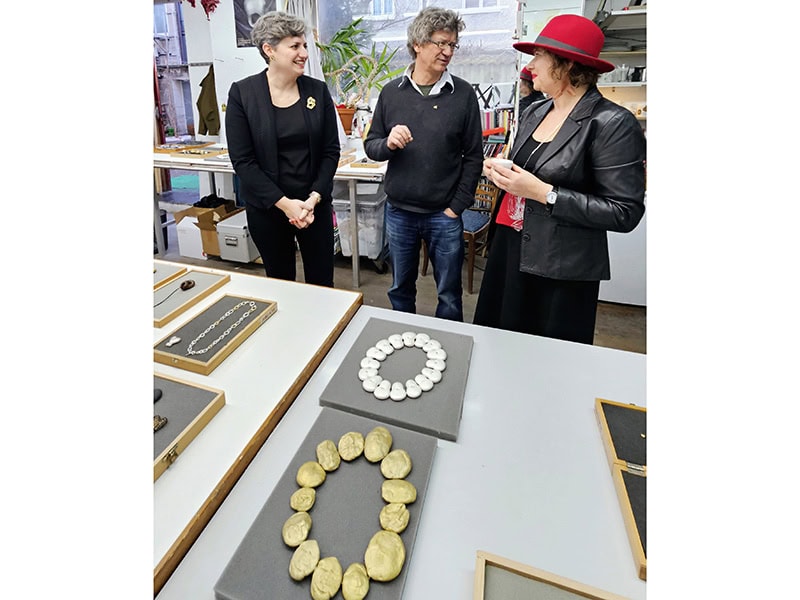
Two intentions guided the project. First, context: the studio as a significant frame for the work. Second, audience: around 20 people were invited personally, all guests Pedroza felt would contribute to the conversation.
The contrast with typical MJW behavior was very much on her mind. Often, visitors come in, look around with their phones, and leave, she says, ticking off as many exhibitions as possible. She wanted to push back against that, inviting people to commit for a few hours. An attempt to genuinely get to know the artist’s work. To look carefully, to try to understand, to talk to each other.
Writing about an event I didn’t attend feels a little precarious. Yet our conversation stayed with me. And while the model is not new (at its core, it’s a studio visit), I had the sense there might be something to learn when it comes to commerce in contemporary jewelry.
Exclusivity is both the event’s strength and its risk. A carefully curated guest list indeed creates conditions for meaningful encounter. But it also raises questions about accessibility and diversity: whose voices are in the room, and whose are absent from the conversation?
Furthermore, getting closer to a maker, a practice, a work can contribute to education within, and beyond, the field. While this event’s guests aren’t unfamiliar with contemporary jewelry, but professionals already working within it, a deepened understanding from their side might find its way to other audiences as well.
Finally, how might an event like this lead to selling work, directly or indirectly? Providing context for an artist’s work, creating space for their practice, and initiating connections are genuinely valuable goals that can also, over time, generate sales. This ties into a recurring, and crucial, question: what are the roles and responsibilities of a gallerist? Through this project, Pedrosa holds several together: (re)presentation, context-building, discourse. As a mediator, she brings artists into contact with each other, as well as writers, collectors, educators, and curators, whose engagement might lead not only to sales but to collaborations like exhibitions and publications. MJW, where people from across the world briefly assemble, offers a particularly fertile context for such encounters.
There is a tendency in the field to cram as many pieces as possible onto a small surface. A drawer, a vitrine, a pedestal. It speaks to an eagerness, and a deep engagement, to show, and, hopefully, to sell. Perhaps somewhere in that impulse, there is also an anxiety of not being seen and not being taken seriously.
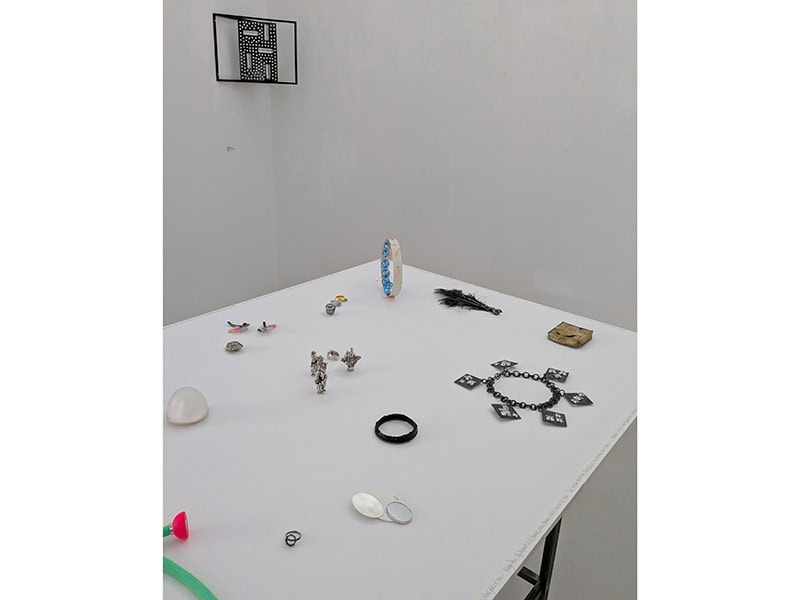
Presentation is not only about the pieces, but also about the space in between. Space does not need to be filled. Pieces need room.
Some manage abundance well. Galerie Door, for example, with Mirror Mirror … Large tables cutting diagonally through the space, a diverse spread of jewelry, and an up-front invitation to try pieces on or ask questions. Handwritten info, including prices, on masking tape at the tables’ edges. Simple and confident. Proudly framing the pieces, and the commercial reality they are part of. Look, here. The field would benefit from more openness.
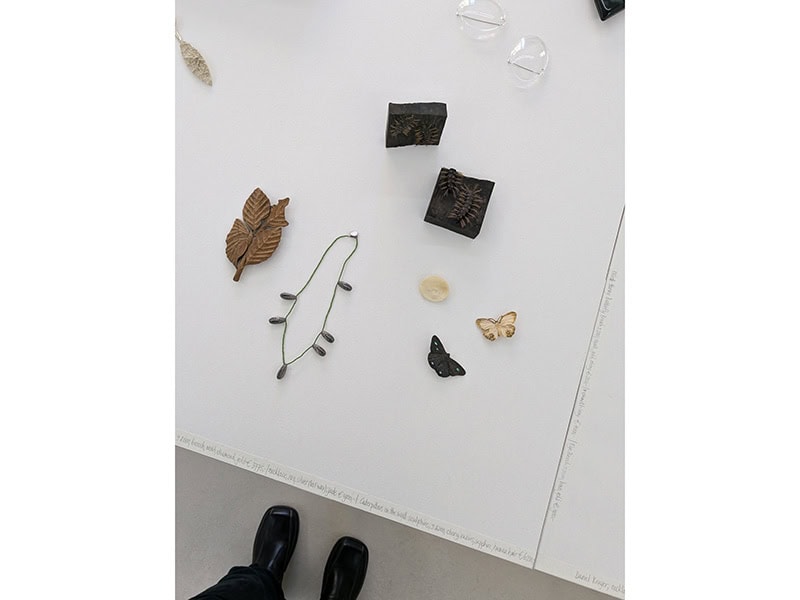
Following MJW, I kept thinking about the direct/indirect angle with regard to commerce in the contemporary jewelry field. Not to decide which is better, as these seemingly opposed strategies open various directions.
Speaking with exhibitors about their approach to commerce came with some hesitation, I realized. Rereading AJF’s Schmuck 13 in Perspective (here), I noticed a similar unease around the subject.
What counts looks different depending on where you’re standing. For some, the priority is encounter, research, or education. For others: did the work sell? Providing context, contributing to discourse, and selling work are all essential for the field to move forward.
The question, then, of how to weave these together is worth reflecting on. And MJW, where many different models and motivations converge, is as good a place as any to keep exploring it. ■
The opinions stated here do not necessarily express those of AJF.
We welcome your comments on our publishing, and will publish letters that engage with our articles in a thoughtful and polite manner. Please submit letters to the editor electronically; do so here. The page on which we publish Letters to the Editor is here.
© 2026 Art Jewelry Forum. All rights reserved. Content may not be reproduced in whole or in part without permission. For reprint permission, contact info (at) artjewelryforum (dot) org