 Before an exhibition opens, something else is already being made. Catalogs are designed, essays commissioned, flyers printed—and, at the Pinakothek, a booklet made for visitors to fill with stamps from 42 schools. By the time Munich Jewellery Week begins, a parallel world of printed matter has taken shape alongside it—and when the week winds down, much of it remains.
This double life of ephemera runs through the four essays gathered here—written by critics, curators, educators, and practicing artists—each attending to the materials that surround an exhibition: catalogs and postcards, flyers stuffed into bags, the waxed blue thread that once held a shortbread pendant. These objects are not incidental to the work. They frame it, extend it, and sometimes outlast it.
“Collected Matters” is part of a series of essay collections responding to Schmuck and Munich Jewellery Week 2026. For many people in the field—and most outside it—ephemera are not the aftermath of the event. They are the event. —Aaron Decker
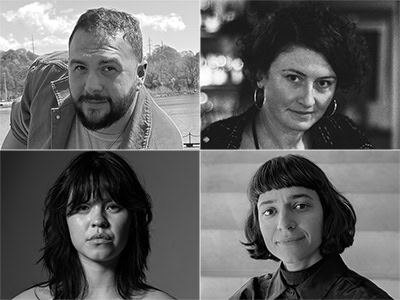
By Anneleen Swillen
If we crossed paths on the streets of Munich, there’s a good chance you’d catch me engaged in making voice notes. Among the many things I collect during MJW, such as postcards, books, business cards, stickers, and event programs, recordings are a favorite way to capture reflections following an exhibition visit or interview.
I am interested in how an exhibition extends, and lives, through the various media that circulate before a show opens, and that have the potential to remain (long) after. Some more fleeting ephemera hold their value mainly during the week itself, such as the informative flyer one may or may not keep. Others, together with the exhibition project they are part of, contribute to the broader discourse of the field. I’ll focus on the latter.
Transforma(c)tions: Matter Dialogues, curated by Sofie Boons and Yitong Zhang, was an exhibition at the intersection of the sciences, jewelry, and education.
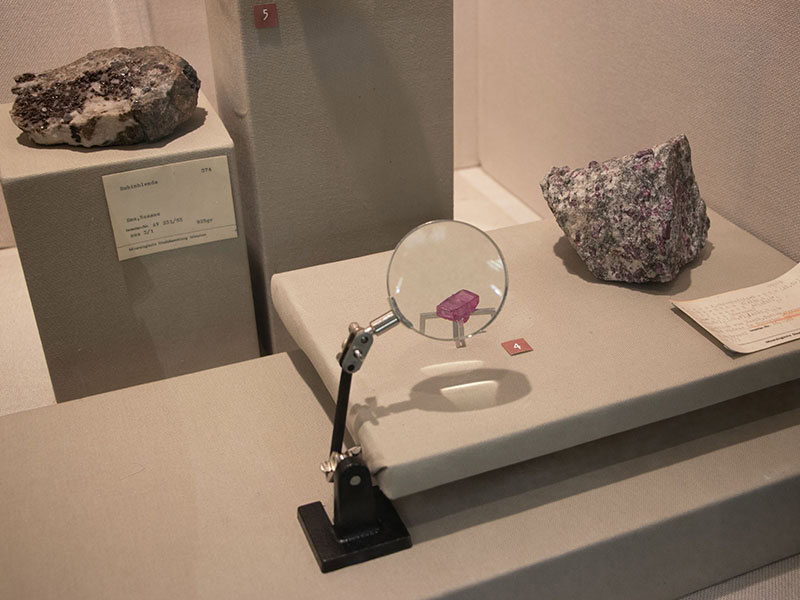
The scenography drew extensively on the museum’s archive, both its mineral collection and its display materials. Boons and Zhang selected minerals in dialogue with the participating artists’ works, and presented them alongside the jewelry in the exhibition as well as the catalog. They looked for minerals that added dimensions to the display, to invite the audience to see things in a new light, and spark questions.
The exhibition opened before MJW and ran for several weeks after, a conscious effort to reach beyond the MJW in-crowd. Hosting the show in a museum means reaching the museum’s own audience, too. The catalog, designed by Otto (Yexi) Chow, extends this ethos. As Boons puts it: “The catalog is incredibly important because it introduces the field to people who are not already part of it. MJW struggles to reach a broader audience. There is a tendency in our field to not label things. I appreciate the breathing space that creates, but if we don’t provide enough information, are we excluding those who haven’t had the training to read the work? When we have the privilege of working with a museum, or access to other kinds of platforms, we should look for opportunities to break out of the bubble, and do that with empathy.”
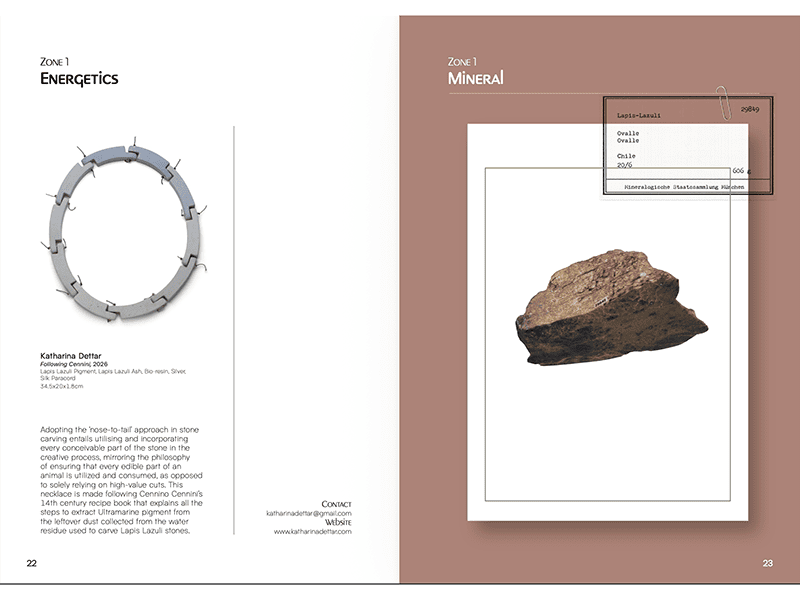
The catalog presents the artists’ work, weaves in a visual dialogue between works and minerals from the archive, and includes two essays that deepen the themes. Rich in content, carefully designed, and available online, it has the potential to contribute to discourse within the field, and reach farther.
Transforma(c)tions was an exhibition about and as research, not merely presenting research, but actively contributing to it. Zhang, for example, conducted surveys of visitors based on displayed pieces from her PhD.
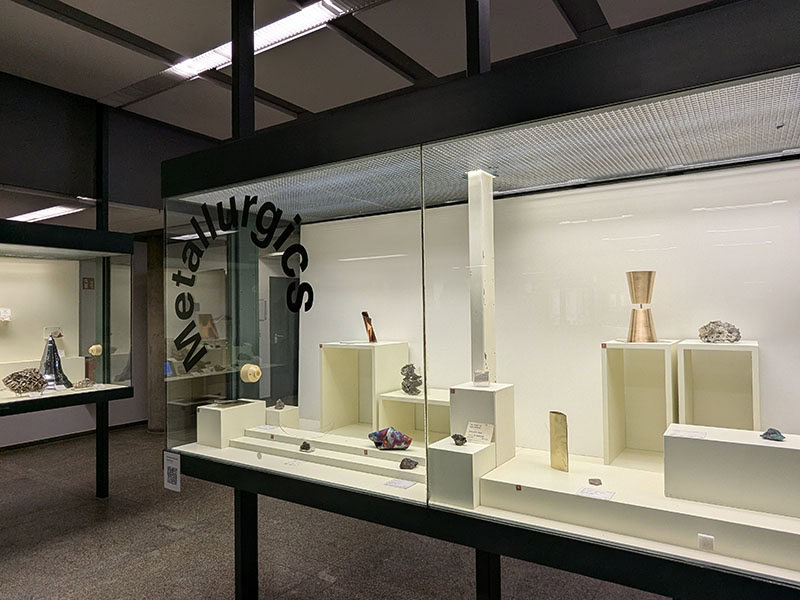
One of the most compelling things about Transforma(c)tions is the density of what it brought together: artistic and scientific research, education, industry collaborations, student work, museum context, and a commitment to discourse that can extend well beyond walls and weeks.
Transforma(c)tions is not the only initiative worth noting here. As part of their exhibition Threads & Thresholds, Eva van Kempen, Bibi Klekachkoska, and Susanne Matsché published a first volume in a planned series, presenting artists’ works alongside guest contributions, and hosted a talk during MJW. And with All In, The WearHouse added a new catalog to their growing collection. I find myself wondering whether exhibition projects and publications like these find their way to audiences outside contemporary jewelry. They certainly have the potential.
Of the exhibitions I missed, some found their way to me. On a phone over dinner, a fellow visitor walked me through images, zooming into details, sharing their interpretation. Not a substitute for the physical experience, but something interesting in its own right: visiting through someone else’s eyes. This, I imagine, is how many people within the field experience jewelry weeks. Through screens, publications, word of mouth. In that sense, perhaps the ephemera are not the aftermath of the event. For many, they are the event—companion matters through which contemporary jewelry, as a living discourse, moves through the world. ■
By Elena Karpilova
Deciding what to see in Munich is always demanding. The Munich Jewelry Week map lists 110+ exhibitions, yet some 40% include no description or curatorial text. Perhaps this helps explain why many shows—and, to some extent, the field itself—feel ephemeral. Personally, I find it hard to commit to an exhibition that offers no explanation at all. Ruudt Peters admits that he relies on familiar names when choosing what to see, saying, “that’s unfortunate!”
Short, accessible texts would benefit both visitors and exhibitors. If we say SCHMUCK and Munich Jewelry Week are one of the most important shows in the field, let’s compare the approach to communication with a similar event—the Venice Biennale. There, each pavilion has a brief wall-mounted text written for a broad audience, and an assistant present to explain the work. This delivers meanings effectively to diverse audiences.
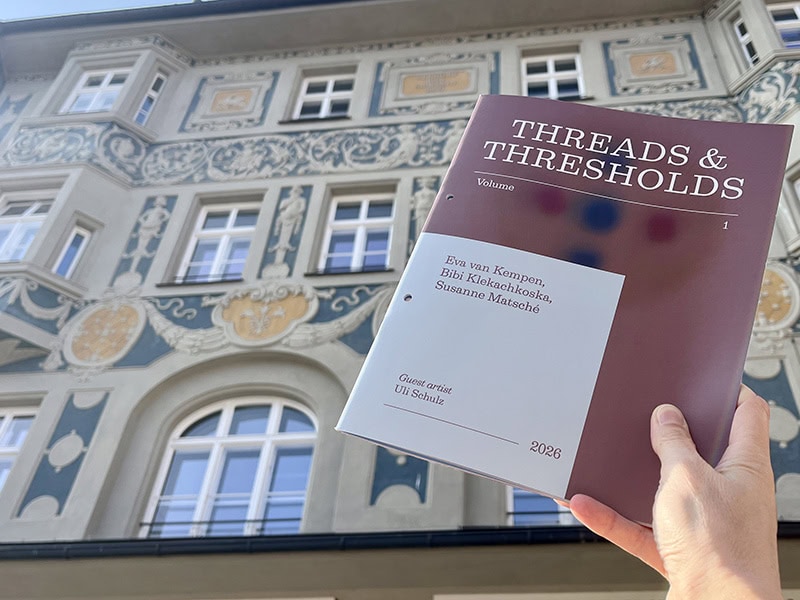
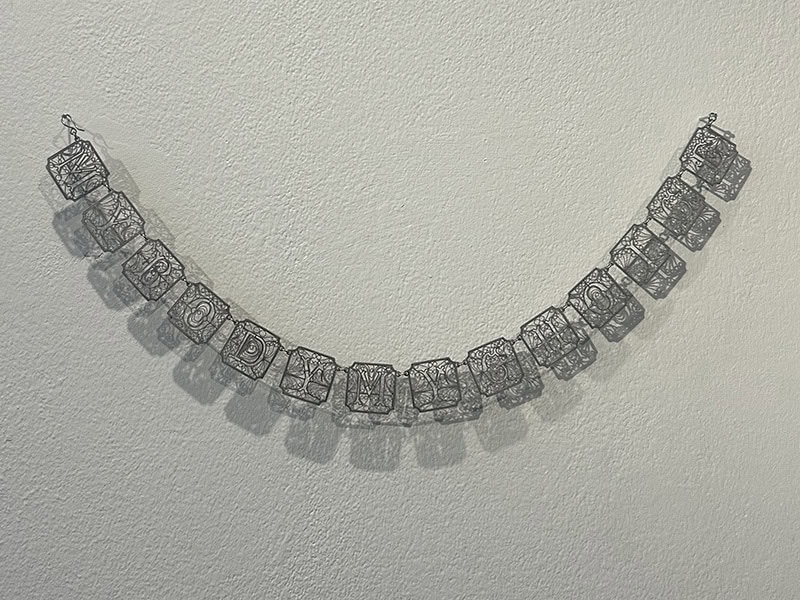
Text is an essential tool for understanding an exhibition and its value. I saw a strong example in Threads & Thresholds, where Eva van Kempen, Bibi Klekachkoska, and Susanne Matsché (with invited artist Uli Schulz) reinterpreted filigree “not as a static tradition, but as an active methodology for negotiating transitions between inside and outside, solidity and ephemerality, past and future.” The exhibition catalog expands on this idea through texts by Lieta Marziali, Johanna da Rocha Abreu, and Roberta Bernabei. Even after the exhibition ends, the catalog remains a valuable, independent object.
Treasure Peninsula featured works by students of metalwork and jewelry in the Department of Crafts at Seoul National University. At the entrance, visitors encountered small packets containing transparent capsules with a tiny blue plastic form inside. These functioned as the “business card” of associate professor Jakyung Shin, who organized the show. Instead of printed materials, she created an object representing the university’s jewelry and metalwork program. The blue form is a miniature silhouette of the university’s main gate—a design by the program’s first professor and now a symbolic landmark. Around 1,200 such capsules were produced with students’ help.
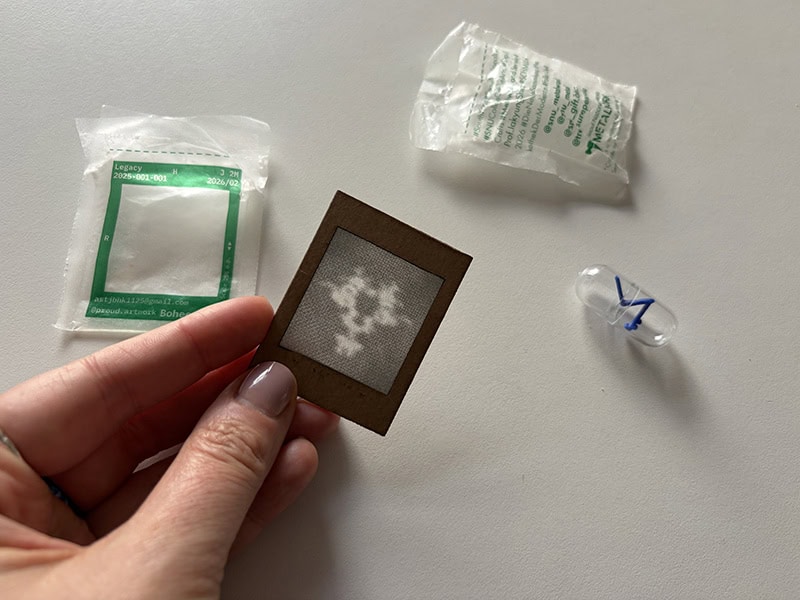
You could also take the visiting cards of jeweler Bohee Jang, designed as small X-ray–like images printed on tracing paper. This reflects her artistic process: she works with cow bones—widely used in Korean cuisine—burning them until they turn into ash, which becomes the material for her jewelry.
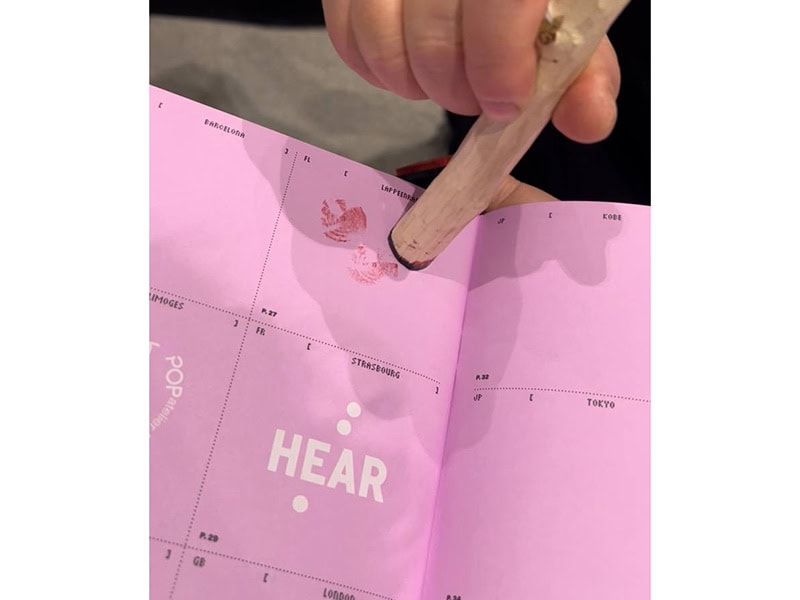
The catalog given out at the Pinakothek during the First Summit of Jewelry Classes really took me back to childhood. Its pages included slots for the 42 schools represented at the event (performance? happening?). You were meant to collect each school’s mark—stickers, stamps—as you moved through the event, gradually filling in the empty slots. What I remember most vividly is the school from Lappeenranta, LAB University of Applied Sciences, Finland, which used a stamp made from the cut end of a wooden stick.
Looking at hundreds of the materials I’ve gathered—from pins and flyers to books—I find myself asking: What exactly was Munich? Neither Schmuck nor Munich Jewelry Week has quite taken shape as a coherent whole: is it a fair, a cultural event, a showcase of achievements? “For me, it’s always a learning experience,” Liesbeth den Besten aptly noted. But “collecting”—whether it’s learning experiences, brochures, or impressions—is no easy task, especially at a scale that far exceeds human capacity, the kind Munich has now reached. “I visit Munich once every five years. Then I spend the next five years recovering,” declares Ted Noten. ■
By isabel wang pontoppidan
Coming back to my studio in Amsterdam, I arrange all of my Munich cards and collectibles on my desk. Among them I find a small leaflet from a nose spray I bought in a German pharmacy—a futile attempt at managing my hay fever in the violent premature spring. The leaflet goes in with the other papers, arranged in a collage.
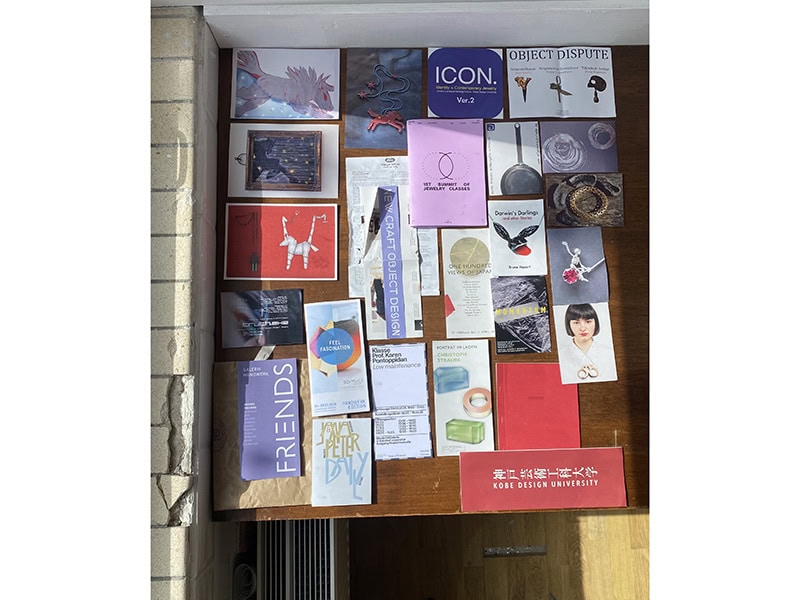
It highlights a sensory element to my time this year in Munich. Sniffly, itchy, and sneezy, I made my way through the city, eyes and nostrils running incessantly, crumpled-up tissues accumulating in my bag and every pocket in my clothes. Through my watering eyeballs, I tried to see as many exhibitions as I could, in anticipation of writing this. I took most of the exhibition cards out of duty when I remembered, out of the same anticipation. Usually, I would not collect things like this, as I dislike the accumulation of objects.
What I will most likely keep are the Helen Britton cards I took from Raumwerk, at the Main Course exhibition. A lot of them feature horses, either in the shape of jewelry or rendered in paint. At this show, I felt that the printed matter featuring Britton’s work (cards and several tempting books ) were much more enticing than the exhibition itself. Something about the colored fabric and furniture made the jewelry look too cozy, like it was asleep, and I didn’t want to disturb it. Seeing the work blown up, printed, and presented to me on page after page of slick paper was so much more satisfying than the real thing hanging next to me. That can happen. In fact, I feel that it often happens. If I had a penny for the amount of times I’ve recently been more titillated by a museum bookstore than its actual exhibitions, I’d have several pennies.
The ephemera turns the jewelry into a different type of representative object, one that is simpler, perishable, nay, ephemeral, easy to store. For me, there are two categories: one for genuine keepsakes, worth holding on to because they are beautiful or remind me of something beautiful; the other has a function similar to snapping photos of description plaques in museums. It serves as an archive of things I want to remember but never refer to. Although I might never consult the majority of its contents, the archive soothes me. Whether it be the hundreds of photos in my phone depicting impactful passages in books, the card of an artist I want to research, screenshots of the location of a good cafe, or a blurry photo of someone else’s phone showing me the next exhibition I should attend in Munich, the moment of recording was one that gave me a feeling of agency.
By the time you’re reading this, I will have sorted through the ephemera and decided what gets archived in either category. Afterward, I’ll rid myself of the excess. ■
By Steven KP
I am always a bit of an ephemera hoarder. Postcards, notes, flyers, readers have always been impossible for me to throw away and, as a result, I tend to be relatively selective with the things I pick up and carry back to my library. However, when tasked to take stock of the collected matters of Munich Jewelry Week, I found myself gathering any piece of text or image handed my way—less passive accumulation than an active, almost curatorial instinct to hold onto fragments that might stand in for a much larger, fleeting whole.
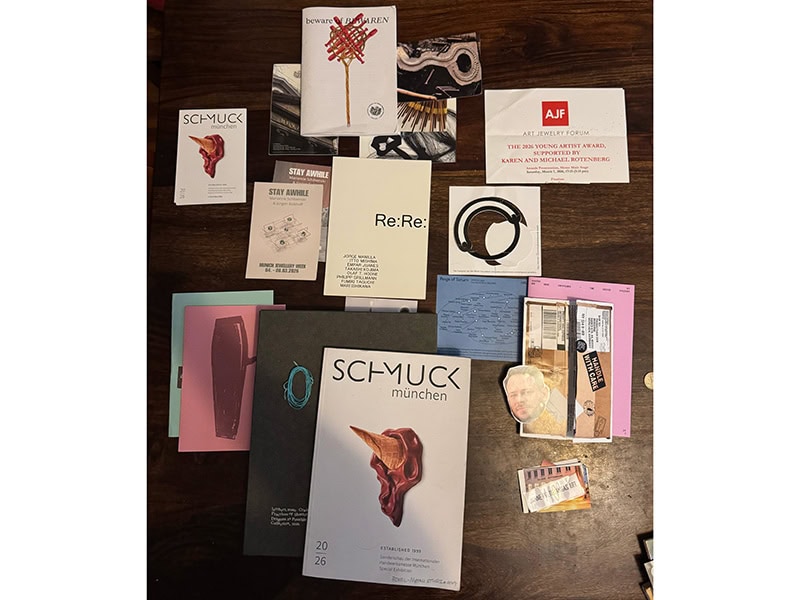
The things that remain with us after an event can transport us right back to it. I don’t know a single jeweler or jewelry lover who can, in good faith, claim to be unsentimental. The physical media and souvenir scraps I collected during my visit are a much more immediate and enduring reminder of works that moved me—and shows that didn’t—than any one of the dozens (hundreds?) of photographs I took while wandering from gallery to gallery. Images flatten; they record form, but rarely weight, intimacy, or the social context of encounter. A scrap of printed matter, even a cheaply produced flyer, holds time and place differently.
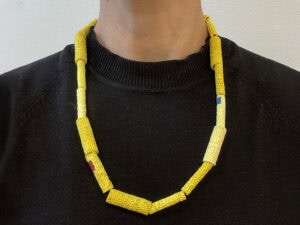
One of the prizes I brought back with me is a length of waxed blue thread that once held a shortbread “pendant” at the opening reception for Recover, organized by Jana Brevick, Theresa Wingert, and Franziska Langheinrich. The cookie lasted approximately three minutes in my possession, but the string stayed around my neck for the duration of my time in Munich. The jewel consumed, the act of wearing remained.
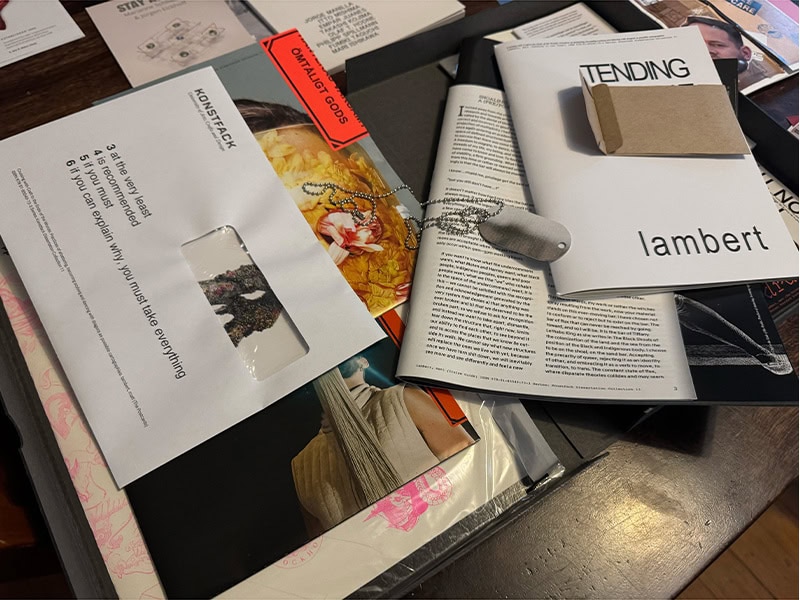
The week’s most important role, beyond sales, collections, or even seeing work, is bringing together art jewelry’s creative voices into a dense, shared moment. The field produces remarkable boundary-pushing work, yet it is often produced in isolation. What makes this gathering distinct, and increasingly rare, is the chance for in-person discussion and exchange where research and ideas can be collectively tested and expanded. One of the most impactful objects I left with this year was a physical copy of matt lambert’s dissertation, completed this spring at Konstfack. Amid a flood of images and impressions, its bound, multi-media, and hand-printed presence feels as radical as its scholarship, an insistence on the physical enduring over immediacy, and on dialogue over volume.
After my time at various jewelry weeks and events, I do think that for a field that depends on material interaction to make things meaningful, there is an overreliance on the digital and the non-material. Without these physical remnants, beautiful moments and thoughtful contributions risk being lost to the churn of the new, the next, the louder. And yet, accumulation itself carries a tension: if everything is kept, nothing is emphasized. The power of ephemera lies in its specificity: this card, from that conversation, in that moment. To hold onto it is also, in some sense, to annotate it, whether mentally or through systems of keeping that deepen rather than dilute its meaning.
Bring back posters, books, postcards. Write more, print more. I am a glutton for printed matter—not simply to possess it, but to resist disappearance, to let ideas settle and endure in forms that can be held, revisited, and remembered. ■
The opinions stated here do not necessarily express those of AJF.
We welcome your comments on our publishing, and will publish letters that engage with our articles in a thoughtful and polite manner. Please submit letters to the editor electronically; do so here. The page on which we publish Letters to the Editor is here.
© 2026 Art Jewelry Forum. All rights reserved. Content may not be reproduced in whole or in part without permission. For reprint permission, contact info (at) artjewelryforum (dot) org