Once upon a time, a very, very long time ago, I found myself on a river boat heading down the Danube from Passau, Germany, to Vienna, Austria. I was in the US Infantry, having been trained rigorously as a machine gunner. It was August 11. I’d been given a seven-day pass. The voyage down the Blue Danube through the many locks was quite amazing. The boat’s captain used the public address system rarely, and then only to name an important castle. Sometimes they were in ruin, and sometimes family occupied. Always high above on great mountainous rocks. The location of the startling discovery of the Venus of Willendorf was pointed out with great justified pride.
In the stern of the boat, where I chose to sit, were 20 or so Norwegian university students. They were all holding big black umbrellas to protect themselves from the hot sun. They were polite and quiet. You could hear the water breaking along the prow of the boat. At every small village along the banks, 10 to 15 teenagers would dive into the Danube, swimming alongside the boat to the next village where they would climb out of the water in great jollity, waving to us as they walked back to their home village.
The great adventure took the entire day from early morning to shortly after sunset to catch sight of Vienna glittering in the dark, the way great cities on bodies of water do. The Danube isn’t blue any longer. It’s a rather muddy brown. However, on this night in August it appeared to be made of polished black glass. A few ripples proved to the passengers we were on water, and not sailing in the sky.
Vienna is a large cosmopolitan city built by and for emperors. There is much to see. My small hotel was in the city proper, but far from the central area. Each day I took a bus toward the center and every day I passed a large, beautiful palatial building. A tiny bronze plaque was attached to it, unreadable from the bus window. Every day, there, too, was parked a great classic black Rolls Royce from the 1920s. On the fifth day I could no longer resist the automobile and had to see the dashboard, always so beautifully crafted in vintage “Rolls.”
I read the small bronze plaque, and to my great surprise the building proved to be a museum with an exhibition on the first floor. I had thought it a private residence because of the great automobile.
After climbing a flight of broad stairs, I was confronted with a pair of wide, tall double doors. Upon opening one of them, I saw two rows of old-fashioned cases, the type with sloping glass front and back panels, like an elongated pyramid. The glass was framed in oak.
There were two rows of cases, 10 in each row, with a wider aisle between them. The cases were filled with tremblant diamond brooches. There were hundreds of brooches and thousands of diamonds. If you are not familiar with tremblant jewelry, it was extremely popular in the 1700s. They were jewelry pieces created for the very rich. This was, of course, long before the invention of electric lighting. Imagine, then, great candle-lit crystal chandeliers illuminating a ballroom or a vast dining hall. In tremblant, diamonds are mounted on tiny springs or other such devices made of precious metals, silver, white gold, or platinum. These allow the diamonds to tremble from the slightest of movements. Their structures are so delicate even a breath of air can make them move.
There was no one in the room but myself. Remarkably, not even a guard. I walked between the 20 old cases, the wood floor’s vibration transposing through the wood legs of the cases and causing the thousands of diamonds to tremble and send sparks of light throughout the entire room.
Never had I seen or even dreamed of such scintillation.
Flashing forward through numerous decades, I return to Vienna. There I spoke to one of the great collectors of contemporary artist jewelry. She had seen the same exhibition. As it happened, the jewelry was in the building for just one summer while the tremblants’ original home was being renovated. I had seen this stunning display in its magnificent setting by pure chance.
As I streak fast forward from the 1700s into the twentieth century, memory and actual time has a way of shifting with great speed, is it not so?
In the twentieth century, I meet Susan Grant Lewin.
How, where, and when remained a mystery to us both for many years. Then suddenly one day I remembered.

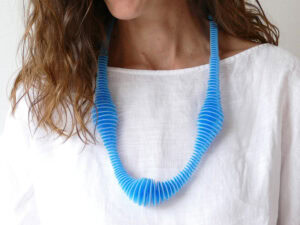
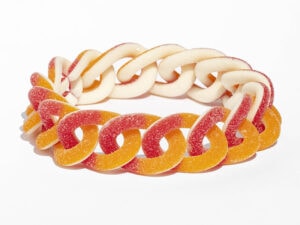
It was at the opening of an exhibition that Susan herself had organized during the time she was global creative director of the Formica Corporation. The exhibition consisted of objects made using Formica, primarily jewelry and furniture. Susan asked me if I would be interested in working with the new ColorCore product. Regular Formica, developed decades earlier, had a dark base. Only the uppermost surface had color, and sometimes printed designs. It was shiny, sleek, wore extremely well. It changed the look of kitchens around the world, and diners across America. Its flaw was the edges and corners, for there the dark base material showed. The new ColorCore was homogeneous, and more refined. It was 1 mm thick of solid color, the finish nearly matte. Where corners and edges met, the dark line was eliminated. Yes, I would be interested in working with it! And so began our long professional friendship.
When Susan wrote her book, American Art Jewelry Today (Abrams, 1996), she invited me and two other people along with herself to aid in the selection of works that would be published. Previously she had contacted a great number of jewelers to submit photographs. This was pre-internet, if you can remember such a time. Nearly all the jewelers responded, so there were huge stacks of work to process. The first step was to eliminate photography that would not reproduce to high standards.
When the book launched, it was well received and sold out quickly.
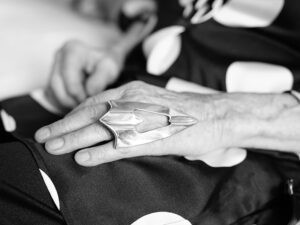
From there a lot of history began to evolve. Susan was enamored of contemporary art jewelry. Her first piece was ironically—since she collects primarily American work—not American, but rather a ring by the Swedish jeweler Vivianna Torun Bülow-Hübe. She still wears it today. I have seen it often.
Susan is a world traveler. She has a great collection of artist jewelry, which she is slowly donating to major museums throughout the world. Her particular interest is in placing American work, as she correctly feels it is not well-enough known in Europe. This is a difficult, complex task, for donating work to an important museum is far more complicated than you might think.
Her interests are wide in the arts. They all apply. Painting, sculpture, architecture, dance, modern and classical. But her overriding passion is artist’s jewelry made by the jewelers themselves.
When I first met Susan, she was a bit indiscriminate with her purchases. That is to say, she might purchase several inexpensive pieces with no real artistic content simply because she liked them and wanted to wear them. Slowly this segued into refined work of excellent craftsmanship and unique idea. Both always a required absolute.
I’ve been to many jewelry exhibitions with Susan. Once, in Munich, Peter Skubic, the great Austrian jeweler, and myself went through an enormous jewelry exhibition finding what we thought the best works were so we could point them out to Susan. She looked carefully at each piece we suggested. Then, as Susan will, she picked out exactly what she felt was right for her.
I wrote of tremblants at the beginning of this essay. Well, Susan is a tremblant when she walks into a jewelry exhibition. Her eyes light up, her mind quivers on fine—albeit calm—springs, and she dances in the ballroom of jewelry.
Now, you may think you know Susan Grant Lewin, but there is so much more. However, I’ve used up my assigned allotment of words.
The opinions stated here do not necessarily express those of AJF.
We welcome your comments on our publishing, and will publish letters that engage with our articles in a thoughtful and polite manner. Please submit letters to the editor electronically; do so here. The page on which we publish Letters to the Editor is here.
© 2026 Art Jewelry Forum. All rights reserved. Content may not be reproduced in whole or in part without permission. For reprint permission, contact info (at) artjewelryforum (dot) org