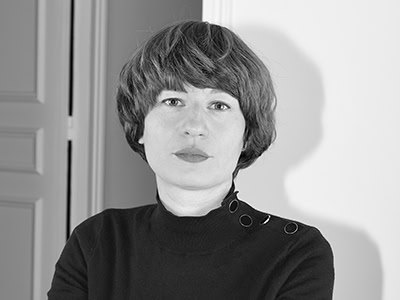
Last year, Marion Delarue, a French artist who works mainly with wearable objects, was selected for a research residency at the Musée des Arts Décoratifs (MAD) in Paris. The goal of the residency was to study objects from the museum’s collections, with special access to storage areas and the restoration workshop. Her research focused on objects related to hair, headpieces, and feathered objects. Since the dian-cui technique brings together these three elements, Delarue chose to study it in more detail. This rare technique, originating from China, uses only kingfisher feathers. This article presents the main discoveries from her research.
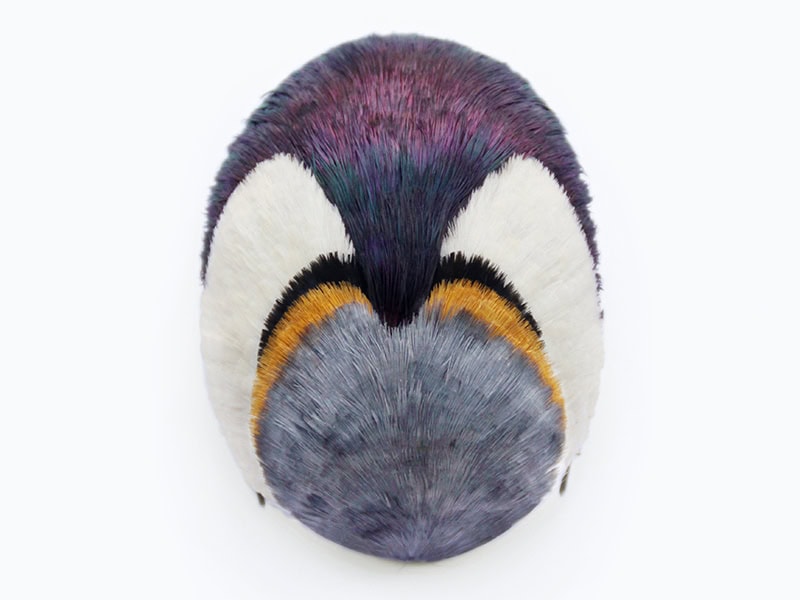
My earlier research, carried out mostly during residencies in Asia, led me to work with many materials, such as mother-of-pearl, porcelain, glass, lacquer, wood, and stone. Among them, feathers have played a central role in my practice for the past 10 years. I first encountered featherwork during an artist residency in China. From September to November 2025, I joined a research residency at the Musée des Arts Décoratifs. With over one and a half million objects, the museum holds one of the world’s most important decorative arts collections.
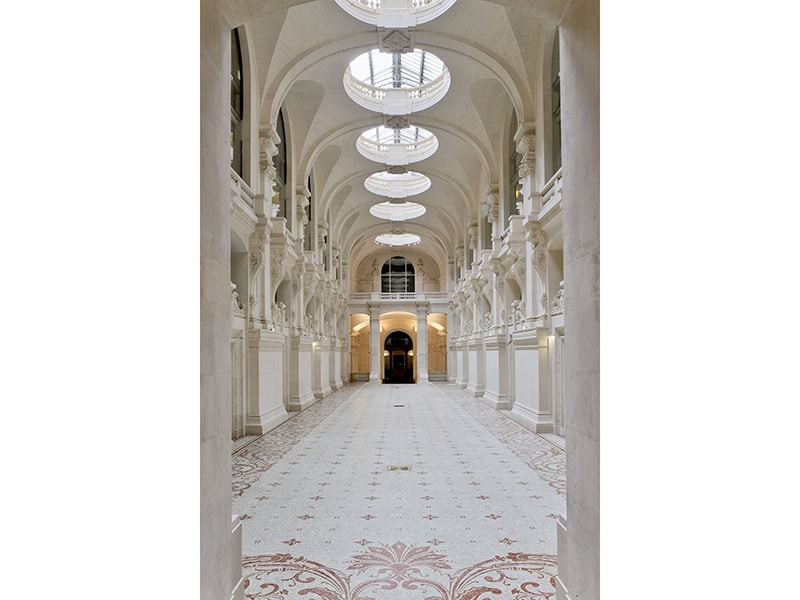
These residencies allow artists and researchers to study works in exceptional conditions. My research focused on objects from the Jewelry, Asia, and Fashion departments, and especially on those made with feathers. I thus studied closely two dian-cui objects: a hairpin and a Dian Zi headdress. Each object shows one of the two known methods used to apply kingfisher feathers. Both pieces are very well preserved and are particularly valuable for understanding this rare technique.
The hairpin, which is permanently displayed in the jewelry galleries, is especially meaningful to me. It was the object that first inspired me to go to Beijing in 2014 to learn about the origins of dian-cui. At that time, I realized how difficult it was to access this almost lost knowledge. Xiao Guangchun, one of the last recognized masters, refused to meet with me. His daughter, Xiao Yumei, who later took over his practice and chose to work only with dyed goose feathers for ethical reasons, was also unreachable. More than 10 years later, I now fully understand how rare it is to study authentic dian-cui objects in such ideal museum conditions.
The dian-cui technique appeared in China during the Warring States period, 475–221 BC. It reached its peak during the Ming and Qing dynasties, from the 14th to the early 20th century. Traditionally, making a dian-cui object follows very strict rules and requires several steps. The first step, ding-cui (examining feathers), is to choose feathers from the wings, the tail, or the back of the kingfisher.
The next step is cai-xing (trimming feathers). In this step, the feathers are cut into small pieces using special tools such as a scraping knife and a thin brush pen. The artisan removes the black parts of the wing and tail feathers. Then comes dian-pu (dotting and spreading feathers). During this stage, the small feather pieces are placed one by one onto the patterned base.
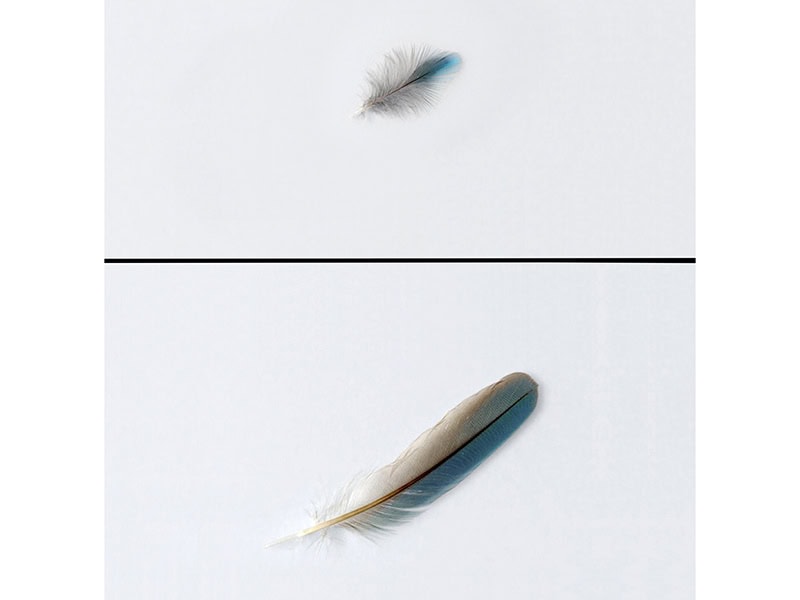
Two main application methods are known. In the first method (called shun-pu), feathers from the wings and tail are sometimes glued onto paper before being cut to the right size. They are worked in the same direction as the feather barbs. In the second method (called pin-dian), feathers from the bird’s back are used. These feathers are completely blue and are cut while keeping the central shaft. They are placed in overlapping layers, like roof tiles, so that the individual feathers are almost invisible.
Both methods are followed by ya-he (pressing feathers), in which the artisan presses and flattens the feathers onto the surface of the base. The final step is gua-qing (scraping the cyan). In this step, the feathers are polished evenly with an agate tool held at a 30-degree angle. This helps bring out the shiny texture of the feathers and makes the surface shine with bright, enamel-like reflections. The adhesive is organic. Researcher Imogen Clark describes it as a mix of animal glue and seaweed extract. This glue does not soak into the feathers and leaves no visible marks, which helps preserve their color and shine.
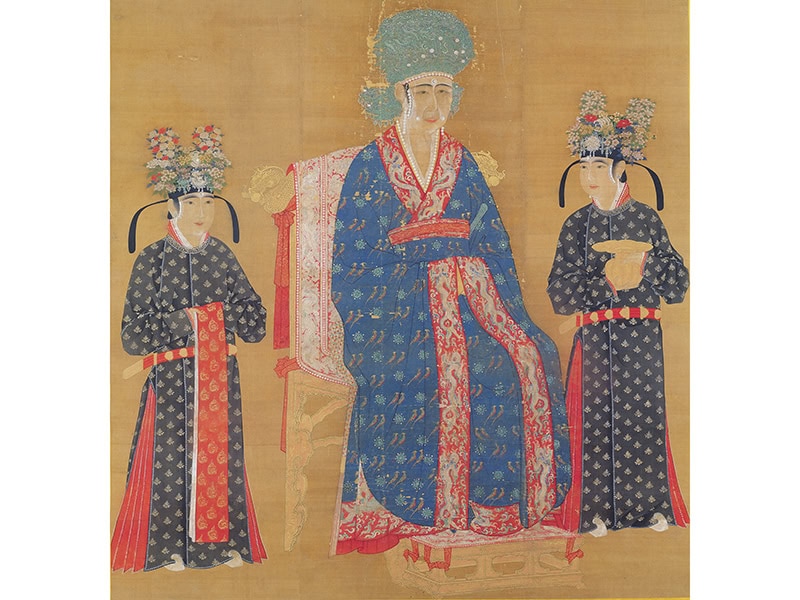
Historically, dian-cui was mainly used for hair ornaments. These included hairpins, ornaments for traditional Manchu hairstyles called liang patou, and headdresses. The lotus flower often appears in these objects. Serving as a place for the kingfisher’s spring mating displays, the lotus rises above the mud and blooms beautifully. It represents purity and fertility. Dian-cui objects, carefully placed in women’s hair, encouraged them to use the lotus as a model. In ancient China, young girls could wear their hair loose or braided, but tradition required giving a hairpin to mark the transition to adulthood. The word “ji” meant both hairpin and young girl. After marriage, women were expected to wear their hair in a bun and, depending on their social status, they could have hairstyles of different levels of complexity. Using kingfisher feathers to decorate women’s hair may also be linked to the color cyan, which was associated with fertility in ancient China. This shows the cultural belief that motherhood was considered an important duty for women, and hair decoration served as a way to show these values.
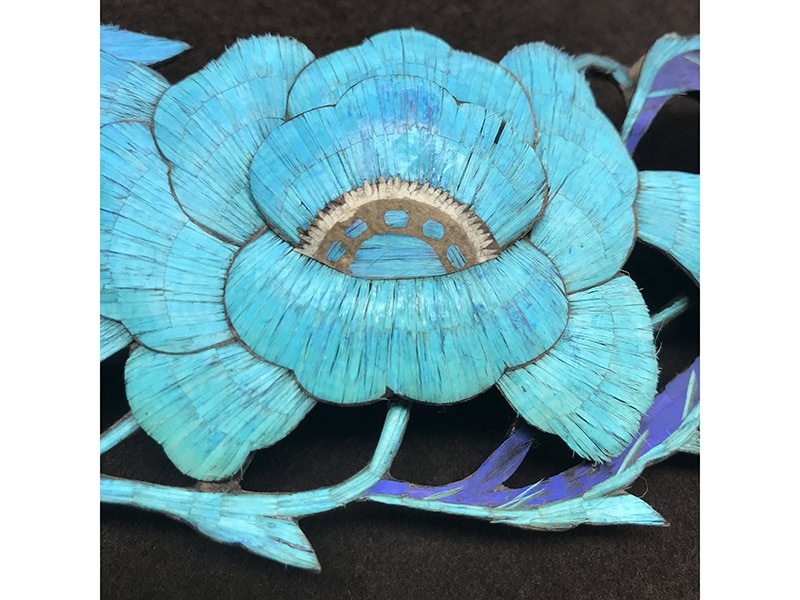
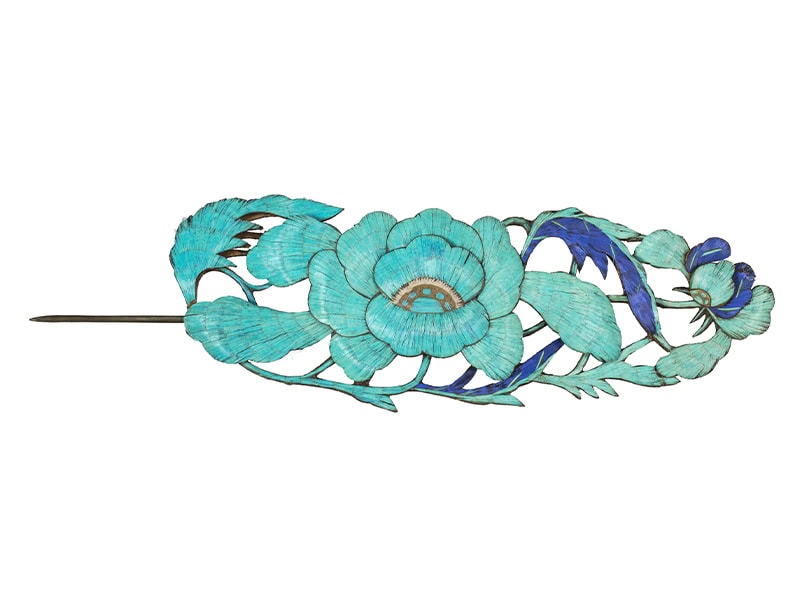
The dian-cui hairpin I studied during my residency follows the pin-dian method, dates from the 19th century and measures 8 ⅝ x 2 ¾ inches (22 x 7 cm). It combines feathers from two types of kingfishers, creating turquoise and violet tones that I was able to observe closely using a stereomicroscope (see detail below).
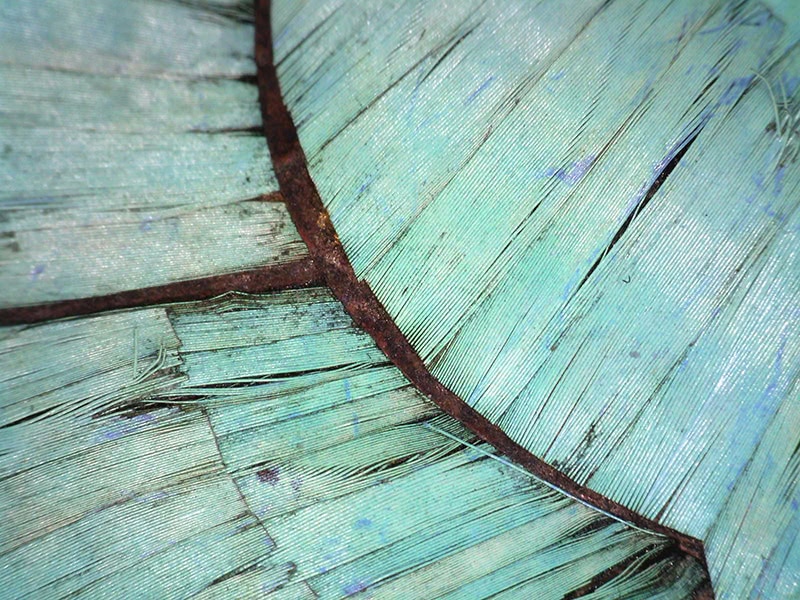
The design likely represents a peony, a flower symbolizing wealth and good fortune. Despite its age, the hairpin is in excellent condition, with only minor losses, and shows the typical overlapping layers, like roof tiles.
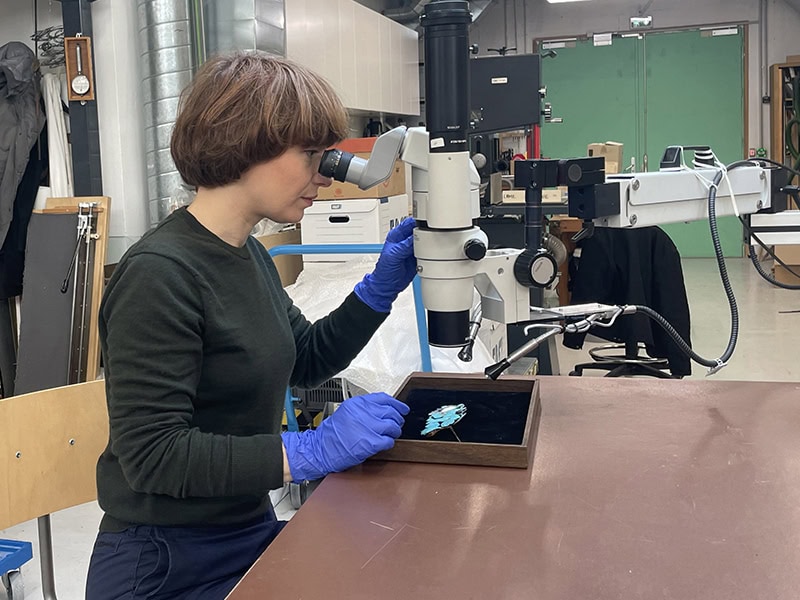
Mélina Plottu, a textile restorer at MAD, explained to me that conservators and restorers really want to help the public understand and appreciate the value of a work of art, even when it is not in perfect condition. Studying the hairpin in the restoration workshop was fascinating. The front is very precise and refined, while the back looks much simpler.
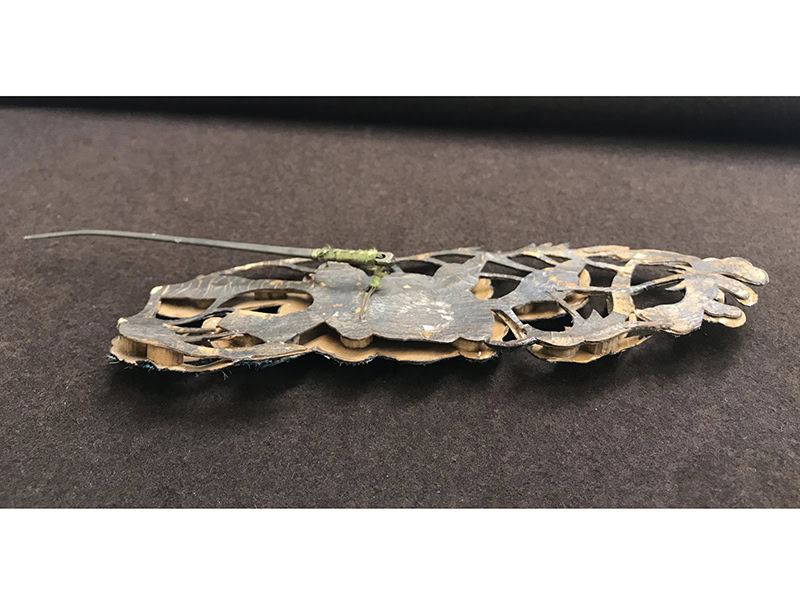
It is made of brown paper about 0.7 mm thick, probably covered with silver and varnish. During the Qing dynasty, paper was often used for large jewelry pieces because it was lighter than metal. The metal pin is mounted as a tremblant, allowing it to move with the wearer. Small wooden supports give the piece its curved shape and enhance the light effects of the feathers. The openwork design is made of several overlapping elements, creating a lively composition. According to Mathieu Rousset Perrier, curator of the jewelry collections at MAD, this hairpin is one of the most important pieces in the museum. It has been displayed for more than 10 years, and kingfisher feathers seem to keep their color better than many other types of feathers.
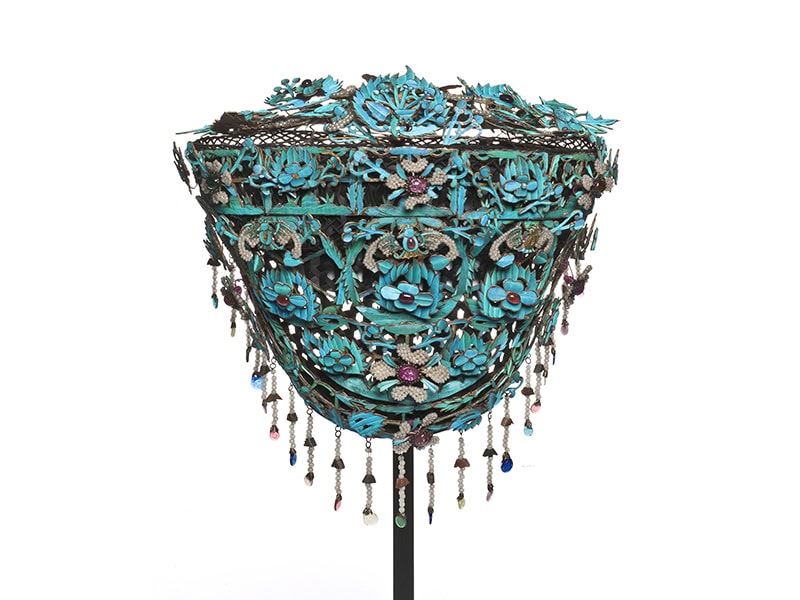
The second object I studied is an extravagant dian-cui Dian Zi headdress (which in the Manchu language translates as a “hat ring”). It also dates from the 19th century, but it follows the shun-pu method. It measures 10 inches (25 cm) wide and 1 ⅛ inches (29 cm) high and is built on a black basketry base. Cardboard elements covered with kingfisher feathers are attached to this structure using metal wires and textile fibers, along with semiprecious stones, freshwater pearls, and glass beads. To wear it, a woman placed her hair in a bun, set it inside the headdress, fixed the headdress on her head, and added hairpins.
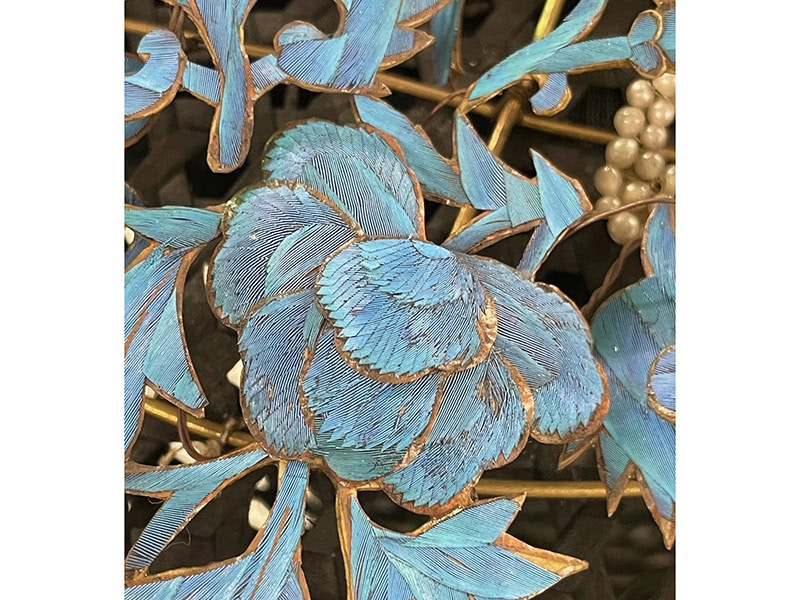
According to Béatrice Quette, curator of the Asian Collections at MAD, the headdress shows many lucky symbols, including bats (biānfú), whose pronunciation is very similar to the word for “heavenly favor” (bianfu); peonies, which represent wealth; begonias, connected to refinement; and lotuses, associated with purity and fertility. This type of headdress was worn only for special occasions by court ladies, but not by an empress, since it does not include the phoenix motif that symbolizes her.
Studying these extraordinary objects, as well as other fascinating pieces from the collections, allowed me to explore new aesthetic possibilities and, by deepening my understanding of the relationship between the body and the feather, both in Asia and in the West, to open the way to new conceptual directions.
For ethical reasons, the research I am currently conducting on hair and head objects that require feathers is carried out exclusively using feathers from farm-raised birds. I also chose to work with recycled vegetable-tanned leather (because producing this type of leather is eco-friendly, and it stays “alive,” which allows it to change shape endlessly and be molded) and guinea fowl wing feathers, whose technical qualities fascinated me. My decision to work only with leather and feathers, without adding any other materials, is meant to directly refer to a bird’s skin. Many legends, especially in Chinese culture, tell stories of humans taking animal skins and wearing them for spiritual reasons, either as trophies or to gain the animal’s special qualities. I found these stories very interesting, especially those about bird skins.
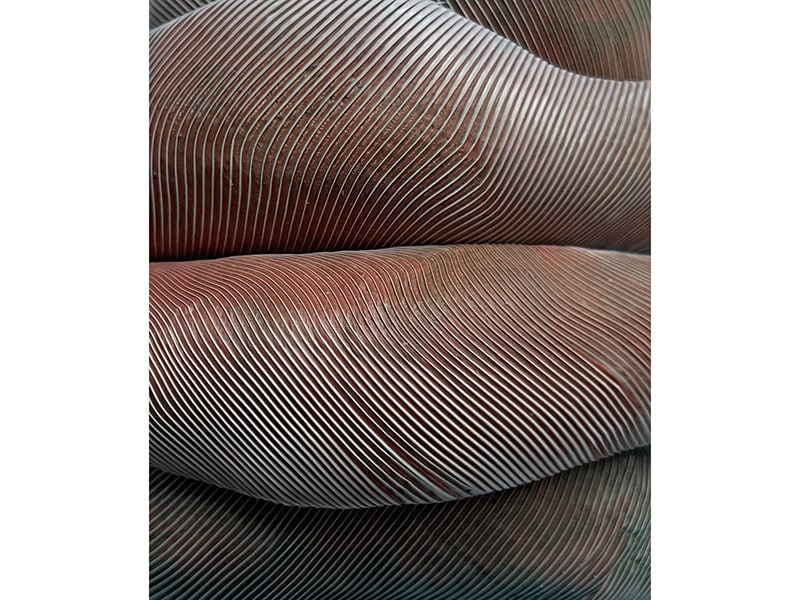
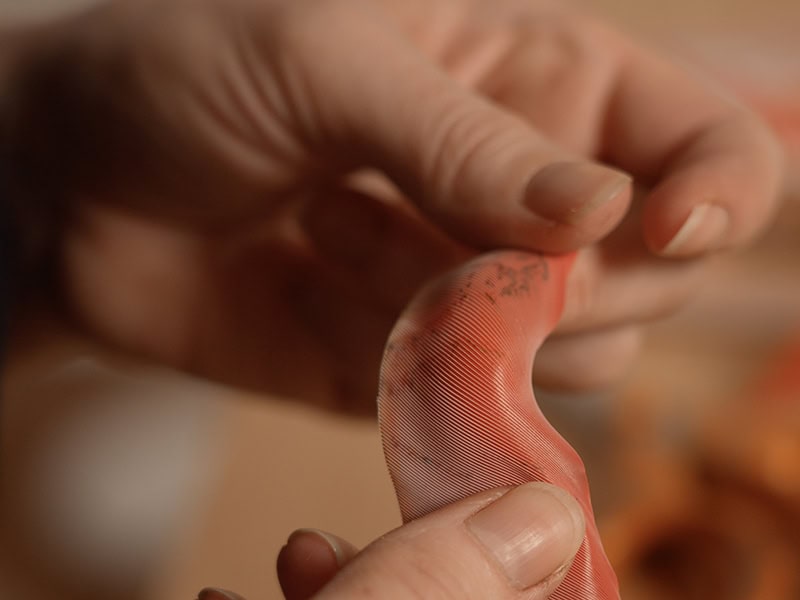
I begin by creating a clay shape, over which I mold the leather and then let it dry. Next, I prepare a mixture of fish glue and hide glue. This mixture is applied to the feathers, which are dyed beforehand. The barbs of the feathers are gently stretched to make the most of the natural elasticity of the flight feathers (wing feathers), allowing them to follow the shape of the leather. I have not yet managed to find the original dian-cui glue recipe, but I am continuing my experiments.
The new works, along with earlier pieces and selected objects from the museum collections, will be presented in a solo exhibition at the Musée des Arts Décoratifs this autumn.
1 Beverley Jackson, Kingfisher Blue: Treasures of an Ancient Chinese Art (Berkeley, CA, Ten Speed Press, 2001).
2 Imogen Clark, “Chinese Hairpins: Rhapsody in Blue,” Rethinking Pitt-Rivers, Pitt Rivers Museum, 2020.
3 Yan Yan, “The Beauty of Hairs in the Qing Court Scroll Picture,” Encyclopedic Knowledge, no. 22 (2018).
4 Yiqian Wu, “A Study of Historical Transformation and Cultural Change in Chinese Dian-Cui Jewellery” (Master of Arts by Research, The University of Sydney, 2020).
5 Alf Hiltebeitel and Barbara Diane Miller, eds., Hair: Its Power and Meaning in Asian Cultures (Albany, NY, State University of New York Press, 1998).
The opinions stated here do not necessarily express those of AJF.
We welcome your comments on our publishing, and we will publish letters that engage with our articles in a thoughtful and polite manner. Please submit letters to the editor electronically; do so here. The page on which we publish Letters to the Editor is here.
© 2026 Art Jewelry Forum. All rights reserved. Content may not be reproduced in whole or in part without permission. For reprint permission, contact info (at) artjewelryforum (dot) org