The Australian editor of Garland magazine poses the question: What does it mean to make jewelry for the “more than human”?
Murray gave this presentation as part of the 2026 “AJF Speaker Series: Jewelry that Makes You Think,” which featured 16 talks over five days. Most of the series took place in the booth AJF shared with Arnoldsche Art Publishers at the trade fair.
Re-wilding Jewellery
The emerging field of land jewellery in Australia
Coledale Necklace
The COVID lockdown was a once-in-a-lifetime opportunity to try out new creative practices. I was particularly struck by a series of interventions by the Australian jeweller Melinda Young. While isolated from others, she walked along her local beach, gathering materials and applying her jewellery sensibility to what she found. The Coledale necklace (2023), for instance, is a large work formed from a series of pale shells collected from that shoreline. Outside of the normal expectations of shop or gallery, hers was a reaffirmation of the primordial act of adornment.
The “more than human”
It prompts the question. There has been much recent interest in practices that engage with what is called the “more-than-human.” While there are practical ways in which humans can help other species flourish, such as ceramic soral, the question of adornment remains problematic. What benefit does nature gain from our attempts to beautify it?
In Young’s case, her work resembles the making of cairns—the stacking of rocks as a signal of your presence to future travellers. It’s a simple rearrangement of elements already at hand in nature. For Young, this is a social signal made in isolation: it becomes a way of sharing an appreciation of landscape with others.
Eventually, when works found their way into the gallery, they featured human-made remnants such as brick and coal. These are eroded by the ocean over decades, becoming smooth to the touch. You can read into them a collaboration between Young and the “more than human”.
On Country
This attempt to work with nature has particular relevance to Australian jewellers of settler origin. As the myths of empire have waned, Australian life has recently been strongly influenced by First Nations culture, especially its deep commitment to “Country”. In Australia, “Country” refers not simply to land, but to a living system of kinship, ancestry and responsibility. This is evident in the work of First Nations jeweller Maree Clark, who revived the kangaroo-tooth necklace made from roadkill. Such practices highlight how adornment can signal relationship and responsibility to place.
Shimenawa
This emerging practice prompts the question: What does it mean to adorn nature? Here, the Japanese tradition of shimenawa is instructive. You may recall the scene in the Studio Ghibli animation My Neighbour Totoro (1988) in which the Kusakabe family bows before a great camphor tree encircled by a sacred rope. The rope necklace marks the tree as spiritually significant and separate from human interests, such as logging. It clearly has no obvious function for the tree itself, unlike interventions such as espalier or topiary. Its function is more negative: it prompts gratitude rather than opportunities.
Land art
This form of adornment is quite distinct from the interventions of land art, most dramatically exemplified by Christo, whose wrapping of landscapes—including Little Bay in Sydney (Wrapped Coast — One Million Square Feet, 1969) —can be read as a grand imposition on nature, an anthropocentric assertion of dominance. By contrast, what we might call “land jewellery,” often practised by women, tends to work with what is already present rather than overpowering it.
Yu-Fang Chi
An extreme and poetic example is Yufang Chi, who, during a residency in Belgium, braided grass in situ as an act of jewellery-making within the landscape itself. As she wrote about the work:
…winding grasses is like the jumping rings of a necklace—one by one, linked as a loop. People walking around the piece made it like a moving jewel.
Expanded jewellery
Yu-Fang’s work resonates with the idea of expanded jewellery explored by Roseanne Bartley, whose Human Necklace (2004) project engaged the circle dance in Barcelona as a living chain of adornment. Here, jewellery expands from object to relation.
Tree Ring
Trees, in particular, have inspired significant works. A seminal example is The Tree Ring (2005) by Marion Hosking, who cast an imprint of a large ash gum in the Gippsland forest and later exhibited the 20-metre-long silver form in a gallery. Unlike the shimenawa, this does not physically reconnect us with the tree, but the fine detail of bark impressed into metal carries a powerful testimony to its presence, bringing the trace of the forest into an urban setting.
Cara Johnson
As yet, the practice of land jewellery has been largely symbolic. There is little sense of a mutual benefit between human and nature in the practice. The recent work of Cara Johnson moves in this direction. Johnson combines her jewellery practice with running a plant nursery in rural Victoria. Johnson frequently employs materials associated with settler control of landscape, particularly plastic tree guards, which she transforms into necklaces. She has reflected on ring-barking as a form of violence, and has created works that act as a negative version of the shimenawa—necklaces that acknowledge damage rather than sanctity.
Remnant
Her public commissions are particularly instructive. The Remnant (2023) commission at Lake Eildon responded to bushland that had been flooded. Johnson wrapped the branch of a drowned tree in rope, which she then cast in iron. After returning the branch to the lake, where it resumes its decay, she planted grassland species around the cast rope form. Johnson returns regularly to monitor the growth and witness the patina. While a symbolic act of homage, Johnson combines this with adornment as regeneration.
Greybox
Greybox (2025) was a local government commission that responded to the trees felled for a train yard expansion. Taking one of these dead trees, she ringed it with 20 grey box saplings grown from local seed. In these works, she honours nature using the very materials provided by the site.
What is the place of “land jewellery” in the broader field?
While this trajectory is particularly relevant to the Australian scene, it also contributes to the broader jewellery field. In the broader context of jewellery practice, it is helpful to recall the spatial framework developed in the AJF publication Contemporary Jewelry in Perspective (2013). This framework traced jewellery’s shifting values across contexts: at the bench, in the gallery, on the plinth, in the magazine; in the drawer as collection; on the body in pleasure; on the street in identity; in the temple as sacred; and, in this case, in the landscape. When jewellery moves into the land, its central concern becomes the cultivation of right relations between humans and nature. Unlike in the other spaces, we ask of this work how it benefits the more-than-human.
Does nature care about adornment?
Here we return to our initial question: Does nature care if we adorn it? Perhaps the question is not whether nature needs our adornment, but what adornment reveals about us. When a rope encircles a tree, when a dead trunk is cast in silver, when seedlings are planted around a felled form, these gestures do not improve nature in any material sense. Instead, they alter our relation to it. To adorn can be to claim, but it can also be to restrain. It can mark something as sacred—not in a mystical sense, but in the simple and radical sense that it is beyond use. Land jewellery, at its most thoughtful, does not beautify the world. It acknowledges it. And in that acknowledgement lies the possibility of a more careful presence.
Postscript
If you would like to explore these stories further, many have been collected with Melinda Young in a Garland feature titled Trellis: The Garden of Stories. The title evokes a structure that supports growth—a framework within which nature can flourish. It is an apt metaphor for land jewellery itself: not an imposition, but a scaffold for a relationship.
References and further reading
Black, C. F. The Land Is the Source of the Law: A Dialogic Encounter with Indigenous Jurisprudence. Routledge, 2010.
Chi, Yu-Fang. “When the Land Becomes a Jewel.” Garland Magazine, n.d. Accessed March 1, 2026. https://garlandmag.com/article/when-the-land-becomes-a-jewel/.
Contemporary Jewelry in Perspective. Edited by Damian Skinner. Lark Crafts, 2013.
Johnson, Cara. “Tracing Trees: Processing Land Clearing through a Jewellery Practice.” Garland Magazine, March 5, 2021. https://garlandmag.com/article/tracing-trees/.
Knowledge House for Craft. “Beyond the Gallery.” Accessed March 1, 2026. https://knowledgehouseforcraft.org/Warp/Talks/Beyond+the+Gallery.
Lippard, Lucy R. The Lure of the Local: Senses of Place in a Multicentered Society. New Press, 1997.
Loop. “Mel Young ✿ Mapping the Tideline.” Garland Magazine, June 1, 2020. https://garlandmag.com/mapping-the-tideline/.
Murray, Kevin. “The Sacred Ring: Craft for the ‘More than Human.’” Garland Magazine, February 20, 2026. https://garlandmag.com/the-sacred-ring/.
Skinner, Damian, and Kevin Murray. A History of Contemporary Jewellery in Australia and New Zealand: Place and Adornment. University of Hawaii Press, 2014.
“Trellis ✿ Jewellery on Land.” Garland Magazine, May 28, 2024. https://garlandmag.com/trellis/.
Questions
● Is this really jewellery, or is it environmental art?
● Does nature need our symbolic gestures?
● Is this different from ritual?
● Why frame Christo as domination? Wasn’t his work celebratory?
● What about consent? Can a tree be adorned ethically?
● Is this specifically Australian, or universal?
● Is this aestheticising environmental loss?
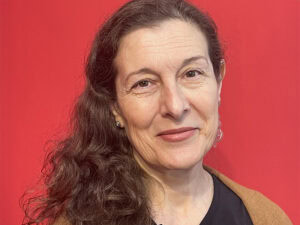
Dr Kevin Murray
Dr Kevin Murray is the editor of Garland Magazine and the co-founder of the Knowledge House for Craft. He has curated many jewellery exhibitions, such as Welcome Signs, Guild Unlimited, Signs of Change and Joyaviva: Live Jewellery across the Pacific and written related publications, including Place and Adornment: A History of Contemporary Jewellery in Australia and New Zealand (with Damian Skinner). In association with Art Jewelry Forum, he set up an ambassador program to reflect the diversity of jewellery voices across the wider world. He lives at the bottom of the world in Melbourne, known again as Narrm, where he is a Senior Industry Fellow at RMIT University School of Art. On the side, he is the coordinating editor of the Encyclopedia of African Crafts. See jewellery-related writing here.
The opinions stated here do not necessarily express those of AJF.
We welcome your comments on our publishing, and we will publish letters that engage with our articles in a thoughtful and polite manner. Please submit letters to the editor electronically; do so here. The page on which we publish Letters to the Editor is here.
© 2026 Art Jewelry Forum. All rights reserved. Content may not be reproduced in whole or in part without permission. For reprint permission, contact info (at) artjewelryforum (dot) org