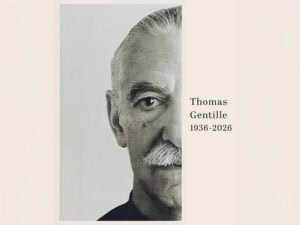
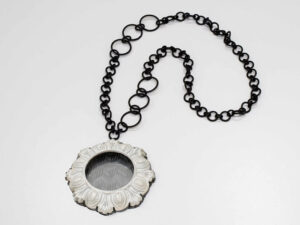
My friendship with Thomas Gentille became the best friendship one can have, long and deep, and I must admit it is somewhat difficult to write a remembrance at this moment, such a short time since his passing.
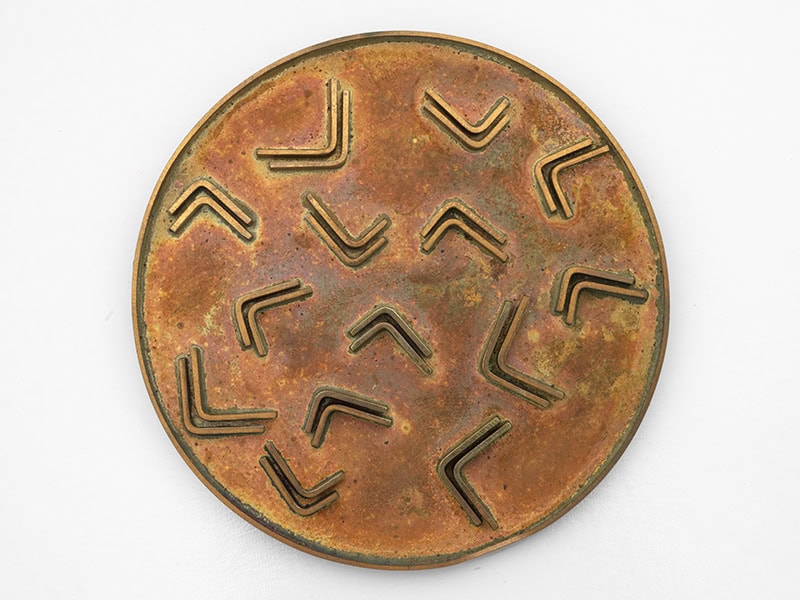
I met Thomas through his presence in a book, Susan Lewin’s One of a Kind: American Art Jewelry Today, over 30 years ago. I met him in person soon after in New York, where he lived in a six-floor walk-up on East 84th Street a few blocks from the Metropolitan Museum.
Thomas dedicated his own book, Color Light Air, to three works of art in the Museum’s collection “in the hope that you will have the privilege to behold them.” It is with a certain chagrin, throughout my many visits to the Met, including with Thomas, that I never sought them out, but I have looked them up online now.
- Georges Braque, The Studio (Vase Before a Window), 1939, oil mixed with sand on canvas, Metropolitan Museum of Art, 1993.400.6
- Marble shell, Greek, ca. 400 BC, Metropolitan Museum of Art, 1995.19
- Terracotta lekythos (Oil flask) ca. 440 B.C., attributed to the Achilles Painter, 1989, 1989.281.72
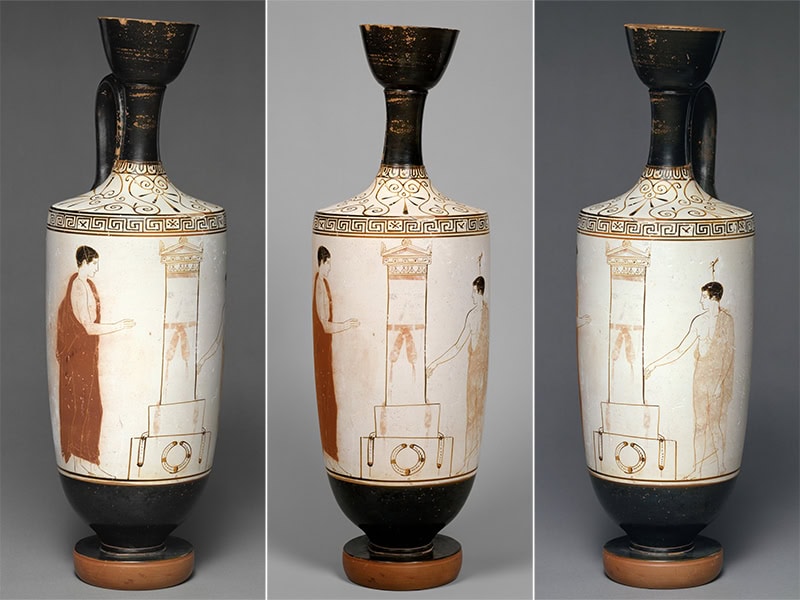
The lekythos couldn’t have been more relevant and moving to discover. Lekythos were oil flasks often made as funerary offerings, which is depicted literally here. There are two male figures, one on the left with the offering, the one on the other side is the man who has died, indicated by the sign of the soul departing at the top of his head. The two figures are line drawings on a white ground. They are not clothed in their linear presence. The robes are painted in over the naked figures. The detail in the monument is delicate but strong at the same time.
Though they might not be the expected acknowledgments, the marble shell and Braque’s painting reveal more obvious connections to Thomas’s work in jewelry, in painting, in life.
In the last months, as Thomas’s illness presented more problems, I visited him several times. Before those visits I asked what I could do to help him. He answered simply, “Call me.”
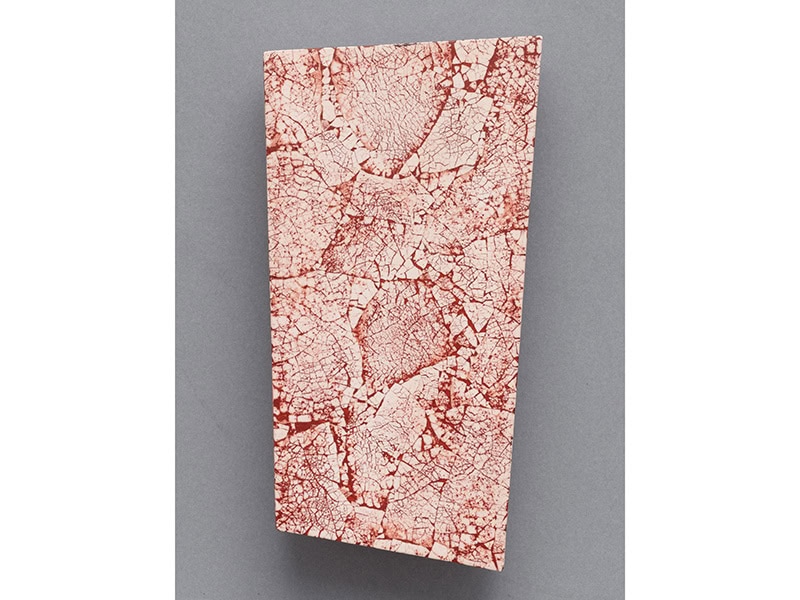
Over 30 years, we spoke quite often. Though we often talked shop, it was not so much about technical problems. Rather it was circling around ideas, discussing the art of others, remembering early aesthetic impacts that might have indicated the direction we would take in our work. I liked talking shop with Thomas. One time a prominent jewelry advocate commented that she couldn’t understand why we were close, since our work was so completely different. There was, however, a kinship.
We certainly didn’t agree on everything, but found argument, in the good sense, a way of learning and perhaps arriving at a conclusion that was the combination of our differences, the third thing in between two sides. In fact, we shared many of the same concerns and ideas. It was the expressions that took different forms. Our disagreements were always productive, even exciting, coming to a conclusion, a third perspective, perhaps including both. And if we remained resolute in our positions, it was always with respect in savoring our differences.
Thomas was succinct in his intentions and in the work itself. The first time my husband, Rod, and I visited Thomas in his apartment, there was still room for us to sit down and a small table surface between us. We saw many pieces that day and exclaimed often about the wonder of it all. If we said something specific, and I suppose in a way to elicit a response, Thomas would simply answer “thank you”—no concurrence, no further details, simply “thank you.”
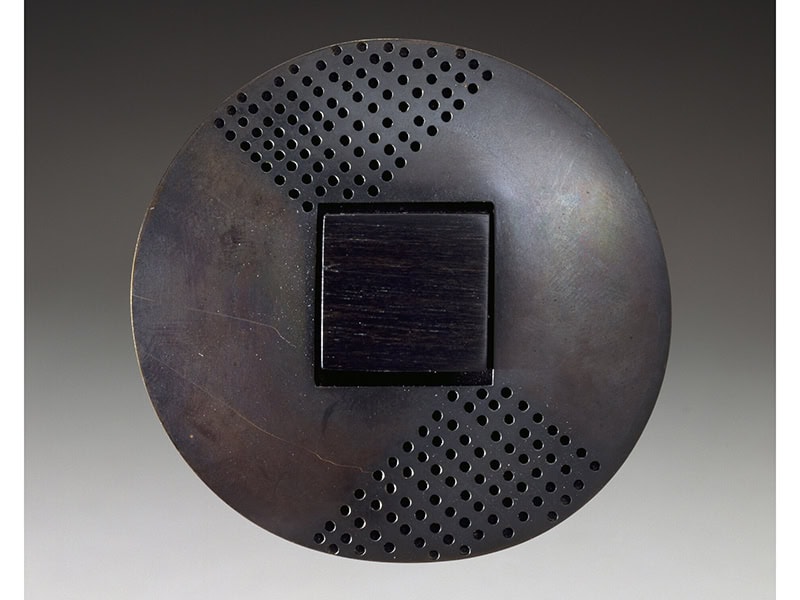
He was unwavering in his response to questions of meaning. The piece of jewelry was complete in its full aesthetic presence—no outside references, none necessary, no context needed. Though there are many discussions of Thomas’s use of material, the formal aesthetics, the technical prowess involved, some others question the lack of context in his work, as though it’s a failing.
In ongoing arguments and discussions, Rod, a curator, teacher, photo historian, and writer, advocated for the necessity of context in viewing, understanding, and attending to art. For the most part I agree with him; ideas past and current, are necessary components in art as well as formal concerns. But we both agree Thomas was one of the exceptions.
Thomas loved to walk the city, his beloved Manhattan, and on one of many little excursions he showed me the moss garden he had secretly been cultivating in Central Park. We visited this spot after I mentioned the moss garden in Japan, how in a way I wanted to make my work as a garden rather than as individual masterpieces.
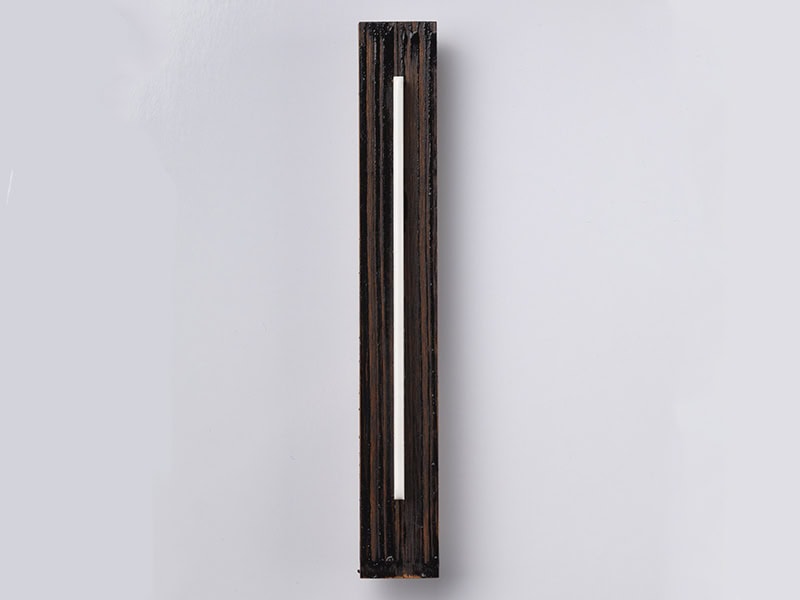
Thomas talked energy, my word was vitality.
His work was contained, ordered, mine was expansive, clarity and vitality through metaphor.
To Thomas precision was both technical and necessary to aesthetic expression—perfection incarnate, in mind and hand. It was in one of these discussions that I learned how my concerns were with the necessity of imperfection as a sign of the hand, endowed with the energy of ideas.
My way of exploring imperfection and repair started with a letter inviting 18 artists whose work I greatly admire to participate by sending me a damaged, incomplete, or inconclusive fragment or piece of theirs that I might complete for an exhibition. I explained my intentions to Thomas and remember remarking that since he aimed for such perfection in his work, he may not connect with what I valued in imperfection.
“Oh, I know just what you are getting at! I’m still trying to make the right mistake.” He then went on to say that for 20 years he never allowed himself to use a compass to draw a circle. He drew circles freehand, trying to make them perfect that way. After 20 years he began using the compass again, since he now understood the circle.
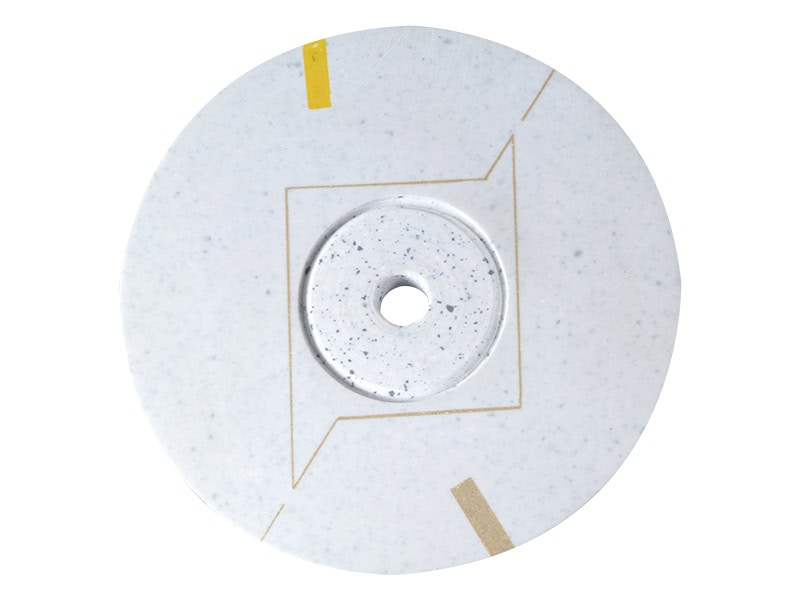
For the project Re:Pair and Imperfection, Thomas sent a circular carved resin piece that had been chipped. My approach to this piece was almost, yes, almost, entirely formal with a bit of metaphor thrown in. Some time after the resin piece another package arrived from Thomas. He had just found the chip from the first piece and thought I might want to use it for repair. However, I liked the little package itself, with his writing, sealed with tape, so I left it unopened. It became a kind of mascot for the whole project, occupying different spots on my table for over a year. When I told him that I would use it as it was, he exclaimed that, had he known, he would have used an archival paper towel. Here, our different concerns for permanence.
In the end I chose to treat the package as a precious relic, housed on the hand in a two-fingered ring, keeping in mind Otto Künzli’s bracelet called Gold Makes Blind concealing a gold orb as though swallowed by the rubber tube.
Tacey Rosolowski wrote about Thomas’s pieces in Re:Pair and Imperfection in the catalog for the exhibition at the Chicago Cultural Center in conjunction with the SNAG conference in 2006.
“Argilos is a particularly vivid illustration. Thomas Gentille contributed a chipped synthetic resin disk carved as a geometrical study of a circle housed in a square. This was the most formal of the fragments, and Slemmons continued to carve in this spirit. She eliminated the chip and most of the carved portions, revealing a Gentillian clarity of line. Then she placed a disk of industrial grade ceramic in the brooch’s center, hence the title—’Argilos’ as derived from ‘argil’ a chalky white potter’s clay. The addition strengthens Gentille’s formal geometry while revealing Slemmons’ admitted ‘latent formalism’—though with a found object characteristic of her own approach. Slemmons also replaced the Formica segments from the chipped edge (cut into triangles). The line where Gentille’s form splinters into a random intersection of planes marks a place where formalism erupts into wabi-sabi. It also stages a dialogue through imperfection: Slemmons literally transforms Gentille’s damage so that self-contained formalism might re-emerge as aesthetic chaos. The movement between the two aesthetics creates a third not fully encompassed by either.”
Because of the now ubiquitous nature of jewelry—as decoration, as protection, as costume—it can be harder and harder to identify what is art. In the ending page of Color Light Air, Thomas quotes Georges Braque: “The only valid thing in art is that which cannot be explained.”
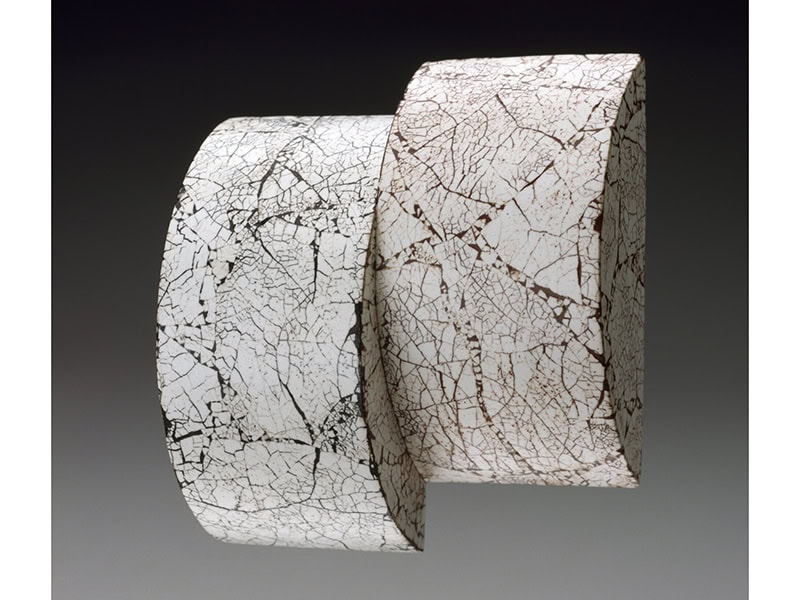
Thomas was a man of few words when asked for the meaning behind his work. He was resolute in the economy of language. Work in the studio meant everything to him. There was little separation between art and life. Even though he was solitary, friends were dear and he always made room for them.
During my last visit in Thomas’s apartment, before he had to leave, we sat in the kitchen. Just inside the door was a chair and a box with a clean surface. I drank in the room. Thomas pointed out the flowers that Bettina had brought him. Nearby was a black frame with an image of the wolf head pendant I had made out of mouse bones for Re:Pair and Imperfection. On the opposite side of the room in the midst of kitchen things and stacks of books, my eyes landed on two rather immense red tomatoes, the biggest I had seen in a long time. The size of saucers. Susan had brought them and they appeared to be completely ripe. Firm but ripe and energetically red. They commanded the room. I thought of the Wallace Stevens poem, “Anecdote of the Jar.”
I placed a jar in Tennessee,
And round it was, upon a hill
It made the slovenly wilderness
Surround that hill.
The wilderness rose up to it,
And sprawled around, no longer wild.
The jar was round upon the ground
And tall and of a port in air.
It took dominion everywhere.
The jar was gray and bare,
It did not give of bird or bush,
Like nothing else in Tennessee.
So it was with those tomatoes.
“Let me make us a salad,” Thomas said.
“Oh, but you don’t need to in this short time we have.” I had been observing how much strength he had lost.
“But I want to celebrate the moment.”
Finally I got it and accepted this generous offer. Thomas narrated the preparation, cutting the slices carefully, drizzling them with olive oil, garnished with capers. The white flat surface of the box next to me was just big enough to accommodate the white plate with the three slices of tomato. Both the tomato and its sumptuous red were nourishing, and such was another visit with Thomas.
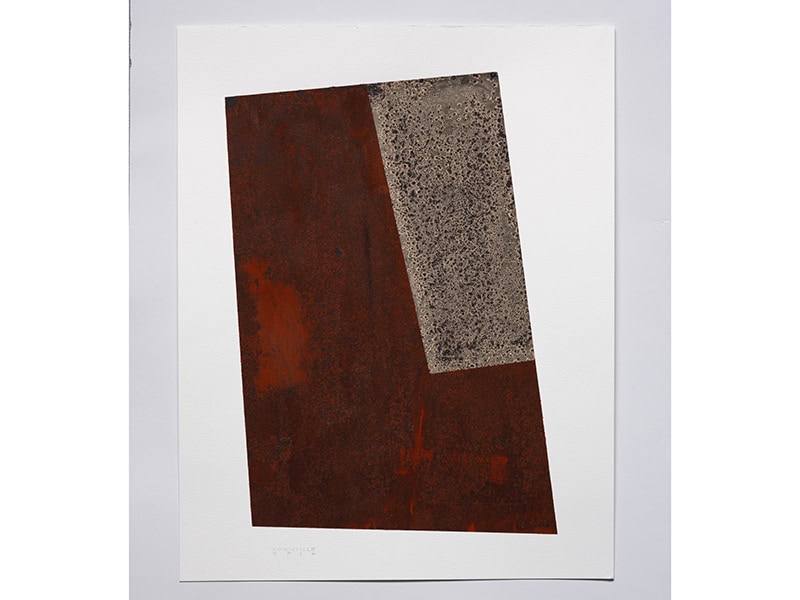
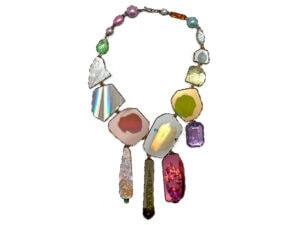
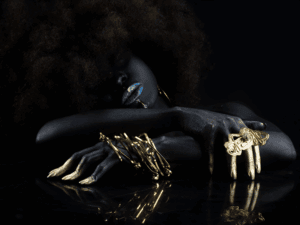
Jewelry, photo: Bruce M. White Photography
The opinions stated here do not necessarily express those of AJF.
We welcome your comments on our publishing, and we will publish letters that engage with our articles in a thoughtful and polite manner. Please submit letters to the editor electronically; do so here. The page on which we publish Letters to the Editor is here.
© 2026 Art Jewelry Forum. All rights reserved. Content may not be reproduced in whole or in part without permission. For reprint permission, contact info (at) artjewelryforum (dot) org