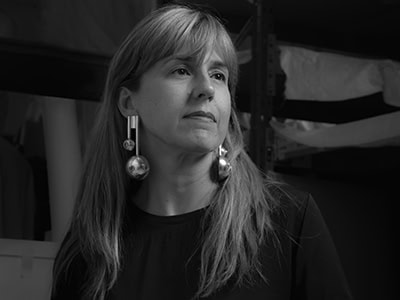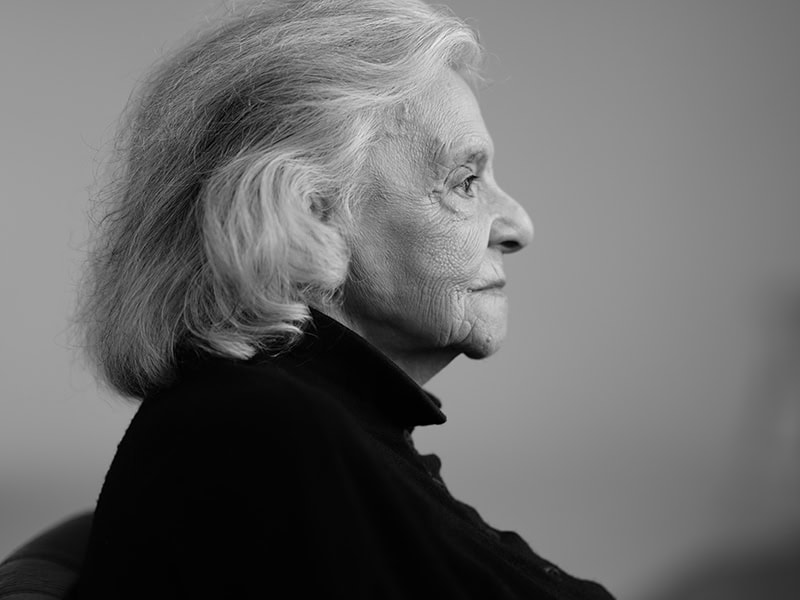
Kukas, as Maria da Conceição de Moura Borges Magalhães was known in the Portuguese world of culture and arts, was born in 1928 in the Beira Baixa region of Portugal. Her trajectory traced one of the most disruptive paths in applied arts in Portugal in the 20th century. She was one of the pioneers of contemporary jewelry in the country, propelling it as a fully fledged artistic expression.
Kukas’s work cannot be grasped by conventional categories. Her work operates a radical transition from jewelry as adornment to jewelry as a fully-fledged artistic discipline. This journey, while flourishing in the realm of portable objects, is fueled by another primordial dream never abandoned: sculpture. Kukas transposed this ambition to the scale of the body, transforming each piece into a profound investigation of matter and space.
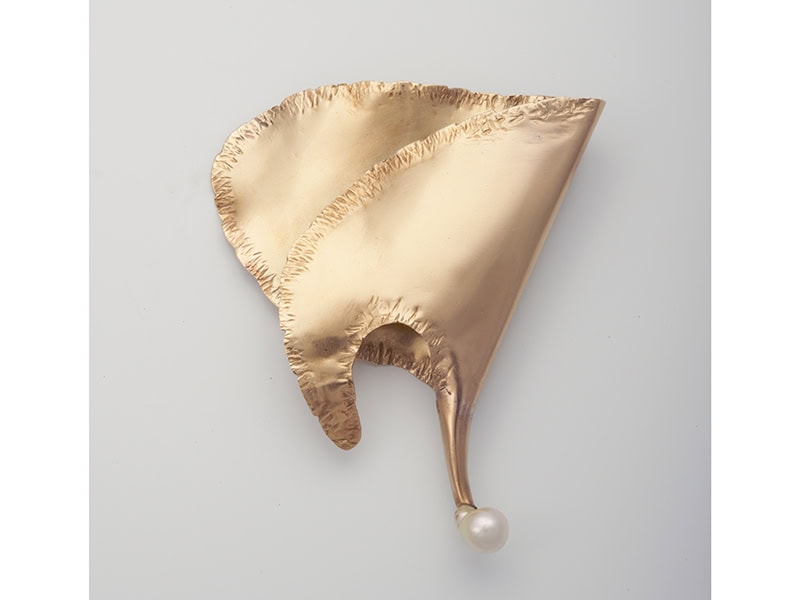
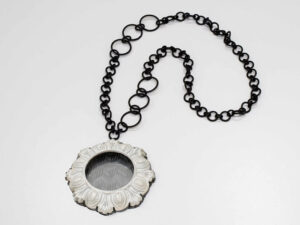
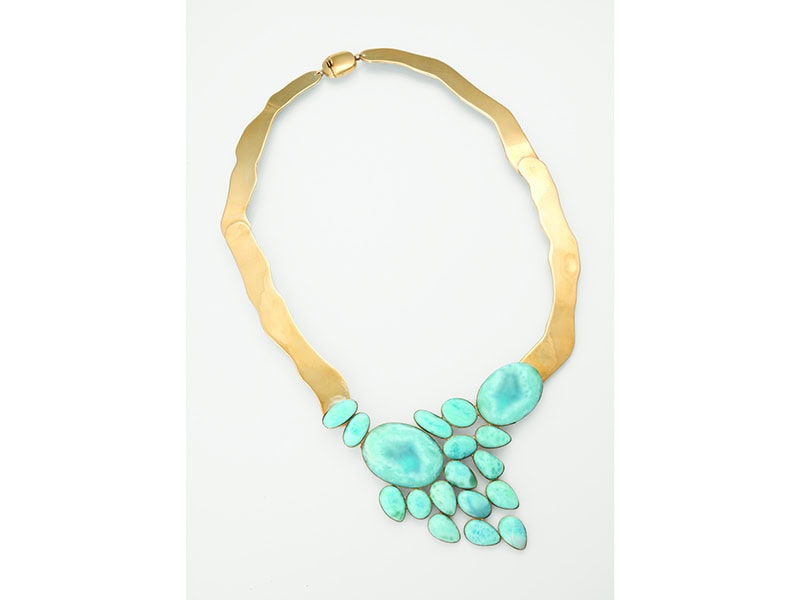
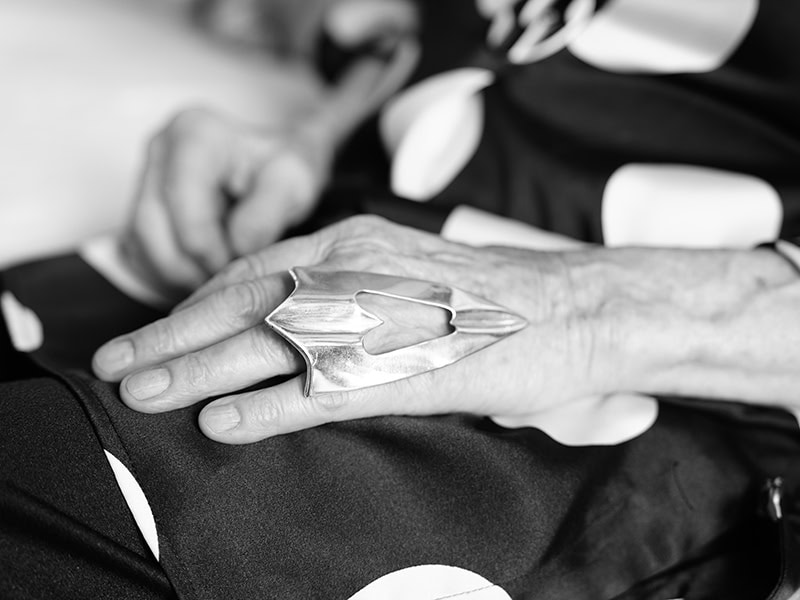
The Kukas brand became synonymous with jewelry—usually in precious metals, integrating stones in a structural and organic way—that, through their materiality, scale, and proportion on the body, asserted themselves as portable sculptures, while her decorative and utilitarian objects always maintained a rigorous geometric matrix.
Kukas’s sensitivity manifested itself, above all, in an almost visceral taste for formal exploration. Her experience with ceramics left indelible marks on how she approached the plasticity of metals. For Kukas, silver and gold are not supports for ostentation, but materials with their own “body,” density, and weight. Her work evidenced a search for formal performativity where gesture, corporeality, and tactility were sovereign. When handling her pieces, one perceives that each surface was designed for touch. The craftsmanship sometimes reveals itself as brutalist and archaeological, and at other times presents itself with a geometric rigor of an industrial flavor.
Originally, in the 1950s, she had cherished the desire to pursue a career in law, motivated by the wish to “do justice to the world,” as she stated. However, after a prolonged illness, she changed course and opted for family education studies. It was there that she had her first contact with art history and ceramics, although clay did not fully fulfill her.
She then decided to attend drawing classes[1] and sculpture classes,[2] in addition to studying at the Engraving Society, in Lisbon. The real turning point came in 1958, when Kukas left for Paris. Originally intending to study art education, she surrendered to the modernity of the French capital, enrolling in interior design at the École Supérieure des Arts Modernes. Between visits to the Galerie du Siècle, where she discovered the simplicity of Scandinavian design, and life drawing classes at the Grande Chaumière, Kukas absorbed the spirit of the times. Her internship at the Louvre Museum, where she met Marc Chagall (1887–1985), and her interaction with the Portuguese artistic diaspora[3] placed her within an international avant-garde context. Her passion for art and architecture, which began to emerge at this time, would continuously mark all her work, with a particular fondness for Fernand Léger (1881–1955), Joan Miró (1893–1983), Frank Gehry (1929–2025), and I.M. Pei (1917–2019), for example.
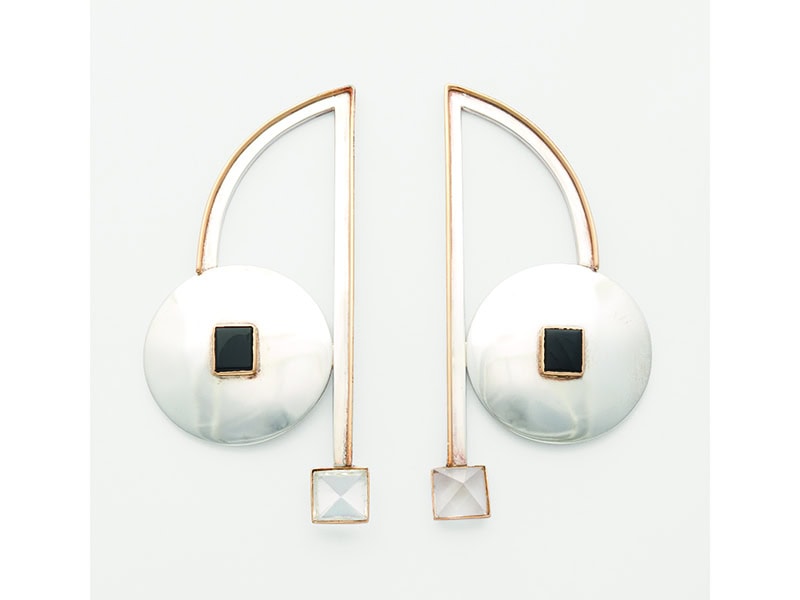
After returning to Portugal, in 1961, Kukas began in interior design, exhibiting her design proposals in the shop of the painter Menez (1926–1995), in Chiado. Her jewelry career took off in 1962, when the innovative nature of her designs led her to take on the execution of the pieces, relying on the technical mentorship of Master Jordão. Her work became the material reflection of her unique vision of art and design as she began to develop a relationship of creative complicity with important designers and artists.[4]
Kukas’s public breakthrough came in 1963, with her first solo exhibition at the Galeria Diário de Notícias, in Lisbon. Shortly after, in 1964, a grant from the Calouste Gulbenkian Foundation took her to New York and on a trip through South America. The experience would consolidate her language and style. Her aesthetic maturity reached its peak in 1968, at an iconic exhibition at Galeria 111, in Lisbon, where she—surprisingly—presented her creations inside transparent acrylic globes.
In addition to the aforementioned presentations at the Diário de Notícias and Galeria 111 galleries, her exhibition career included significant moments at the Galeria Divulgação, in Lisbon (1964); the Galerie La Cloche, in Paris (1968); the Calouste Gulbenkian Foundation (1982); the Ringeling Gallery, in Rotterdam (1986); the Palais des Congrès, in Paris; and the Hotel des Indes, in The Hague (1992).
In 1975, as part of the revolutionary group MRAR – Movement for the Renewal of Religious Art, she conceived a series of modern sacred art objects.
Alongside her artistic production, Kukas fostered a culture of modernity and cosmopolitanism in Lisbon across various commercial spaces. Between 1981 and 1992, she established the first store dedicated to designer jewelry in the city. In 1989, she opened a second space, where, in addition to her own creations, she sold pieces by national and international designers; however, this project ended about a year later. She had a final space on Rua de S. Bento (1998–2003), provided by the Lisbon City Council, which closed after a violent fire.
In recent decades, Kukas’s institutional recognition has been cemented by large-scale exhibitions that have integrated her work into the fields of design and contemporary art. In 2011, Lisbon’s MUDE – Museu do Design (Design Museum) dedicated the anthological exhibition Kukas: Uma nuvem que desaba em chuva (Kukas: A Cloud That Falls into Rain), curated by Cristina Filipe, to her, publishing the accompanying catalog in Portuguese and English. This retrospective allowed the general public to understand how her jewelry, through its concept, scale, and materiality, asserts itself through its sculptural value. More recently, in 2023, MNAC – Museu Nacional de Arte Contemporânea (National Museum of Contemporary Art) hosted the exhibition Kukas: Homenagem à Geometria (Kukas: Homage to Geometry), celebrating architecture and the latent movement of its forms.
In 2018, the launch of the “Kukas by Casa Fortunato” project brought new momentum and dynamism to the brand. Kukas maintained inexhaustible creativity, designing new pieces and developing projects until her death in February 2026, at the age of 97. She had resided for about six decades on Travessa do Conde de Penafiel, near Lisbon’s São Jorge Castle, a house that was the nerve center of her production.
Her legacy is represented in the MUDE Collection by way of jewelry, furniture, and lighting pieces that bear witness to her aesthetic and artistic language, thereby ensuring the continued dissemination of Kukas’s work as a source of inspiration and research.
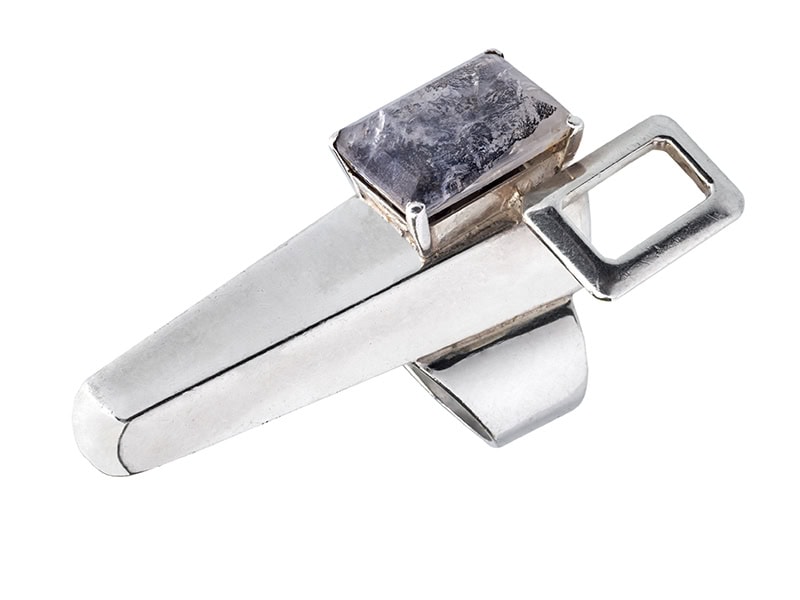
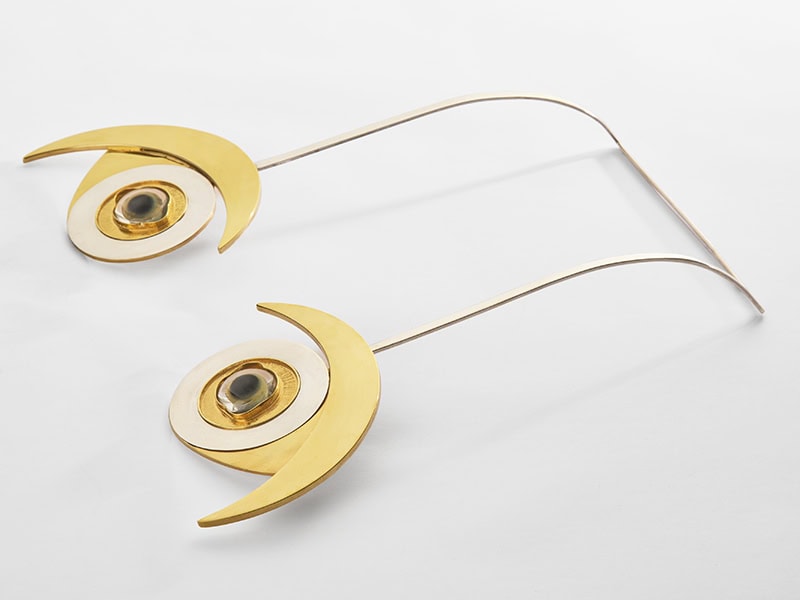
In terms of formal qualities, Kukas’s work asserted itself through the exhaustive exploration of primordial and archaic forms. Her visual lexicon—based on cubes, spheres, spirals, and pyramids—was not a simplification, but a search for the universal essence of form. This rigorous geometry was frequently challenged by an apparent instability, where volumes and masses intersected to generate an intrinsic, almost kinetic movement that came to life in interaction with the body. From a material point of view, her mastery was revealed in the way she extracted a singular expressiveness from each element. The preference for perennial metals such as silver and gold, sometimes in dialogue with chrome, shells, and stones, reflected an aesthetic sense of total inventiveness. Kukas did not submit to the commercial hierarchy of gems. By favoring rock crystals, moonstones, and quartz, the artist transformed jewelry into an optical device that captured reflections and altered spatial perception, blending the solidity of metal with the immateriality of luminosity.
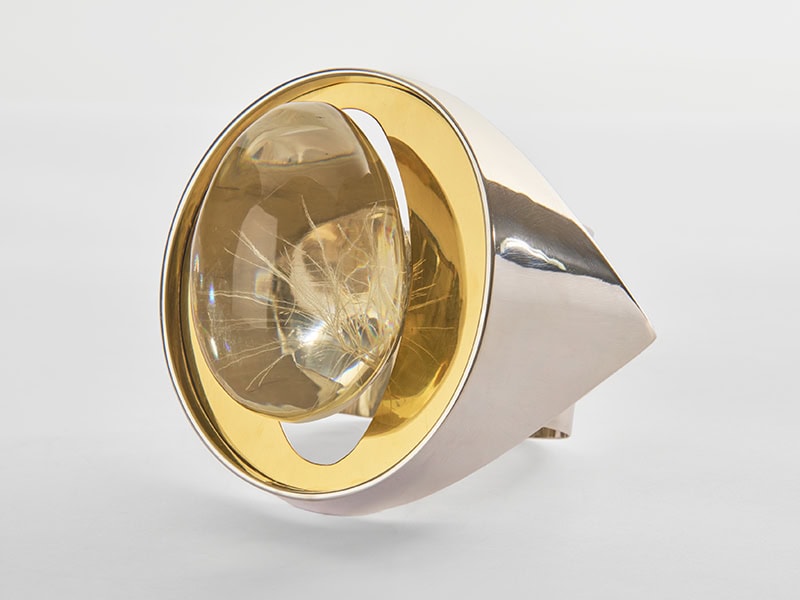
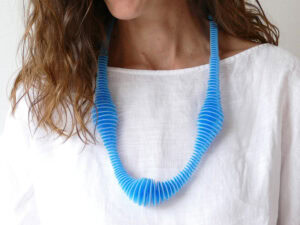
One of her most distinctive signature traits was scale. Kukas rejected the small and the tiny, as well as the traditional categories of feminine and delicate. Earrings, rings, brooches, and necklaces assumed proportions that defied gravity and the very movement of the body that wore them. This preference for a large format was not a mere aesthetic whim, but a necessity to project forms into space, creating portable sculptures. Kukas saw her forms as spatial structures in motion, exploring with constructivist imagination the dichotomies between symmetry and asymmetry, harmony and disharmony. The poetics of her pieces reveal a refined and timeless aesthetic, where the simplicity of form represents the ultimate refinement of the idea.
Equally relevant was the choice of materials, as it reinforced the desire for permanence: silver and gold were chosen for their longevity, as each jewel should be a testament to a time that was intended to be eternal. Unconcerned with the transience and experimentalism of more contemporary materials, Kukas remained faithful to the lineage of precious metals, where the rigor of form found its most enduring echo.
Particularly interesting is that Kukas’s creative process rarely involved two-dimensional drawing. Her methodology was one of observation and direct manipulation. Kukas “saw” with her hands, possessing a rare ability to find beauty in the most banal everyday objects. Her process began with the construction of tactile models, translating the ideas for the artisans. Through gesture and word, she conveyed an idea already fully constructed in her spatial imagination. She hoped, then, that technical skill and an identical capacity for visualization would transform the (virtual) model into a (real and physical) object. Even in commissioned works, where the symbolic value of preexisting pieces might impose limits, Kukas chose to add rather than subtract. She did not disturb the root of the piece; she listened to it, associated new materials to it, and gave it a new life, respecting the past but projecting it into the future.
Kukas’s legacy is, therefore, a lesson in humanism and optimism. Her art reflects a woman with a straightforward gaze and serene determination, driven by vital enthusiasm and an uncommon ability to recognize and create beauty, celebrating in each piece her profound love for nature and the animal world. This wonder at existence, which accompanied her to the end, manifests itself in the humor with which she faced her own finitude. Like someone who rejects the silence of boredom in favor of constant celebration, she left us a motto inscribed on her final resting place: “Here lies, utterly disgruntled, one who was never bored.” It is this continuous fascination with life that shaped her work; a body of work that, by its very essence, will make her presence last, vibrant.
Bibliographical References
Coutinho, Bárbara. “Kukas. Sculpture, Matter and Motion,” in Cristina Filipe, concept and scientific coordination. In Kukas: Uma nuvem que desaba em chuva (Kukas: A Cloud That Breaks into Rain). Lisbon: CML/MUDE — Museu do Design e da Moda, 2012, 9–15.
Filipe, Cristina, Joalharia Contemporânea em Portugal: Das vanguardas de 1960 ao início do século XXI / Contemporary Jewellery in Portugal: From the Avant-Garde of the 1960s to the Early 21st Century. Lisboa: MUDE – Museu do Design e da Moda/Stuttgart: Arnoldsche Art Publishers, 2019.
Kukas by Casa Fortunato. Available at: kukas.pt. Accessed February 22, 2026.
[1] With José Júlio (1925–1963).
[2] With Joaquim Martins Correia (1910–1999).
[3] Namely Lourdes Castro (1930–2022), Rene Bértholo (1935–2005), João Vieira (1934–2009), and José Escada (1934–1980).
[4] Such as Daciano Costa (1930–2005), António Garcia (1925–2015), and Nikias Skapinakis (1931–2020).
The opinions stated here do not necessarily express those of AJF.
We welcome your comments on our publishing, and will publish letters that engage with our articles in a thoughtful and polite manner. Please submit letters to the editor electronically; do so here. The page on which we publish Letters to the Editor is here.
© 2026 Art Jewelry Forum. All rights reserved. Content may not be reproduced in whole or in part without permission. For reprint permission, contact info (at) artjewelryforum (dot) org